Hiển thị các bài đăng có nhãn Animal Man. Hiển thị tất cả bài đăng

Review: Animal Man Vol. 2: Animal Vs. Man trade paperback (DC Comics)

Người đăng: Unknown on Thứ Năm, 14 tháng 3, 2013

Animal Man Vol. 2: Animal Vs. ManThere’s a striking similarity between Jeff Lemire’s Animal Man Vol. 2: Animal Vs. Man and Scott Snyder’s first volume of Swamp Thing, Raise Them Bones. It’s in Animal Vs. Man that Lemire most directly revamps the Animal Man character, revising his origin and making him more specifically Lemire’s; Snyder did the same thing right away in Raise Them Bones, presenting a Swamp Thing significantly different than what had come before. The change, however, is easier to digest in Animal Vs. Man, given that Lemire gave us a volume of “traditional” Animal Man before he began to alter things.

While Animal Man Vol. 1: The Hunt largely introduced Animal Man Buddy Baker’s supporting cast and set up the direction of the series, Animal Vs. Man is much more Buddy’s book — Lemire hones and enhances Animal Man before the “Rotworld” crossover to come.

[Review contains spoilers]

“Let me tell you about the weirdest dream I ever had …” So begins the third chapter of Jeff Lemire’s Animal Vs. Man, the first part of the story “Extinction is Forever.” No slight against the first two chapters (which includes a great bit with Buddy’s daughter Maxine reminiscent of a similar scene in Alan Moore’s Swamp Thing), but “Extinction” is where Animal Man really gets going. That “weird dream,” of course, is one of the best-known moments from Grant Morrison’s seminal run on Animal Man (now coming out in omnibus), in which Buddy actually meets Morrison and Morrison reveals to Buddy that he’s a comic book character. “As strange as that dream was,” Lemire’s Buddy continues, “it was nothing compared to this.”

Lemire throws down an ambitious gauntlet here, to suggest his Animal Man story might be more outrageous than Morrison’s fourth wall-breaking one. And Lemire’s story is not in Morrison’s league, ultimately, but it’s still exceptionally good, as Buddy begins a trek across an increasingly medieval Red, the source-dimension of his powers, seeking new life after Buddy is killed by the marauding Rot.

In this King Arthur/Heart of Darkness mash-up, Lemire sends Buddy on the classic hero’s quest and, as is usually the case, Buddy emerges with a healthy dose of self-actualization. Literally rebuilt from nothing, Buddy becomes a wilder, more horrific Animal Man — now Lemire’s own, and playing to the strengths of artists Travel Foreman and Steve Pugh, among others, as when Buddy sprouts a cheetah’s snout and wings. This is a new Animal Man for a new era, the New 52 Animal Man, and it feels right and natural for Lemire to introduce him at the end of his second year (as opposed to the new Swamp Thing that lead off that character’s series).

Lemire’s changes to Animal Man aren’t just cosmetic, however. Lemire also takes on the Morrison origin, recasting the multiversal yellow aliens who gave Buddy his powers now as the Red’s “tailors,” who both build Buddy a new body and, we see in the Zero Month issue, pretended to be aliens when they first gave him the Red’s powers because alien interference would be “something he can comprehend.”

Far from causing any offense, Lemire’s joint preservation and alteration of the Morrison origin is exactly what writers should do in revamping a character. The simplicity of Lemire’s origin story — Buddy gets his powers and immediately resolves to be a superhero — is no accident and instead echoes the Silver Age aesthetic of Buddy’s original appearances; I also liked that Lemire tied Buddy’s origins to the first appearance of Superman in the New 52 universe, reinforcing the momentousness of that event and how it reverberated throughout this new world.

It bears mentioning that however excellent Lemire’s characterization of Buddy and especially of Buddy’s son Cliff and daughter Maxine are, the new Animal Man series wouldn’t be half what it is without artists Travel Foreman and now Steve Pugh (who drew Animal Man the last time around, too), with Albert Ponticelli. The goat-men and Rot-beasts and half-deformed animals separate this book from the others on the stands around it; story and art come together in the final, nail-biting sequence in which I really wasn’t sure whether Buddy would be able to save his son from the Rot or not.

If there’s a hitch in Animal Vs. Man, it’s that Buddy’s wife Ellen’s growing upset over his superhero life begins to make her a one-note character. I grant that Buddy wasn’t Animal Man when he and Ellen married, and that having undead animals chase your children would be disconcerting, but Animal Man has long been a “family sitcom”-type book (with room for horror, gore, and metaphysics) in which Buddy and Ellen balanced raising kids and superheroics. That Ellen blames Buddy for the craziness in their lives is almost nonsensical — he neither gave himself his powers nor did he cause the Rot to target them. Lemire’s Ellen comes off as overwrought and shrewish; the reader knows Buddy has to go fight the Rot, so Ellen is constantly in the wrong, and this is a poor position for one of the few wives left in the New 52 DC Universe.

But that shouldn’t give anyone pause in picking up Animal Man: Animal Vs. Man, which in total is a great sequel to Animal Man: The Hunt and remains one of the top books of the New 52. Animal Vs. Man also nicely includes a surprisingly long — six pages! — preview of Animal Man Vol. 3: Rotworld: The Red Kingdom, which is a lovely treat — thanks, DC!

[Includes original covers; sketches by Pugh, Ponticelli, and Timothy Green; “Rotworld” preview]

Next week, Catwoman and Batman: City of Owls. Don’t touch that dial!
More about

Review: Animal Man Vol. 1: The Hunt trade paperback (DC Comics)

Người đăng: Unknown on Thứ Hai, 7 tháng 5, 2012

I admit that even though I enjoyed the DC Comics New 52's first collected offering, Justice League: Origin, it was not the kind of "instant classic" comic I was hoping for to launch the New 52. Animal Man: The Hunt is that comic.

Though The Hunt does not really take its impetus from the reborn DC Universe (aside from foreshadowing a crossover with another "Dark" title), it is nonetheless a fantastic take on the Animal Man character by writer Jeff Lemire with artist Travel Foreman, and a great start to DC's new line. Animal Man is witty and frightening, faithful to Grant Morrison's definitive portrayal but a smidge less meta, a little more pop horror. This is what the Vertigo imprint looks like meshed with the DC Universe, and it's just about perfect.

[Contains spoilers]

Jeff Lemire's Animal Man Buddy Baker is a good guy who doesn't quite fit in anywhere, a sense we got of the character in his recent appearances in the weekly 52 series and Countdown to Adventure, too. The initial text interview that Lemire conducts with Buddy (a nod, perhaps, to Grant Morrison's own talks with his character) points out that Buddy can never quite sit still -- stunt man, super-hero, activist, actor -- and yet he's had a stable marriage throughout his modern depiction. What would seem a credit to Buddy, however, is the source of most of the book's tension. Buddy is not an overly successful super-hero, but neither is he entirely present for his family; grasping at both, he succeeds at neither.

Lemire makes this worse in that Buddy learns he's an agent of the cosmic force The Red, meant solely to father and then protect his even-more powerful daughter Maxine. The reader detects a hint of jealousy on Buddy's part, and it's another complexity Lemire adds to the situation -- Buddy isn't who he thought he was nor who he wants to be. The Red wants Buddy to protect his daughter for the benefit of all humanity even if it means sacrificing son Cliff and wife Ellen, something Buddy's not prepared to do (yet).

Buddy therefore exists in this in between space, victim of a good life yet unable to please anyone, including himself. It makes for a fully-rounded character and wonderful reading, because we root for the inherit goodness of Buddy (even his name suggests someone you'd get along with) even as we can see the threads of that good life beginning to come unraveled at the seams.

One way in which Lemire demonstrates that life coming unraveled is in the book's final chapter, which shows in part Buddy's movie about a down-on-his-luck superhero, Tights. The movie finds former Red Thunder Chas Grant divorced, drunk, unable to see his son, and ultimately almost beaten to death when he puts on his costume again. The film is obviously a vision of there but what might otherwise be Buddy himself, being watched surreptitiously by Buddy's often-troubled son Cliff.

The movie underlines all that Buddy stands to lose as he takes his family on the run from the Red's opposite, the Rot. At the same time, mixed media and meta-interpretation has long been a facet of Animal Man series, and I wouldn't be surprised if we found Buddy living out Tights before too long, or if in an Alice in Wonderland twist we found out Buddy's life is the dream and Chas Grant is the dreamer, or the like.

The horror in this book evokes the early days of DC's mature Vertigo imprint and the series that lead up to Vertigo, of which Morrison's Animal Man was one. It is not gross-out horror here, but the fear of something hideous waiting for you when you turn the next page; I was reminded, for instance, of Neil Gaiman's first arc in Sandman: Preludes and Nocturnes. Lemire balances this with a lively amount of humor, both in superhero Animal Man's absurd family drama, the hilarious voice of precocious four-year-old Maxine, and the tropes of a family-horror flick -- Ellen and Cliff run over a Rot monster with the family car, for instance.

All of this is sold handily by artist Travel Foreman. In previews of Animal Man I wasn't sure I'd enjoy this series because Foreman's art is sketchy and distorted, but indeed it's just right for this series. He's got the facial expressions right for the family drama, but also depicts grotesquely distorted monsters -- akin to Doug Mahnke's work, perhaps, except Mahnke zigs toward science-fiction while Foreman zags to the supernatural. On occasion I had trouble telling members of the Red apart, but this is a small matter in the book as a whole.

It's only the beginning of the DC New 52, but I'm already eager for the second round of collections -- Swamp Thing gets name-checked quite a bit in Animal Man: The Hunt, and it ought be in the second collection that we see these two series come together. Lemire has already departed the other DC New 52 series that he started, Frankenstein, Agent of SHADE -- a shame but one I can't feel so worked up about, just as long as he'll be sticking around on Animal Man for a while.

I said Justice League was an accessible book? Animal Man is even more so. Don't let this one pass you by.

[Includes full covers, Travel Foreman sketchbook section]

We're going to dive back into the "old" DC Universe coming up, but I don't think you'll mind -- next is the Collected Editions review of Batman, Incorporated! See you then.
More about

Ten Great Comic Books! Being Generally Positive As A Balance (Part 1 of 3)

Người đăng: Unknown on Thứ Sáu, 10 tháng 12, 2010


Jennifer left a comment. She wrote "I hope you'll do a series on another work that you find generally positive soon as a balance, you know? For your own mental health". I thought it was a kind and generous thing to say, and read onwards.

And then, a few days later, after wrapping up the pieces on "Kingdom Come", I remembered, for no apparent reason at all, Jennifer's comment. Now, my mental health is fine, as far as I can tell. (The Splendid Wife tells me that I'm no worse than normal, which is something at least.) But Jennifer wasn't thinking, I'm sure, of the psychological extremes so much as the everyday business of being happy. And I realised that I did indeed want to be "generally positive". I've had so much fun and I've learned so much - not least from the comments folks have left - from writing about "Superman: Earth One" and "Kingdom Come", but it has become obvious that Jennifer had a point. There is indeed a "balance" that needs to be re-established. I find myself wanting to say good things for awhile!


Now, I'm not the world's best at sitting down and writing purely positive pieces. I think it's my Scots working class background. Happiness is an indulgence, while critical analysis is all part and parcel of avoiding Godless complacencies.

But while I may be a dour old fundamentalist by inclination, I'm a cheerful pragmatist by training, and there are slight and idle temptations which can always assist me in short-circuiting my gloomily well-intentioned self-control. One of them is chocolate, which unfortunately helps little here. Another is a less-enticing and even less-substantial compulsion, a shamefully egotistical compulsion, for I find it hard to resist imagining what my own answers would be to any list of questions I chance upon. At times this leaves me struggling to respond with single word answers to queries posed to horticulturalists in the Splendid Wife's gardening magazines, but the effort apparently has to be made. And if there ever was a way to outsmart my own dour self where the matter of writing cheerful pieces is concerned, it would be for me to pose a simple supposedly character-revealing question or two that demands, demands, to be answered.

Such as, for example; "Name ten superhero comic books that you feel extremely positive about, and give a single reason why you feel that way about each example."


Oh. Well, I can do that. It's not exactly a celebrity questionnaire, but you just try to stop me, me.

Now should you at any point want to try this imaginary exercise at home, here's the imaginary procedure to go with the imaginary questions;
  • You have 6o seconds to write a list of 10 excellent superhero stories.
  • They must be stories that you think positively of, but they can be about serious and unhappy matters.
  • You're not to add or subtract a choice from your list after the 60 seconds is up.
  • You're not allowed to leave a story out from your list because you believe anyone else might snigger or roll their eyes if they saw what you'd written.
  • You mustn't add a story because you feel you ought to. This is your list, not a nomination for a superhero story hall of fame.
  • You must have at least one good reason for each choice, and it has to be more substantial one than "I think it's great because it's great".
  • You don't need to explain anything about the comic except the point you're making, otherwise you'll be there forever!
  • Your mood must be celebratory!
How could I resist that then?


1. The Golden Age, book 3; "We Had Prosperity", writer, James Robinson, artist, Paul Smith

"The Golden Age" is a tense book. Re-reading it again, it's astonishing how long it takes before the reader is told exactly what it is that's threatening the post-war America depicted in its pages. The skillfully managed drip-feed of enigmas and partial reveals creates a constantly intensifying sense of anxiety and menace. By the end of book three, many readers are surely bending back page-corners with apprehension. That this doesn't undercut anticipation with frustration is a reflection of how very cleverly the book is structured. Every threatening and darkening twist in the plot brings with it the compensation of seeing another few superheroes gather closer together into what is in effect an uncomprehending but valiant resistance. This provides an emotional sense that something heartwarmingly important is being achieved even as the story itself points the reader in a far less optimistic direction.

And then things keep getting worse.

"The Golden Age" is a tense book.


2. "Dr Strange: The Hunter & The Hunted" (Strange Tales # 131) writer, Stan Lee, artist, Steve Ditko

In "The Hunter & The Hunted", a disguised and clearly anxious Dr Strange is pursued through Hong Kong by both the human and inhuman servants of Baron Mordo. The typical folk of the island are shown to be utterly unaware of the desperate events occurring in their midst, a fact that's the source of much of the tale's fiercely claustrophobic power. What Mr Lee and Mr Ditko depict here is an everyday world that co-exists unknowingly with a fearsomely threatening magical realm. In doing so, they provide us with the fascinating proposition that Stephen Strange's responsibility isn't to keep mystical powers from invading our world so much as to make sure that the likes of you and I never have to notice that they're here already.


The scene in which Strange's astral form rises from his body during a plane flight to fight one of Mordo's spirits above the heads of his oblivious fellow passengers is the most remarkable sequence in a remarkable tale. This Dr Strange has all of the sense of purpose which later incarnations of the character have so often lacked. And as the reader watches the typical women and men of Ditko's Hong Kong walk through intangible furies and magical bolts without so much as a single hair being disturbed, an unsettling question is constantly being prompted; what's going on around us here in our "real-world" that we can't see, and who's fighting for us there, unnoticed and unthanked?

I'm never so convinced that Dr Strange possesses a clearly defined role and an admirable heroic responsibility as I am when I'm re-reading "The Hunter & The Hunted".


3. "Animal Man # 26: "Deus Ex Machina", writer, Grant Morrison, artist Charles Truog

The oddest thing about "Deus Ex Machina" is that it's not about Animal Man at all, despite it being the final and concluding chapter of a very long run on the character by Mr Morrison and Mr Truog. Instead, of course, it's a story concerned with the gods of Animal Man's universe, the writers of superhero comics. In that, it's a still all-too rare example of the superhero comic as an example of the literature of ideas. Why, Morrison asks, do writers who live in an undeniably cruel world so often create brutal and meaningless lives for the characters they're responsible for? Strip away the charm and eccentricities of characters such as Animal Man in the name of realism and maturity, Morrison is arguing, and all you're left with are flat, bleak and purposeless plot-devices fit only to express violence and despair. "Maybe for once we should try being kind." suggests the comic-book version of Morrison in the tale, before he restores Buddy Baker's family and home to their previous mundane glories, suggesting that even the script-writing gods can choose to learn from their mistakes and serve the imaginary communities that rely upon them, even as a superhero might.


That the fictional "Grant Morrison" misses much of the point of his own tale is the closing irony which leaves the story feeling far less smug and self-glorifying than it might otherwise have seemed. Despite the fact that "Deus Ex Machina" is something of a plea for creators to look beyond their prejudices in order to discover the lost virtues of the characters they write, "Grant Morrison" abandons his search for an imaginary childhood companion before "Foxy" can signal that he still exists. There may be some small signs of kindness in the genre, the story suggests, but there's a lot more staring out into the darkness to be done before all the wondrous potential of the superhero can be rediscovered.


Coming soon; numbers 4 to 7, and the review of USM volume II, number II as promised. I'm as always grateful for your visiting, and I wish you a splendid day and a most productive sticking together!

nb: those who enjoy reading such lists, and I do, might care to know that the estimable Brigonos has begun his own list of 10. Until he did, I didn't even KNOW Grant Morrison had written the Zoids. A link to Mr B's blog "Take Comfort In Silence" can be found in the Comic Book Role Of Honour: UK box to the right of this page.

.
More about

Some Thoughts On "The Last Days Of Animal Man", by Gerry Conway & Chris Batista

Người đăng: Unknown on Thứ Ba, 4 tháng 5, 2010


1. A Brief Warning

Spoilers! Spoilers!

2. Angst Is Not An Inevitable & Lasting Byproduct Of Conflict

It's really not difficult to spot who's supposed to be the hero in your everyday cape'n'booties comic book. They're the ones with;
  • the attention-seeking, merchandising-friendly costume
  • the super-powers which turn the fight against whatever evil has dropped in this month
  • the greatest measure of angst
Stan Lee's decision to give every one of his superheroes a hang-up of some kind, from a dodgy heart to a dead sidekick, has over the years undergone conceptual inflation until a hero isn't a hero unless they're permanently, cosmically miserable. If I shut my eyes, I can easily picture some great metropolitan skyline where each towering building has a superhero perched on top of it straining to howl "Woe, woe, woe is me!!" louder than the bellowing choir of bemuscled miseries around them. And this choir of broken, self-contradictory and permanently emotionally crippled "super-heroic" characters tell us nothing about despair, or depression, or the even darker spectrum of misery which lurks out there for any of us to endure. Nope, these epic indulgences of self-pity and story-telling short-cutting are just there to increase the supposedly tension-breaking moment when the Thing hits Dr Doom really hard and the misery can stop until the next panel.

What does mental health treatment constitute for the super-powered hordes of the cape'n'booties Universes? It strikes me that it can't be anything other than an hour or two on a Japanese Whack-A-Mole arcade game, because that seems to be the only way any superhero ever experiences a significant measure of validation or closure: by hitting something.


So "huzzah!" for Gerry Conway, who's written 132 pages where the only angst on show is a logical byproduct of everyday human existence, Even more heretically, that angst can be recognised, reflected upon and resolved. Does Buddy Baker come to terms with the fact that he can't be Animal Man anymore? He does. Do his children Maxine and Cliff overcome the fact that Buddy was often absent slugging bad folks when they were growing up? They do. (Their lives may not be perfect, and their pasts certainly weren't, but they've made their own sense of their experiences and they're taking responsibility for their own decisions now. The lack of self-pity on their part is so untypical that it's quite revolutionary.) Did Ellen build a new career and do her best to support Buddy while he was lost in his Aplha-Male denial? She did.

For there isn't a single panel of this comic book which isn't solely focused on the necessity for the individual to learn to take responsibility for both their own life and for the welfare of their own community. The narrative of "TLDOAM" doesn't digress and it never dithers: it's all concerned with being "true" to your own "bliss" - horrible phrase, I readily accept - while contributing to that of others. And here the "heroes", if we can even call them that, are ordinary people, those strange and typically uninteresting characters who usually hang around waiting for walls to fall on them or for tidal waves to sweep them away, or, at the very least, to complicate our heroes' lives by increasing the level of angst-osity they're subject to.

But what we find here, well; it's such a relief. Nobody is "special" in "TLDOAM"; there's just human beings working for a good cause, or human beings trying to work for a good cause, and two self-obsessed super-villains whose actions are so contrary to the theme of the tale that we just know they're going to get theirs. (And a fine Black -Plaguey sort of getting-theirs it is too.) But, refreshingly, simply wearing a costume and flying through the air on its' own doesn't complete the job-description of "human being", let alone that of "superhero". Huzzah!


3. The Big Whale GL Whose Story Isn't This Story

I. It's one thing to have the idea of a really big whale wheeling across the page dressed as a Green Lantern. It's another thing to actually draw that very big flying whale. And though there's not currently a great deal of competition in this field, I wouldn't want to be the next artist after Chris Batista stepping into the flying superhero Whale business. And that's because there's some very specific storytelling problems associated with having two quite different scales of focus in a single comic-book panel. Imagine getting the script for the panel above. Mr Batista has to show two very different events in the same panel. Firstly, he has to show the Whale GL rescue Animal Man, and he has to do it without diminishing the grandeur of the Green Lantern or compressing to an unrecognisable degree Buddy Baker and his situation. Then, far below, the script demands that we clearly perceive the conscienceless Bloodrush engaging a gaggle of prison guards. And there's no way to cheat on the flying whale front, because (1) that's the money shot here, and (2) just showing a piece of the whale isn't even likely to tell us it's a whale, let alone make us laugh with the sheer rush of the bravado story-telling riffing off the amusing concept. It really is all or nothing. I can't imagine that anybody won't recognise what a fine job Mr Batista has done in the above panel, or, indeed, through this book.

II. And thankfully, in story-terms, the Green Lantern flying whale is allowed to remain what it is; a fantastic idea whose main purpose, beyond the golly-gee-wowisms, is to provide the audience with a sense that this is a world where time has past. The four human Green Lanterns of 2010's Earth are gone and there's a whale doing their job: story plot-point cleverly dumped. We get that it's the future, and yet what a sheer relief it is that the story isn't pulled away from it's theme and its narrative just to fill in the fanboy details. We don't need to know how the whale came to be a big flying whale, and so we aren't told. And this untypical restraint allows, for example, the "League Of Titans" to appear without us having to be told, in continuity-deep and continuity-ignorable depth, why Batman isn't in the League and Nightwing is, or why that new Flash is black and blunt rather than white and bumptious, or white and revered. Because it doesn't matter. The story matters. These are the background characters, they're facilitators for the main event, and we don't need to know. Huzzah!


Somebody else can create a "mythos" for our intergalactic whale. And they can come up with his long-lost one-finned and beautiful mate, his crippling inability to sing underwater and all the angst he'll need to really fail to engage an audience on that fundamental level where a big whiner registers spectacularly highly on the "I'm not enjoying this at all" scale.

4. The One In The Gym Where We Discover Who's The Grown-Up

My favorite page of comic book story-telling in a very long time appears in the third chapter of "TLDOAM. (It's the next scan you'll come across as you scroll down this blog.) It's a brilliant fusion of script and art and I'd love to know how much of this was Mr Conway and how much Mr Batista, though in truth, it doesn't matter a jot; "just" pulling off the excellence of the execution of this page would be a feather in Mr Batista's cap even if the composition had been outlined in detail and laid out in a storyboard by Mr Conway beforehand. And it's the mass of detail and how elegantly it's delivered through the fusion of words and pictures which delights so. Consider, if you would;
  • the elegance of the rarely-used eight panel page, which allows the awkwardness of Buddy's meeting with Maxine to be accentuated, which slows down time and also permits the space for some considerable measure of dialogue to be presented there.
  • how the young woman sitting on the stands watching the game in panel one, who seems incidental to the drama of the page, is revealed on a second reading to be intimately connected with what's going on, and how all of that is conveyed without words until she takes a protective and supportive position next to Maxine.
  • the beautifully-telling body language of the discussion, how Maxine is calm and deliberate and Buddy defensive and awkward. (Maxine of course has come to terms with Buddy's lack of parenting skills, even if that coming to terms hasn't left her as the young woman Buddy thinks he wishes she could be. This is a comic book about being a grown-up, after all, and Maxine is as much her own creation, if not considerably more, than she is Buddy's.)
  • how the angle of view in panel 7 quickly shifts, as we are taken behind Buddy's shoulder to grasp how he feels as his daughter walks away with her partner, and then the marvellous subtlety of Mr Batista's rendition of Maxine's almost-pitying expression as she delivers in panel 8 what would have otherwise been an even more shattering final note to the conversation. Maxine's strength and common-sense adjustment to less than perfect circumstances would've been swallowed up in anger and angst in the hands of a less-careful artist, but here her words seem less bitter and cruel and more wistful and yet matter-of-fact.
It really is lovely work, and should have been far more highly praised and granted a far higher profile. It may be that the decision to deliberately front-load each chapter - except for the first - with fan-catching comic book scenarios, and to end each chapter with, again, fanboy-audience cliffhangers worked against the recognition of the book for what it is. Because there's a sense that much of the more-traditional superhero fare has been placed where it'll grab casual readers, and that the story-pages between the two money-shot sections of each issue is therefore quieter, less dramatic, and almost belongs to a different comic entirely. And though, for example, Mr Batista draws a splendidly forceful first page of chapter 6, where Buddy's face is being hit by a very large drawing of Bloodrush's right fist, and though the full page conclusion of chapter 2 with the League Of Titans is a well-executed superhero group shot, it's actually the less-intense scenes, and the more quiet and personal shots, that Mr Batista excels the most in. An artist on a superhero book who can't draw 7 superheroes presenting themselves to the reader in an entertaining fashion isn't fit for minimum purpose, but an able artist such as Mr Batista who can take a relatively small panel and make something thrilling out of a throwaway shot of three costumes racing to the rescue, as shown below, is a more precious talent.


(There is a problem with that structural choice to so front-and-back load the comic book. It leaves the middle pages often feeling slow by comparison, and I kept thinking of a sandwich where a slice of bread has been coated on each side by some very tasty ingredients. It would almost be an sandwich, and it would all be, I'm sure, very edible and tasty, but the composition wouldn't be, shall we say, quite right.)


5. An End To The Valhalla Syndrome?

With a few notable exceptions, superhero deaths have always been terribly melodramatic and often strangely futile. There's something so saturated with hyper-angst about the character who insists on going down with their boots on and their wrist-projectors pumping out energy-blasts, especially if it's the hundredth cape this year to be popping off to the other side for a temporary stay. For every Captain Marvel, dying in bed from cancer surrounded by the alien allies who have become his family, there are a host of last-ditch, hold 'em off at the pass impossible stands which have often felt very wrong to me. So, whereas the Executioner atoning for his sins by holding off Hela's army of the dead in Water Simonson's "Thor" felt appropriate, because it grew out of the narrative and naturally closed a character's journey, so many superhero deaths feel indulgent, manipulative, thrown in to add gratuitous levels of jeopardy to unremarkable stories which otherwise wouldn't synthetically carry enough weight to earn a second reading. So, it's often as if this character and that character have to die because the writers have decided that a bit'o'death will work like the final drum roll just before the closing chorus, ratcheting up the momentum before the grand finale, and not because there was no other future for the hero at all.

But the "death" of Animal Man is a challenge to all of these exploitative narratives, and that's all the more welcome because there don't seem to be many other Big Two superhero books which are taking on the shallow-effect climaxes of dying universes and self-sacrificing "heroes". Because although Buddy could've gone down in one last punch-up, that has all been done. We've seen it happen, and we also know it doesn't last. The Flash will return from the Anti-Monitor's beams, the Batman will survive Superman's battering and lead the revolution. And where cheap effect is futile and counter-productive and yet constantly put to use, it needs to be deconstructed and undermined, and, obviously, that's what's happening here. It's thoroughly enjoyable to watch how Mr Conway plays with his readers, allowing the possibility of Animal Man's death to stay in the options for narrative closure, while the themes of the story declare with absolute authority that Buddy isn't going to die here. He's going to have to be far more brave than that.

6. That Bloody Heroes Journey, That Damn Kubler-Ross Model


If there's two models of story-telling that I had no interest in ever catching sight of again, they would be the Heroes Journey, and all its' bastard Vogler-esque children, and the Kubler-Ross model of the progression of grief. So full marks and a throwing of hats in the air to note that Mr Conway has applied both with such considerable control that it would take a curmudgeon to object to their use, particularly when they've been used as a structure to nail the theme that the real challenge of life is how to live it well rather than how to "nobly" throw it away. And this is, no matter how obvious and commonplace, a necessary corrective to a medium which in its' obsessively adolescent-worldview celebrates physical potency and denigrates anything to do with its' decline. (Heroes are young, villains are old. Heroes are hirsute, villains are bald. Heroes are either young and wise or quickly learn wisdom while young, the old, such as the Guardians of the Universe, are scared and forgetful.) In a medium where Reed Richards marks the onset of old age, and where even the old superheroes in "Watchmen" were only there to be riven with regret and murdered by criminals or their old teammates, Mr Conway is radical in suggesting that life may not only extend beyond the menopause and the end of naturally-occurring hour-long hard-ons, but that it may even be more productive and more satisfying than before.

A middle-aged person who's lost their powers and who isn't immediately senile, lost to an ill-defined and meaningless suburban domestic stupor, or a victim of disease or crime? Oh, please. Men and women can fly and that's easy to swallow, but growing old and death are pretty much the same horrible thing, aren't they? Better to get ripped apart limb-from-limb by Superboy-Prime in a fight in which you have no chance of winning and no business engaging in than getting old.

Well, "Huzzah" to Mr Conway for having nothing to do with that rubbish.


7. The Relentless Application Of Theme And Structure

There is something about the relentless application of theme and structure to "TLDOAM" that left me smiling even as I knew that there were elements of the story I didn't enjoy. For example, there was a sense of ill-disguised inevitably about the stories' progression and conclusion, though that was cleverly subverted in part in chapters 5 and 6 by the shifting of scenes of time and place during Buddy's last confrontation, where we're introduced to Buddy's final weapon of choice and then to his survival before we're told how he saved the day and himself too. There was also a sense in which Maxine and Cliff and their relationship with Buddy were unresolved, because we went straight from seeing how their lives had been affected by his decisions, and their sense of those decisions, to seeing them function as an Animal Man cheering section. Bloodrush was, I know, a deliberately Image-like stereotypical villain, chosen perhaps to appeal to the modern audience while acting out the theme of necessary responsibility, but he was too close to the unremarkably familiar for my taste. I also worry about Ellen's role in the tale, where she does come off as more of a facilitator for Buddy's development than a woman in her own right. And the lack of representations of people of colour and non-majority culture ethnicity disappointed me too: the future of 2020 seemed awfully middle-class and white and clean, though it's heartening to note that at least Mr Conway and Mr Batista think we might make it through another ten years with our laundry facilties intact.

So I don't want you to mistake what I'm saying for unqualified praise.

And yet, all those qualifications didn't matter in the end. The structure of the story was so taut, the absence of unrelated and irrelevant digressions so noticeable, the emotional and intellectual power of the moral so decent and pleasing, that whatever quibbles I had dissolved into a great big toothy smile. This is a story which has a directed momentum and logic all of it's own. If the reader is expecting a typical superhero story, then I could imagine a sense of frustration and disappointment and then even more frustration emerging, because it's as much an anti-superhero narrative as it is a genuingly traditional tale, which it is too. But I don't mind being manipulated by such a control of craft into finding myself - almost against my will - smiling. That's what storytelling is. A great big lie that can completely subvert and defeat conscious objections. And whatever my objections, by the time Buddy is clear through the fire and clocking on in his new job, I was smiling.

It's an ultimately feel-good comic about how to ultimately feel good.


8. Saying Goodbye To Our Man Buddy

I. There was a great deal more from Mr Conway and Mr Batista that I could've plastered up here to be admired. I had every intention of discussing the chilling scene of what happened when Prismatik encountered her lost father in a "mirror" dimension, for example, and Brian Bolland's typically peerless covers. But then I had the little sense to recall that these pieces aren't supposed to replace the reading of the text, of course, but to encourage it. And the truth is, that anything else I added would only act to underline the points I've made above, which is that this is a book worth tracking down and indulging yourself in. It may be that it's another piece of evidence that the superhero comic-book marketplace can't accommodate narratives that reflect a world view of anybody older than about 14, but I'd rather see it as another subtly inspiring blow against the Empire. If enough of these quietly conventional-and-yet-unconventional superhero books can slip out into the marketplace, there's perhaps a tiny hope that some kind of critical mass might eventually be achieved. A niche market within a niche market? Superheroes for folks too jaded for traditional superhero fare, and yet too conservative to want to break from the genre completely?

That's me, then.


For this isn't a masterpiece, and I wouldn't want to sell it to you as such. There are strains and contradictions between the theme and the expectations we may bring despite ourselves to superhero tales. There are moments of quiet beauty which sit uneasily with big-time superhero smackdowns, and if Plasmatik is a gem of a new villain whom somebody needs to transport back to the present DC Universe now, then Bloodrage is best left crippled with plague in 2024. But it is without doubt a splendid example of craft and care, a noble and in-part successful attempt to square the circle of what to do with these perpetually adolescent musclemen and women, and I was glad to read it.


II. The very last page of "TLDOAM" is a splash of Buddy Baker alone in the morning on the floating base of the League Of Titans off the shore of Ellis Island. It's a well-executed piece. There's nothing of the super-heroic about it, although Buddy is obviously the hero of the shot. (It's clever of Mr Conway and Mr Batista to avoid showing Buddy with any of the active superheroes who serve in the base. That would create a sense that he's there to serve them, because a superhero always unbalances a narrative in their direction, whereas Buddy's quiet early morning of coffee and reflection on his own shows us that he's working for his own bliss as much as for the needs of others.) The rebuilt Twin Towers reflect the early morning sunlight, the waters are calm, and Buddy tells us how "Life is a choice. I choose to live."

And yet I prefer the preceding panel, which you'll find above, where Buddy is just leaving the interior of the LOT building. As is typical in this book, the big moments are perfectly competent, but the smaller ones are often more revealing and charming. I love here how Mr Batista has Buddy's hair catch the breeze, and how we see his middle-aged neck and the hint that one day our man Baker will have a fair double chin. He seems very real to me in that panel, and I'm glad that he isn't dead yet, even in that far-off, impossible-to-believe-it's-out-there-somewhere 2024.

Not dead yet, though one day, of course, just like the rest of us, he will be.

But not yet.


I read "TLDOAM" because Mart of the "TooDangerousForAGirl" site advised me to. You can find the link to his blog to your right, in the "Comic Book Role Of Honour UK" section. If you like your reviews erudite and unpretentious, two enviable skills, then I'd advise you to pop over anytime about now. And thank you for reading. I hope you have a fine day, and let me know how you yourself have found "The Last Days Of Animal Man", or indeed anything in this piece; I would love to know.


.
More about

Happy Endings: Super-Hero Comic Books & When It's Time For Their Stories To Stop

Người đăng: Unknown on Thứ Tư, 31 tháng 3, 2010


1. There Will Soon Come A Time To Look Away

While I bow to no-one in my admiration for, and frankly adoration of, Gore Vidal's essays, a similar appreciative taste for the great man's novels has nearly always escaped me. And please don't think that I've not tried. Oh, I have tried. But in the end, I've never been able to escape the conviction that no novel by Gore Vidal could ever be as entertaining as Gore Vidal essentially talking about himself.

Ah, but there nearly always has to be an exception to the rule, and for me that exception is "Burr".

I had found myself one Christmas, deep in the lost continent of the Eighties, staying over with the family of a soon-to-be-ex-girlfriend, and all there was to keep me going, while more than just the chill of winter outside settled over proceedings, was L's mother's roof-of-the-mouth-lacerating roast potatoes and "Burr".

Yes, there was undoubtedly a degree of displacement involved in my losing myself in the 562 closely-worded pages of Mr Vidal's fictional biography of Aaron Burr, a historical figure as well-known and famous in Britain as Charles Edward Fox is in the States. But I have the paperback I read then by my computer at this moment, precious to me now just as that doomed relationship from 23 years ago no longer truly is. And it was almost worth everything, I think now, just to read that book and to have felt the experience so fiercely, though if you ever time-travel through my life back into the spring of 1986, don't dare say anything of the sort to the younger me. For he'll be mastering the art of the inconsolable soul of a Young-ish Werther.


I won't tell you all the places I took "Burr" to just to read another sentence of it before returning to that intense mixture of politeness and fierce resentment which the English seem so good at. (Maybe all human beings are gifted at that sport, but my experience of screwing up is mostly limited to one country.) And I can recall reading the last sentence of "Burr" as I washed my hands of wood-chip and moss in their little kitchen, holding the pages with first one hand and then the other.

I'll give you that last sentence of Vidal's book at the end of this blog. If you don't want to know, you don't need to read it, though I assure you that the sentence itself will tell you little. It's just 21 words, functioning as a last little paragraph.

But what finely chosen words they are. Like a brilliant physicist intuiting a value which will resolve competiting and contradictory equations, Vidal takes every living strand of his still open story and without the slightest rustle of artifice, of manipulative trickery, quickly and quietly closes off his tale with every issue solved and every question answered.

In 1986, my life had once again fallen apart, but "Burr" was an achievement of quite the opposite tendency. "Burr" was perfectly resolved.

I have a flashbulb memory of the moment when I first read those 21 words, and I can precisely recall the final sentence now. I know it as I do the last paragraph of "The Great Gatsby", or the "Life Is But A Poor Player" speech from Macbeth, or indeed the Swordsman's final words in Giant-Size Avengers number 2. ("I'm just one of those people who doesn't count.") And recalling the last line of Burr even today makes me feel as if somewhere close to the surface of me a superhot emotional flare is about to fire itself up and through my skin off high into the ether.

That flare swelling up in me feels like a powerful thing. It might disrupt telecommunications for miles around. So I'll think of something else. I have work to do.


2. Adrian Thinks He Finished It Off

Of course, as Dr Manhattan says in "Watchman", and as the journalists of the "New Frontiersman" will discover when they eventually open Rorschach's journal, "... nothing ever ends." No story can ever be so precisely and elegantly resolved that it can't be resurrected straight afterwards. Have Thanos take the Infinity Gauntlet and utterly destroy the universe, leave a perfectly black panel empty on the page, and then letter in; "In the beginning was the word .... "

And off we go again.

3. I Just Can't Stop It

The problem with super-hero comic-books and endings is that the two most powerful commercial forces in the Universe are conspiring to actively prevent any significant measure of closure. The first is the quite legitimate and easily comprehensible desire of the mainstream publishers to keep making profits. (It would insanity for them to consider any other option, so rest assured there'll be no temptingly altruistic models for economic hari-kari being proposed here-in.) The second is sentiment, for Marvel and DC's audience desperately don't want to experience the end of these shiny and touching super-heroey things.

So, with economic self-interest at least in part skipping along hand-in-hand with an albeit-aging and diminishing audience, the problem remains the truly challenging one of how to make things matter when nothing can possibly matter enough to end the stories we can't seem to stop consuming.


4. Coming Attractions, No Coming Attractions

I'll be talking about the various strategies that writers, editors and publishers have adopted to help perpetuate their cloak'n'costumed characters in a "being-written-as-I-type" entry entitled "Diamonds In The Garbage". * I hope you might consider coming back at a later date to peruse it and letting me know what you think. But as something of a prequel to it, I thought I'd take this opportunity to consider those rare moments when I've felt strongly that a favourite comic book had come to its natural end, when, regardless of my strong affection for a particular character, I thought that the final curtain had quite naturally fallen and all that was further required was a round of applause and a careful filing away of the individual issues into the "those we have loved" section.

Or, to put it another way, with reference to the strange counter-intuitive world of superhero comics, where we're now in our ninth decade of continuous publication with no end at all in sight, I'd like to talk about those rare failures where talented writers and artists failed in their duty not to wrap up loose ends and not to allow their heroes and heroines' journeys to reach culmination. I'd like to discuss those issues where a loyal reader was able to get up, smile, brush a tear away and say "Well, that's over, wasn't that great? Wish there was more, glad that there isn't 'cause it ended splendidly."

* I'd love to know if anybody else recognises where this quote comes from. It's stuck in my memory for years and years now. I mean, I know, but does anybody else?


5. Caterpillar Peace In Our Time

What I'm not going to talk about here are those situations where a book has been cancelled and the writer has free reign in the last few issues to murder the hero's cat and burn the hero's secret sanctuary hidden in the Ditko-esque water-tower down to the supporting roof's tarmac.

Nor am I concerned with the deaths of supporting characters, or those situations where we long to call Dr Euthanasia to put a beloved book to a peaceful sleep before someone clones the hero's giant caterpillar friend, fills it's insecty-head with Goebbels's brain, and then sets everyone off on a twelve part series full of retro-continuity merging The Book Of Enoch with the Kree-Skrull War.

No, I'm only talking about continuing series with long-established characters where someone carelessly and skillfully screws up by accidentally ending the whole series without anyone noticing.


6. Failure Number One: Animal Man # 26 (When Buddy Met Soren)

Grant Morrison's Buddy Baker could have taught Soren Kierkegaard a thing or twelve about the existential crisis, and Buddy could've shown Soren how all that high-falutin' stuff about living more fully through an awareness of death and knowing oneself were certainly not the only path to a better life. Because Buddy didn't want to know anything of death, and wasn't interested in his secret soul even as it was being boiled out of him by all the ill-fortune that Grant Morrison could immerse him in. Buddy just wanted his wife and his kids back, and Grant Morrison had killed them. It was the restoration of his external life that Animal Man longed for, not any healing transformation of his inner self, and for a very long time it didn't seem that he was ever going to receive that creator-granted blessing.


Mind you, Morrison had a plan. He was, I'm sure, always going to bring Ellen and Cliff and Maxine back. He was always going to wipe Animal Man's memory of his terrible descent into the very darkest night of the soul. And so we can forgive what he did to Buddy, how he destroyed this one-dimensional kindly everyman and no-man by stripping him of his family, his present-day existence, his hope in the future, and eventually even his misguided belief that he existed as a person rather than as a two-dimensional comic-book superhero. We can forgive this because Morrison was only borrowing Buddy's life and his faith to make a point about how contemporary comic books strip their characters of their innocence and humanity only to leave soulless musclebound and cruel husks behind. And we can also forgive him because Morrison is, despite his reputation, an extraordinary gentle writer. Few can match him for the empathy he feels for all the folks he writes about. (It's impossible not to feel that Morrison would, for example, quite like to let the Shaggy Man rage his way to the domination of the Cosmos simply because Morrison can't help but ask himself what would he feel like if he was twisted General Eiling in that savagely powerful immortal body?) Morrison seems to want for his characters what they would want for themselves, even if he can't always deliver it, so it's no surprise that he gently placed Buddy back into his suburban home with his suburban family, the kind of setting that most comic book writers can't wait to destroy in order to generate that noxious plot-plutonium that is unnecessary angst.

But having accompanied Buddy through several of the circles of hell, and then returned hopelessly with him to the unexpected rebirth of his family, I felt that there was nothing more that I'd ever need to experience with Animal Man and his lovely little world. It'd been a tough, tough journey. I'm unsure whether any super-hero has ever lost as greatly and as deeply as Buddy did. When Buddy returned to the ruins of his old house in # 25 and found the corpse of TC, his old dog, well; I could've wept. I know what secondary depression is, I had no desire to see it so convincingly imposed on Buddy. (I can bear any amount of furrow-browed and constipated suffering on the part of characters who've lost distant dimensions and mystic artifacts. But not the loss of a helpless monkey and the lonely death of a loyal sweet dog.)

There is a skillfully cartooned panel by Mr Troug in his and Mr Morrison's swan-song together as a creative team where Animal Man realises that his wife and kids, and his dog, are still alive. In fact, he is quickly forgetting that they were ever dead, but his relief, his absolute relief at their survival, wells up inside him and sometimes it's all I can do not to weep. And I remember his words then as I do those other words I mentioned earlier in this blog.

"Ellen ... I must have been asleep. I thought ..... Oh, Ellen ... I had the most terrible dream."


Well, we all feel sometimes that life is a terrible dream, and we all have somewhere a sense that we may perhaps one day or night wake up and find everything that's been lost restored, for now and ever after as it was before.

So I was so pleased that Buddy had survived to reach his families own private Resurrection Day, and I saw no need for him to ever be broken and twisted by conflict again. That's the point of Resurrection days, isn't it? The end of time, the state of grace, the grave that ain't never gonna hold us down no more.

Let Buddy put his feet up with his family, I thought. And give Grant Morrison his beloved cats back too. And can I have my poor lost cats and dogs back, if that would be OK?

Please?


7. Failure Number Two: Daredevil # 233 (When Matthew Met Karen)

Grant Morrison broke down Buddy Baker's life to show his readers how daft and destructive the idea of the embittered lost-and-dangerous superhero archetype could be if it were tackily applied to every character in every companies' books. Frank Miller destroyed Matt Murdock's life so that he could rebuild the dangerously conflicted and torn Daredevil as a balanced, healed character free of his ghosts and ready to engage in his mission rather than his misery. In both cases, the writers were rejecting the ever-quickening race towards soulless violence, tortured vigilantism and nihilism, though they appeared at first to be actually surfing that brutal wave that roared on from Batman to The Batman to the Punisher to Wolverine to Rorschach to Lobo and beyond. (Or should that be 'beneath'?)

Again, I can recall reading the first issue in the justly-famous "Born Again" sequence. It's burnt into my memory, as all these excellent failures are. I bought it in Kingston, and then later sat in my car under a bridge near Hampton Court and read as Matt Murdock had in one issue everything taken from him, and then I drove on to watch Wimbledon play Middlesborough, I think, and thoroughly thump the opposition.

Do I tell you this because I think it's interesting in itself, or because I imagine those memories in themselves illuminate "Born Again"? No. I certainly do not. I do it to show you that these failures, these stories which refuse to permit their narratives to continue for me beyond their immediate closure, were so powerful that they triggered a memory not only of themselves, but of all the trivial details which framed my lonesome reading of them. They in effect froze time for me in real life in addition to closing it off for future creators where these specific characters were concerned.

And if Mr Miller lacks Mr Morrison's dogged sense of purpose, Morrison's insistence on locking onto and doggedly following the central themes of his stories, Miller retains a master's control of the process by which the hero is destroyed, rebuilt and reborn. Yes, we get sidelined into Captain America's struggles with Reaganite American, but in the end it's Matt's emergence from despair and Karen's victory over faithless drug abuse that captures us and enchants us.


And so, when faced with the final splendid splash page of # 233, drawn so typically brilliantly by Mr Mazzucchelli, where a beaming Matt and Karen are walking through the day in the brightness of midday, and the narration has Matt declare that "I live in Hell's Kitchen and do my best to keep it clean. That's all you need to know.", I'm forced to concede that it is indeed all I need to know. Matt and Karen have been through, as Buddy had, Hell. They may not have had their actual physical existence deconstructed before them as Morrison did to Animal Man, but they've come as close to that as characters can without being shown they're just lines on the page.

A victory as hard and complete as this surely marks the end of the story. Any further step forward would inevitably be at least two steps back. Why, they'd have to split that couple up, return Matt to moral schizophrenia and Karen to some awful and undeserved fate.

So, time to stop, I say. Stop it there. Before someone kills Karen Page just to break the status quo and create some easy tragic conflict.


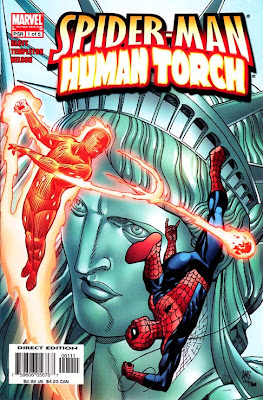
8. Failure Number Three: Spider-Man & The Human Torch Limited Series (When Peter Met Johnny)

Buddy and Matt had their past lives stripped from them, and were rebuilt clean of what'd been to face one last absolute conflict over their very existence. But Dan Slott and Ty Templeton's "Spider-Man & The Human Torch" is about major-league characters who haven't been through such a soul-cleansing process, who are coming to terms with the weight of their 45 years of continual and often contradictory existence. It's the story of long decades of conflict and comradeship, and it's without doubt the best example in all of contemporary superhero comics of a massive body of continuity being lightly weaved together to create a richer and not a wearisomely convoluted comicbook reality.


What emerges at the end of the five chapters, each set in a different era of the Marvel Universe, is a convincingly spry portrait of how two young super-heroes grew up and, then, strangely, seemed to stop growing at all. There's Peter Parker, once that bullied science-teacher's pet, friendless and loveless, who's become a successful and published photographer as well as the husband of a strong and compassionate super-model. And, strangely, there's Johnny Storm, who's floundered somewhat, a famous superhero with a string of apparently enviable affairs, but a man lonely for friendship and bemused by how his teenage successes don't feel so significant now he's grown past 21. It's as subtle a picture of how the relationship between the two characters fluctuates over the years as we could hope for, and it's brave enough, for example, to show Peter Parker slightly cruelly holding off Johnny's desire for a closer friendship because, quite frankly, this incarnation of Spider-Man really does have much of the good luck he needs already. And yet, in the end, the truth is that these two have nobody else to constitute a peer group for each other but themselves, and they're bound by so much common experience that it's easier for them to surrender to familiarity and common experience than to strike out again on their own. It feels, underneath its light and deliciously amusing front, very real and very touching.

In the last few pages of the final chapter, Peter accepts an invitation to spend an evening at the Baxter Building with "the family". And so Peter and MJ bring along Aunt May, and meet with the Richards, and their children, and Ben Grimm, and even Herbie the Robot. I have rarely if ever experienced as subtly-constructed a portrayal of two families getting to know each other as this in a super-hero universe, though Grud knows there may not be that much competition. I challenge anyone not to sit down and luxuriate in the sheer weight of apposite details in these final few pages. Look! Peter can't help but feel a little contemptuous of Johnny, who's still closer in nature to the likes of Flash Thompson as-was than he is to Peter himself. Look! Reed carefully passes baby Valeria to a beaming Aunt May, and surely you agree with me that this must have happened and happened this way. Look! Mary Jane and Sue Richards talking about nothing much at all, as if they were, well, human beings getting to know each other!

And look. Look at what the unfairly under-rated Mr Templeton is so skillfully showing us, look at what Mr Slott is bringing to pass, and close.

Look. Peter Parker isn't alone anymore, isn't land-locked into atomised relationships where only his marriage to Mary Jane saves him from despair. (We shall leave "Brand New Day" and beyond to one side for this moment.) Look. Johnny Storm has a friend he admires and respects, a friend to bring home to his surrogate parents, Reed and Sue. Look, the Richards household has added a fourth generation in May Parker, their respected guest and the foster mother of Spider-Man.

Look how these people complete each other, look how they've become a community, strengthening each others weaknesses, complimenting each other's strengths.

Look at May Parker, how happy and proud she must be of Peter, how pleased and fundamentally relieved that Peter has a wife and such fine friends. How worried she must have been. How well she must have slept that night.

How that terrible, lonely story which began for her with the murder of her dear husband Ben can in significant part close here.

And who could want these friends of ours to go through anymore horrors? Divorces, mutated children, lost lovers, time-lost boys, extra arms, Goblins and Galactus; no. Stop it. Let it go.

This is where their story ends.

9. The End

This, of course, is only my story about where these stories end, and I don't want to give the impression that I haven't thoroughly enjoyed later takes on these characters since the stories engaged with here. I can't, though, in my heart, help but feel that I've already seen how things end up and that what I'm reading now is fine, but not exactly true.

But perhaps the above might be to small degree instructive, in that I suspect it isn't bad story-telling that inspires us to consider walking away from a much-loved character. In fact, as the example of Aquaman might show us, a character can be dragged through endless revamps, inconsistencies, editorial complacencies and creator-centric intrusive whims, and still inspire loyalty and involvement on the part of fans. There are many sins both of commission and ommision which may sink titles, but I don't believe that they can destroy characters, who can even be strengthened in the minds of readers who are moved by incompetent creators to consciously create their own version of who a favourite and abused character might really be.

We get inspired sometimes by ruins, after all.

So strangely perhaps one of the things which can threaten to kill characters stone-dead in their tracks where the more long-standing reader is concerned is to watch gifted creators boil down beloved character's histories to one fundamental existential conflict, and then, having shown that silver thread of the Norn's design which underpins everything else, end the long years of struggle with a perfectly judged happy ending.

I can't help feeling that Matt and Karen still quietly protect Hell's Kitchen, that Buddy and Ellen drift through the suburban summers occasionally disturbed by falling spaceships and the B'Wana Beast dropping by unannounced, and that the Parkers and the Richards and their closest friends meet up once a month just to be in the quiet comfort of each other's company.

Even if Johnny still irritates Peter just that little bit more than we might want to think he does.

10. Last Words

The last words of Gore Vidal's "Burr" are as follows:

"But there was no wish that I could be granted that I have not already been granted by my father Aaron Burr."

No wish left that could be granted. That's the end of the story, unless you're one of those people who love to mess up other folk's happy lives just to see how they struggle and squirm as they fall.

Me? I think it's obvious where I stand on the subject.


Grant Morrison's Animal Man saga is collected in 3 paperbacks from DC Comics, with splendid storytelling by a host of artists led by Charles Troug. Frank Miller and David Mazzucchelli's "Daredevil: Born Again" is published by Marvel Comics. Dan Slott and Ty Templeton's "Spider-Man & The Human Torch" is collected in hardback from Marvel and in a dinky little digest too. Gore Vidal's "Burr" is available in paperback from just about anywhere you might care to look, and look you ought to, if you would. Thank you for reading! Do let me know your favourite unofficial 'last stories'. Good night.


.
More about