And now; the conclusion ...
 10.
10.
Eventually, eventually, I realised that I couldn't trust myself to read comic books anymore. Oh, I'd consume them, and in greater and greater numbers, but I wasn't to be trusted to always actually read them. Some of it was the over-familiarity of so much of the material, and some of it a growing problem with how to make the most of 21st century storytelling. And some of it was the fact that graphic novels could be found stacked on the shelves of local libraries in previously unimaginable numbers. A surfeit of inexpensive entertainment is a fundamentally corrosive substance. It can eat right through a reader's powers of concentration, and complacency is a remarkably easy state of mind to succumb to.

The most effective strategy that I've ever found to keep this slothful-mindedness at bay is to make sure that I never allow myself to finish a comic book without being absolutely sure that I've learned something from the experience. It might be, for example, a trace of the skills of how to show time slowing without resorting to cliche or ponderousness, as Mike Mignola so often succeeds in doing in "Hellboy", or a shimmer of how Charles M. Schulz presents a sequence of minor variations on the same four-panel gag sequence that relies on the reader's recognising a familiar pattern in order to just slightly subvert their expectations. Just remembering to take pleasure in looking for such skills helps keeps the inattentiveness of skimming at bay.

I have friends who can't listen to a piece of music without trying to nail down the notes of a guitar solo or a horn chart in their heads, and it seems to me that they're never idling through their lives in a world where music is so ubiquitous that it's often nothing much more than muzak to most of us. Even if they pick the chords wrong, well, they're still left with something of a new song of their own as a result, because they've not just consumed, they've collaborated, they've conspired.

Part of what makes it so enjoyable to try to sing along with, if you will, writers such as Mr Cornell and Ms Simone is the fact that they have such an apparently clear and unpretentious command of structure, which helps we amateurs feel as if there are some aspects at least of their craft that can be to some degree identified and discussed. And yet, there's also what appears to be an irrepressible intent on the part of both writers to inform these seemingly transparent structures, and the superhero sub-genre too, with a host of stuff that the reader might not immediately expect to find there at all. It's smart and surreptitiously functional stuff - I love that word after 25 years of the necessary pedantry of academia and state schools - and there's a great deal of fun to be had in noting it and writing about it, and perhaps even thinking of how to emulate it.

In this, Ms Simone and Mr Cornell's work exemplifies why I do so enjoy writing about comic books. For I've absolutely no interest in creating pseudo-academic pieces which claim to proclaim to the world a fixed, quantifiable truth about how storytelling works, though I've no objection of any kind to those who do seek to do so. Rather, I simply enjoy thinking about both the discipline and the playfulness of effective and unpretentious storytelling, and I'm always invigorated by the belief that, while clearly told and accessible stories are the foundation stone of the superhero sub-genre, a great deal that's fun can be productively added to the brew too. And if I catch the wrong chords and end up whistling the wrong tune, as it were, I hope the reader will both forgive the fact of my mistake and the truth that I'll not regret it quite so shamefacedly as perhaps I ought to. Because the point of this writing about comics can be, I fear, a dreadfully dry affair, and sometimes I think that a great baroque folly of a piece is far more in keeping with the enthusiastic spirit of these comics than a very precise, very correct, very worthy, academic essay.
But then, to paraphrase Mandy Rice-Davies, I would say that, wouldn't I?

11.
"What Luthor Has Wrought" is in some ways a quite untypical tale of the Secret Six from Ms Simone. This is, of course, only to be expected, as she has a great deal to achieve in the last part of the crossover with Mr Cornell's "Action Comics" and only one issue and a parsimonious twenty pages to do it in. As such, the reader is faced with the first Secret Six story that I know of where some of the book's primary cast pass through the closing of a tale with barely an emotionally telling incident between them. Jeanette is largely invisible, for example, and both Catman and Deadshot are each limited to a single word-balloon's worth of telling talk. Compared to even the single-issue story told in "The Rabbit And The Grave" (*7), where, despite the relative lack of space, every member of the Six shown on-page bar, again, Jeanette, featured in at least a single sequence of character-informing panels, "Secret Six" # 29 stands as a rare example of Ms Simone focusing on a narrow range of her stars and supporting players.
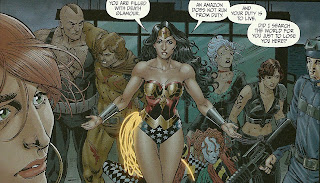
Normally, it's a mark of Ms Simone's work on the Secret Six that most every character of even secondary importance is quite deliberately given their own specific arc of development which is referred to during the climax of her longer stories. And so there are, for example, 11 characters who get a closing, if not a resolving, moment in the last chapter of "Depths", 9 at the end of "Six Degrees Of Separation" and 10 in the final twenty pages of "Unhinged". Obviously, Ms Simone is loathe to allow a character to sit as a passenger in the narrative, both for the waste that such inattentiveness might cause, and, we might presume, because she's too especially fond of her cast to allow them drift without due care and attention being paid to their fates. And it's the skill by which Ms Simone packs her conclusions with a considerable number of individual stories all working to serve a greater narrative purpose without causing the climax to drag that both helps mark out her style and the degree of her achievement.

Yet it's notable how Ms Simone has adapted her typical practise to take advantage of the challenges and opportunities posed by the Action Comics/Secret Six crossover. Rather than attempting to deliver a diluted form of her normal approach, which would presumably have involved presenting exceptionally shallow little secondary plots and perhaps brief melodramatic excesses to give them any weight and meaning at all, her various super-villains in "What Luthor Has Wrought" are separated into clearly differentiated leads and spear-carriers. That's not to say that anyone beyond Luthor, the family Savage and Ragdoll are flat and uninteresting; the single panel's conversation at 4:5 that sets up the issue's closing revelation also tells us a great deal about Catman's parental demons too. But such moments are by necessity very brief and are intended to reflect the status quo rather than to further it.

So far, it could fairly be said, so obviously. But of course a writer faced with a demanding sequence of plot points and a limited amount of pages might decide to focus only upon the most important business before them. But perhaps what's most telling here is how Ms Simone chooses to compensate for her inability to present a typically crowded climax in which a host of characters are by design intensely involved. In the necessary absence of a broad range of simultaneously occurring and intensely-wired events, from grand punch-ups to cruel betrayals, Ms Simone loads the end of "What Luthor Has Wrought" with a simple, focused double climax; a grand punch-up and escape followed by the traumatic details associated with the origin of Scandal's Lamentation Blades, as we've of course discussed before. It's as if a mathematical equation that regulates storytelling has been referred to, determining that in the absence of a large number of arcs great and small, two significant and straight-forward story-closing events which deliver some considerable dramatic force should be put to use instead, one immediately after the other. And

so, Ms Simone has anchored her tale in the horror of the fate of Scandal's mother, one deeply affecting moment rather than the cumulative effect of a sequence of events. Without that closing recollection, which is actually quite unnecessary to the working out of the main plot even as it's so vital to lending some greater emotional weight to it, this whole issue would've felt somewhat light-weight and out-of-place in the Secret Six canon. It would have been something of an indulgence, an anomaly, an issue which existed solely for the undoubted pleasures offered by the chance to collaborate with other professionals. With it, a familiar measure of heavy-hearted character development and emotional intensity is delivered, meaning that "What Luthor Has Wrought" stands not just as a part of an enjoyable crossover, but also as an essential part of the book that the three-parter closes in.

Many writers across the years have relied upon the sparks generated by the simple fact of a story running across two quite separate and typically unconnected titles to justify the linking of one comic book with the other. And despite the fact that Luthor has played such a fundamental role in the Six's past, the very idea of grand old dame that is "Action Comics" holding hands with "Secret Six" is indeed something of a surprise and an event in itself. More so, there's a undeniable frission that's created by seeing two capable creators with such distinct styles working together, both for the fact of how effectively they might combine and for the manner in which the marks of their individual styles might remain. (Mr Cornell's mostly disreputable characters in Action Comics, for example, aren't always possessed of the greatest sense of humour, and they tend to unintentionally say

things that might make a reader laugh at them rather than with them. By contrast, most of the Six possess a self-conscious and highly individual sense of humour that's put to use for a variety of purposes, creating quite a different tone between the two books under normal conditions. We tend to laugh with the Six, but not the utterly self-obssesed Lex Luthor.) But the care invested in the construction, progression and conclusion of this crossover tells us that it's been designed to function as something more than just a rather interesting idea placed on the schedule as yet another event, although pleasing novelties can be a very fine thing in themselves. Instead, Mr Cornell and Ms Simone have made quite sure that the agenda of each of their individual titles is furthered even as the collaboration between the two titles is kept largely self-contained and, with the exception of a previously-mentioned reservation, internally self-consistent.
This is, within the context of a monthly medium which demands, and which has to demand, that work gets done fast and gets done well, a not-inconsiderable achievement. After all, far less discipline could have been applied and the endeavour still applauded.
*7:- Secret Six # 16
 12.
12.
I.
Finally, perhaps we might end with a look at an small aspect of Mr Cornell's work which probably only a blogger with no editor, advertisers, paying customers or, indeed, any kind of mass appeal at all could pay attention to, namely the way that Mr Cornell negotiates the transition between the use of "real-world historical time" and "comic-book continuity-time" in Action Comics # 895 and "Black Widow: Deadly Origin". It's no more than a minor detail of his craft, but it is, if I haven't entirely imagined it, a telling one, evidence of a degree of thoughtfulness and application that the unshowy surface of the work modestly and purposefully obscures.
II.
There is in both "Black Widow: Deadly Origin" and "Action Comics" # 895 a "moment where we go out of historical time and into (comic-book) time" (*8), as Mr Cornell told Marvel.Com when talking about the former book. "Hopefully it's a graceful movement", he stated, and so it is, in both books, but it's always a difficult one to pull off. A comic book scene underpinned in large part by historical events has a quite different meaning to one grounded in continuity, as we touched uponlast Thursday on this very subject. In essence, and for all of the inevitability of historical revisionism, the basic facts of the events of our common past, and especially the past of living memory, are essentially and broadly fixed; John Lennon died on December 8th, 1980, and that, where the bald facts of the matter are concerned, is pretty much that.

The facts of superhero continuity are, however, far more likely to be not just subject to reinterpretation and partial revision, as history is, but to be utterly rewritten and even retconned entirely out of existence. The John Lennon of the DCU may suddenly be revealed to have never died in the first place, or to have never even been born, and such radical and often apparently random changes to a character's status may be many and never-changing and consistently fantastical. (The John Lennon of the MU, of course, actually was, from 1963 onwards, a Skrull!) Lennon the mystic, Lennon the mutant, Lennon the communist spy with a monkey's heart-valve; there is, in truth, no such thing as a "past" in comic-book continuity, although it's necessary that both creators and readers agree to believe that there is for most anything to actually get done.

What's more, "real" time has a sense of proportion and progression and solidity that comic book time doesn't. It's not just a question of whether specific events in the superhero worlds can be relied up to remain as they've been shown before, but also a matter of how all these ever-shifting moments relate to one another in sequence. The 50 years-worth of Marvel Comics since Fantastic Four #1, for example, have to be constantly shoveled into a span of continuity that rarely recognises more than a dozen years as having occurred between Reed Richard's first and tragic spaceflight and the apparent death of Johnny Storm. Even if another 5 or 6 years are added to that period, it still leaves that decade-and-a-half of comicbook years hopelessly saturated with events once the reader starts to wonder, playfully or anally, just what's happened and how it all relates to itself. But out here in the everyday world, a year can only ever incorporate the fixed sum of events which actually happened between January 1st and December 31st. As a consequence of these fundamental differences, making sense of our history involves quite different skills to those we use to cope with the joys and pitfalls of comic-book continuity.

This issue of time isn't necessarily anything of a weakness where the long-lived, massively complex superhero universes are concerned, though it's often talked of as if it were. A comic-book continuum's identity and value doesn't lie in a specific, fixed and closed canon of fictional "facts". Instead, the DCU and the MU, amongst many others, are protean creative opportunities that can be constantly recast in inventive and entertaining ways to entice new generations and reflect changing social situations.

Yet by locking down comic-book events with reference to specific historical moments, the superhero text does take on a whole mass of other qualities, as we talked about before, a weight of other associations, a verisimilitude, a sense that what we're looking at carries far more of permanence and of the real than a typical superhero scene does. And so, where it's possible to do so, a judicial use of the business of history to help buttress the "facts" of a superhero's existence can make the whole fantastical brew of the costumed crimefighter narrative all the more convincing and satisfying.
But in placing the "facts" of the real-world and of a comic-book reality together, two different ways of approaching a narrative are suddenly placed one against the other, one more definite if hardly fixed, one so fluid that it can barely be said to hang together at all without the connivance of the reader and their rather unique skills where making sense of continuity is concerned..
*8:- http://marvel.com/news/story/10148/tuesday_ga_paul_cornell

III.
Mr Cornell does love to inform his characters with a sense that time has passed for them just as it has for us, and that they too relate the rolling onwards of the years with reference to the events common to our world and theirs. At the same time, he's aware that too close a correspondence between character and the recent past will inevitably date the figure concerned as the years turn onwards; link a superhero with the events of a particular war, for example, and the audience will soon start to wonder why that super-person's not getting any older even as the key occurance they were involved in receedes further and further back in the historical record. For that reason, Mr Cornell tends to tie his character's more recent years to events in comic-book continuity, while those folks he writes about who've had a longer than average life, or who existed solely in the past, start to get linked more and more to a mostly recognisable parallel history to that of ours. And so the Skrull John Lennon is declared to have arrived on Marvel-Earth specifically during the Beatlemania of 1963, because that makes his biography all the more interesting, and ultimately tragic, while such never threatened to inconviently age him or any other character who needs to lastingly stay forever twenty-eight, or whatever.

The actual relationship that Mr Cornell's characters typically have with historical events is something of an extension of Stan Lee's decision in and around the early Sixties to have his superheroes just as concerned with their private affairs as they were with their heroic missions, if not more so. Just as you or I might find ourselves worrying on any particular day about the gas not being turned off or the house-keys going missing even as the world's great, and not so great, powers continue to point ICBMs at each other, so Peter Parker would be more concerned with Aunt May's medical bill than Electro's latest scheme for robbing banks. And so, Mr Cornell's characters may be framed by the context of historical events both real and fictional, but they tend to be pursuing their own private agendas while doing so. Ivan in "Black Widow: Deadly Origins" may be caught in Stalingrad during an 1928 attack by "Imperialists", but his thoughts are of saving a friend's sister caught in a burning building. And when we're shown Vandal Savage on the planet Salvation in "Action Comics" # 895, he's far more concerned with getting Luthor to visit his blessed "pustules", matron, than he is with the matter of escaping off of an alien world and returning to Earth. Mr Cornell seems to be constantly using history as a way of locking down a character's existence in relation to comic book and/or real-world events, but he never forgets that history is usually something individuals pass through while focusing on their private affairs, rather than an overwhelming, individuality-erasing temporal fact which utterly defines everyone who experiences it in a similar fashion.

IV.
But there always does remain the problem of how to move a comic-book narrative from a recognisable past, with its relatively fixed and pseudo-historical timeline, into the ever-permanent and yet ever-changing last ten years or so of the superhero universes. In both "Black Widow: Deadly Origin" and "Action Comics" # 895, Mr Cornell creates a buffer between depictions of the past related to history and more contemporary comic-book happenings which occurred in the vague and ill-defined sequence of events referred to as "continuity". And so, as the tale of the Black Widow moves from the historical settings of the Kremlin and the Baikonur Cosmodrome of the early 1960s into the Marvel Universe of "several years ago", the transition is eased by inserting a plausible and yet previously unseen comic-book incident in between the real-world-referenced events of the past and the ever changing and yet oddly fixed matters of comic-book continuity. Once that half-way house of an unknown scene linked to the relatively distant past of the MU is negotiated, the reader can move into a section of the narrative where history and its rules largely disappears and continuity, with all its strangeness and intricacies, can predominate.

Similarly, in "The Black Ring" part 6, events showing the past of Vandal Savage jump from a historically-based scene set in the Prague Spring of 1968 to a previously unseen mission to kill Aquaman set roughly ten or so years ago in comic-book time. There's no specific source for the particulars of any such murderous business in the continuity of the DCU, as far as I know, but once again we're being eased from one way of reading, that involves elements recognisable from our own past, to another, which involves fantastical matters which the likes of you or I will and, of course, never can experience. The key to this comfortable progression from one mode of thought to another is via a scene that is both continuity and not-continuity, that's both linked to the past and yet not fixed to any telling historical moment at all, namely a showdown between Vandal Savage and Aquaman which never happened, or rather, never happened until Action Comics # 895 showed us it had. And then, the transmission belt having been negotiated, Mr Cornell could then start to relate Vandal Savage's activities with reference to specific issues of the "Flash" and "Salvation Run", just as before he was grounding action in the context of particular years and events. One type of engaging with the text was gently replaced by another, and the story rolled on.

It might be observed that this technique works even better in Action Comics # 895 than it did in "Deadly Origins". The sudden appearance of Tony Stark and the unavoidable presence of all of the continuity baggage that comes with him was complicated enough in the Black Widow tale to cause a little judder in this reader's concentration. Stark and Natasha's adventuring and the information-heavy sequence that they were presented in made it too obvious that the reader was shifting from events defined in part by "when did this happen?" to those made sense of through the question "how does this fit with all the comic-book continuity that might be relevant here?" (This was especially so because the scene was cleverly referencing "Iron Man II" in several ways in addition to working within the context of events displayed across five decades of comic books.) It was, perhaps, just a little too dense a continuity-informed sequence to jump straight into after all of the historical moments which preceded it. But the scene of Vandal Savage and his daughter as they set out to kill the King Of The Seven Seas in Action Comics # 895 carried less baggage, involved less detail, and presented the shift from one mode of thinking to another in a way that was, accordingly, easier to make. Of course, in some key ways this is an invidious comparison; "Deadly Origin" was a book that was in significant part concerned to deal with the Widow's complex and contradictory back-story, whereas Vandal Savage's past in the Action Comics/Secret Six crossover was a far simpler affair, with all that needed to be shown being that which drove the plot of these three issues to their common conclusion. It was unavoidable that "Deadly Origin" would carry more of the challenges of continuity along with it, because that was much of its purpose. But, all the same, the more gentle of the two context-shifting scenes was the least disconcerting, and perhaps that might be worth the noting.

V.
The scene of a distressingly young Scandal Savage accompanying her father on the business of murdering Arthur Curry, standing as it does between history and continuity, serves a host of narrative functions while never seeming to be anything other than an entertaining glimpse into the elder Savage's past;

13.
If the example above of the historio-continuity narrative bridge - of course I'm joking! - is a minor example of the craftsman's tool-kit, and of course it is, it's also one worthy of recognition and respect. Indeed, even if there's no such technique being used, even if I've imagined it all, it's a trick that I could now use. Humming along and getting the notes all, or even partially, wrong still produces a tune which wouldn't be there otherwise. (It'll probably be a vastly inferior and fearsomely unappealing tune, but never mind; it eludes us now, but that's no matter, tomorrow....) And, by a similar token, any speculation of how Ms Simone establishes the spine and climaxes of her tales does seem like a terribly futile thing, given that her work is so well constructed that there's a sense that a blogger might just as well try to describe why the curve of an apple is so appealing; it just is, so why bother?

But part of me thinks - I do hope it's not an entirely vainglorious part - that these specific techniques, these hardwon and downright clever ways of telling stories, obvious and discrete, individual and common-store, are often those which are most likely to pass without notice or comment, and it's often the case that such narrative skills are completely forgotten as the years roll on. Indeed, I wonder if there's ever been a popular form that forgets to remember the detail of its own craft as the superhero sub-genre too often does. (Why, for example, does so much of Will Eisner's work from the Forties look as if it's some future destination of the comic book's evolution rather than an example of craft from sixty years ago? Why is so much that might be taken from Alex Toth's work on perspective and placement and shadow being so inexplicably ignored? Why do we so rarely use even the opportunities granted by Jack Kirby's story-closing tripartite panel structure anymore? ) It's not that I can add to any kind of historical record, and I don't aspire to do so. That's for the people who know, and especially for the folks who can do.Yet, it's hard not to want to respectfully notice some shadow of what's being achieved, even if inaccuracy and over-worthiness seems to be the inevitable outcome. The tiny details of a fantastically entertaining magic trick are always worth the noting, or, at least, the attempt to note, even as the performance of the trick itself is the ultimate point of the exercise.
But these details. They are a pleasure in themselves.

Oh, well. Fail harder next time! Thanks for popping in, in the inexplicable event that any tolerant eyes are passing over these words here :) Splendid best wishes are sincerly evoked at this far end of the net in return for your patience, and I wish you an appropriately heartening measure of Sticking Together! too.
.
More about →

Eventually, eventually, I realised that I couldn't trust myself to read comic books anymore. Oh, I'd consume them, and in greater and greater numbers, but I wasn't to be trusted to always actually read them. Some of it was the over-familiarity of so much of the material, and some of it a growing problem with how to make the most of 21st century storytelling. And some of it was the fact that graphic novels could be found stacked on the shelves of local libraries in previously unimaginable numbers. A surfeit of inexpensive entertainment is a fundamentally corrosive substance. It can eat right through a reader's powers of concentration, and complacency is a remarkably easy state of mind to succumb to.
The most effective strategy that I've ever found to keep this slothful-mindedness at bay is to make sure that I never allow myself to finish a comic book without being absolutely sure that I've learned something from the experience. It might be, for example, a trace of the skills of how to show time slowing without resorting to cliche or ponderousness, as Mike Mignola so often succeeds in doing in "Hellboy", or a shimmer of how Charles M. Schulz presents a sequence of minor variations on the same four-panel gag sequence that relies on the reader's recognising a familiar pattern in order to just slightly subvert their expectations. Just remembering to take pleasure in looking for such skills helps keeps the inattentiveness of skimming at bay.

I have friends who can't listen to a piece of music without trying to nail down the notes of a guitar solo or a horn chart in their heads, and it seems to me that they're never idling through their lives in a world where music is so ubiquitous that it's often nothing much more than muzak to most of us. Even if they pick the chords wrong, well, they're still left with something of a new song of their own as a result, because they've not just consumed, they've collaborated, they've conspired.
Part of what makes it so enjoyable to try to sing along with, if you will, writers such as Mr Cornell and Ms Simone is the fact that they have such an apparently clear and unpretentious command of structure, which helps we amateurs feel as if there are some aspects at least of their craft that can be to some degree identified and discussed. And yet, there's also what appears to be an irrepressible intent on the part of both writers to inform these seemingly transparent structures, and the superhero sub-genre too, with a host of stuff that the reader might not immediately expect to find there at all. It's smart and surreptitiously functional stuff - I love that word after 25 years of the necessary pedantry of academia and state schools - and there's a great deal of fun to be had in noting it and writing about it, and perhaps even thinking of how to emulate it.
In this, Ms Simone and Mr Cornell's work exemplifies why I do so enjoy writing about comic books. For I've absolutely no interest in creating pseudo-academic pieces which claim to proclaim to the world a fixed, quantifiable truth about how storytelling works, though I've no objection of any kind to those who do seek to do so. Rather, I simply enjoy thinking about both the discipline and the playfulness of effective and unpretentious storytelling, and I'm always invigorated by the belief that, while clearly told and accessible stories are the foundation stone of the superhero sub-genre, a great deal that's fun can be productively added to the brew too. And if I catch the wrong chords and end up whistling the wrong tune, as it were, I hope the reader will both forgive the fact of my mistake and the truth that I'll not regret it quite so shamefacedly as perhaps I ought to. Because the point of this writing about comics can be, I fear, a dreadfully dry affair, and sometimes I think that a great baroque folly of a piece is far more in keeping with the enthusiastic spirit of these comics than a very precise, very correct, very worthy, academic essay.
But then, to paraphrase Mandy Rice-Davies, I would say that, wouldn't I?

11.
"What Luthor Has Wrought" is in some ways a quite untypical tale of the Secret Six from Ms Simone. This is, of course, only to be expected, as she has a great deal to achieve in the last part of the crossover with Mr Cornell's "Action Comics" and only one issue and a parsimonious twenty pages to do it in. As such, the reader is faced with the first Secret Six story that I know of where some of the book's primary cast pass through the closing of a tale with barely an emotionally telling incident between them. Jeanette is largely invisible, for example, and both Catman and Deadshot are each limited to a single word-balloon's worth of telling talk. Compared to even the single-issue story told in "The Rabbit And The Grave" (*7), where, despite the relative lack of space, every member of the Six shown on-page bar, again, Jeanette, featured in at least a single sequence of character-informing panels, "Secret Six" # 29 stands as a rare example of Ms Simone focusing on a narrow range of her stars and supporting players.

Normally, it's a mark of Ms Simone's work on the Secret Six that most every character of even secondary importance is quite deliberately given their own specific arc of development which is referred to during the climax of her longer stories. And so there are, for example, 11 characters who get a closing, if not a resolving, moment in the last chapter of "Depths", 9 at the end of "Six Degrees Of Separation" and 10 in the final twenty pages of "Unhinged". Obviously, Ms Simone is loathe to allow a character to sit as a passenger in the narrative, both for the waste that such inattentiveness might cause, and, we might presume, because she's too especially fond of her cast to allow them drift without due care and attention being paid to their fates. And it's the skill by which Ms Simone packs her conclusions with a considerable number of individual stories all working to serve a greater narrative purpose without causing the climax to drag that both helps mark out her style and the degree of her achievement.

Yet it's notable how Ms Simone has adapted her typical practise to take advantage of the challenges and opportunities posed by the Action Comics/Secret Six crossover. Rather than attempting to deliver a diluted form of her normal approach, which would presumably have involved presenting exceptionally shallow little secondary plots and perhaps brief melodramatic excesses to give them any weight and meaning at all, her various super-villains in "What Luthor Has Wrought" are separated into clearly differentiated leads and spear-carriers. That's not to say that anyone beyond Luthor, the family Savage and Ragdoll are flat and uninteresting; the single panel's conversation at 4:5 that sets up the issue's closing revelation also tells us a great deal about Catman's parental demons too. But such moments are by necessity very brief and are intended to reflect the status quo rather than to further it.

So far, it could fairly be said, so obviously. But of course a writer faced with a demanding sequence of plot points and a limited amount of pages might decide to focus only upon the most important business before them. But perhaps what's most telling here is how Ms Simone chooses to compensate for her inability to present a typically crowded climax in which a host of characters are by design intensely involved. In the necessary absence of a broad range of simultaneously occurring and intensely-wired events, from grand punch-ups to cruel betrayals, Ms Simone loads the end of "What Luthor Has Wrought" with a simple, focused double climax; a grand punch-up and escape followed by the traumatic details associated with the origin of Scandal's Lamentation Blades, as we've of course discussed before. It's as if a mathematical equation that regulates storytelling has been referred to, determining that in the absence of a large number of arcs great and small, two significant and straight-forward story-closing events which deliver some considerable dramatic force should be put to use instead, one immediately after the other. And

so, Ms Simone has anchored her tale in the horror of the fate of Scandal's mother, one deeply affecting moment rather than the cumulative effect of a sequence of events. Without that closing recollection, which is actually quite unnecessary to the working out of the main plot even as it's so vital to lending some greater emotional weight to it, this whole issue would've felt somewhat light-weight and out-of-place in the Secret Six canon. It would have been something of an indulgence, an anomaly, an issue which existed solely for the undoubted pleasures offered by the chance to collaborate with other professionals. With it, a familiar measure of heavy-hearted character development and emotional intensity is delivered, meaning that "What Luthor Has Wrought" stands not just as a part of an enjoyable crossover, but also as an essential part of the book that the three-parter closes in.

Many writers across the years have relied upon the sparks generated by the simple fact of a story running across two quite separate and typically unconnected titles to justify the linking of one comic book with the other. And despite the fact that Luthor has played such a fundamental role in the Six's past, the very idea of grand old dame that is "Action Comics" holding hands with "Secret Six" is indeed something of a surprise and an event in itself. More so, there's a undeniable frission that's created by seeing two capable creators with such distinct styles working together, both for the fact of how effectively they might combine and for the manner in which the marks of their individual styles might remain. (Mr Cornell's mostly disreputable characters in Action Comics, for example, aren't always possessed of the greatest sense of humour, and they tend to unintentionally say

things that might make a reader laugh at them rather than with them. By contrast, most of the Six possess a self-conscious and highly individual sense of humour that's put to use for a variety of purposes, creating quite a different tone between the two books under normal conditions. We tend to laugh with the Six, but not the utterly self-obssesed Lex Luthor.) But the care invested in the construction, progression and conclusion of this crossover tells us that it's been designed to function as something more than just a rather interesting idea placed on the schedule as yet another event, although pleasing novelties can be a very fine thing in themselves. Instead, Mr Cornell and Ms Simone have made quite sure that the agenda of each of their individual titles is furthered even as the collaboration between the two titles is kept largely self-contained and, with the exception of a previously-mentioned reservation, internally self-consistent.
This is, within the context of a monthly medium which demands, and which has to demand, that work gets done fast and gets done well, a not-inconsiderable achievement. After all, far less discipline could have been applied and the endeavour still applauded.
*7:- Secret Six # 16

I.
Finally, perhaps we might end with a look at an small aspect of Mr Cornell's work which probably only a blogger with no editor, advertisers, paying customers or, indeed, any kind of mass appeal at all could pay attention to, namely the way that Mr Cornell negotiates the transition between the use of "real-world historical time" and "comic-book continuity-time" in Action Comics # 895 and "Black Widow: Deadly Origin". It's no more than a minor detail of his craft, but it is, if I haven't entirely imagined it, a telling one, evidence of a degree of thoughtfulness and application that the unshowy surface of the work modestly and purposefully obscures.
II.
There is in both "Black Widow: Deadly Origin" and "Action Comics" # 895 a "moment where we go out of historical time and into (comic-book) time" (*8), as Mr Cornell told Marvel.Com when talking about the former book. "Hopefully it's a graceful movement", he stated, and so it is, in both books, but it's always a difficult one to pull off. A comic book scene underpinned in large part by historical events has a quite different meaning to one grounded in continuity, as we touched uponlast Thursday on this very subject. In essence, and for all of the inevitability of historical revisionism, the basic facts of the events of our common past, and especially the past of living memory, are essentially and broadly fixed; John Lennon died on December 8th, 1980, and that, where the bald facts of the matter are concerned, is pretty much that.

The facts of superhero continuity are, however, far more likely to be not just subject to reinterpretation and partial revision, as history is, but to be utterly rewritten and even retconned entirely out of existence. The John Lennon of the DCU may suddenly be revealed to have never died in the first place, or to have never even been born, and such radical and often apparently random changes to a character's status may be many and never-changing and consistently fantastical. (The John Lennon of the MU, of course, actually was, from 1963 onwards, a Skrull!) Lennon the mystic, Lennon the mutant, Lennon the communist spy with a monkey's heart-valve; there is, in truth, no such thing as a "past" in comic-book continuity, although it's necessary that both creators and readers agree to believe that there is for most anything to actually get done.

What's more, "real" time has a sense of proportion and progression and solidity that comic book time doesn't. It's not just a question of whether specific events in the superhero worlds can be relied up to remain as they've been shown before, but also a matter of how all these ever-shifting moments relate to one another in sequence. The 50 years-worth of Marvel Comics since Fantastic Four #1, for example, have to be constantly shoveled into a span of continuity that rarely recognises more than a dozen years as having occurred between Reed Richard's first and tragic spaceflight and the apparent death of Johnny Storm. Even if another 5 or 6 years are added to that period, it still leaves that decade-and-a-half of comicbook years hopelessly saturated with events once the reader starts to wonder, playfully or anally, just what's happened and how it all relates to itself. But out here in the everyday world, a year can only ever incorporate the fixed sum of events which actually happened between January 1st and December 31st. As a consequence of these fundamental differences, making sense of our history involves quite different skills to those we use to cope with the joys and pitfalls of comic-book continuity.

This issue of time isn't necessarily anything of a weakness where the long-lived, massively complex superhero universes are concerned, though it's often talked of as if it were. A comic-book continuum's identity and value doesn't lie in a specific, fixed and closed canon of fictional "facts". Instead, the DCU and the MU, amongst many others, are protean creative opportunities that can be constantly recast in inventive and entertaining ways to entice new generations and reflect changing social situations.
Yet by locking down comic-book events with reference to specific historical moments, the superhero text does take on a whole mass of other qualities, as we talked about before, a weight of other associations, a verisimilitude, a sense that what we're looking at carries far more of permanence and of the real than a typical superhero scene does. And so, where it's possible to do so, a judicial use of the business of history to help buttress the "facts" of a superhero's existence can make the whole fantastical brew of the costumed crimefighter narrative all the more convincing and satisfying.
But in placing the "facts" of the real-world and of a comic-book reality together, two different ways of approaching a narrative are suddenly placed one against the other, one more definite if hardly fixed, one so fluid that it can barely be said to hang together at all without the connivance of the reader and their rather unique skills where making sense of continuity is concerned..
*8:- http://marvel.com/news/story/10148/tuesday_ga_paul_cornell
III.
Mr Cornell does love to inform his characters with a sense that time has passed for them just as it has for us, and that they too relate the rolling onwards of the years with reference to the events common to our world and theirs. At the same time, he's aware that too close a correspondence between character and the recent past will inevitably date the figure concerned as the years turn onwards; link a superhero with the events of a particular war, for example, and the audience will soon start to wonder why that super-person's not getting any older even as the key occurance they were involved in receedes further and further back in the historical record. For that reason, Mr Cornell tends to tie his character's more recent years to events in comic-book continuity, while those folks he writes about who've had a longer than average life, or who existed solely in the past, start to get linked more and more to a mostly recognisable parallel history to that of ours. And so the Skrull John Lennon is declared to have arrived on Marvel-Earth specifically during the Beatlemania of 1963, because that makes his biography all the more interesting, and ultimately tragic, while such never threatened to inconviently age him or any other character who needs to lastingly stay forever twenty-eight, or whatever.

The actual relationship that Mr Cornell's characters typically have with historical events is something of an extension of Stan Lee's decision in and around the early Sixties to have his superheroes just as concerned with their private affairs as they were with their heroic missions, if not more so. Just as you or I might find ourselves worrying on any particular day about the gas not being turned off or the house-keys going missing even as the world's great, and not so great, powers continue to point ICBMs at each other, so Peter Parker would be more concerned with Aunt May's medical bill than Electro's latest scheme for robbing banks. And so, Mr Cornell's characters may be framed by the context of historical events both real and fictional, but they tend to be pursuing their own private agendas while doing so. Ivan in "Black Widow: Deadly Origins" may be caught in Stalingrad during an 1928 attack by "Imperialists", but his thoughts are of saving a friend's sister caught in a burning building. And when we're shown Vandal Savage on the planet Salvation in "Action Comics" # 895, he's far more concerned with getting Luthor to visit his blessed "pustules", matron, than he is with the matter of escaping off of an alien world and returning to Earth. Mr Cornell seems to be constantly using history as a way of locking down a character's existence in relation to comic book and/or real-world events, but he never forgets that history is usually something individuals pass through while focusing on their private affairs, rather than an overwhelming, individuality-erasing temporal fact which utterly defines everyone who experiences it in a similar fashion.

IV.
But there always does remain the problem of how to move a comic-book narrative from a recognisable past, with its relatively fixed and pseudo-historical timeline, into the ever-permanent and yet ever-changing last ten years or so of the superhero universes. In both "Black Widow: Deadly Origin" and "Action Comics" # 895, Mr Cornell creates a buffer between depictions of the past related to history and more contemporary comic-book happenings which occurred in the vague and ill-defined sequence of events referred to as "continuity". And so, as the tale of the Black Widow moves from the historical settings of the Kremlin and the Baikonur Cosmodrome of the early 1960s into the Marvel Universe of "several years ago", the transition is eased by inserting a plausible and yet previously unseen comic-book incident in between the real-world-referenced events of the past and the ever changing and yet oddly fixed matters of comic-book continuity. Once that half-way house of an unknown scene linked to the relatively distant past of the MU is negotiated, the reader can move into a section of the narrative where history and its rules largely disappears and continuity, with all its strangeness and intricacies, can predominate.
Similarly, in "The Black Ring" part 6, events showing the past of Vandal Savage jump from a historically-based scene set in the Prague Spring of 1968 to a previously unseen mission to kill Aquaman set roughly ten or so years ago in comic-book time. There's no specific source for the particulars of any such murderous business in the continuity of the DCU, as far as I know, but once again we're being eased from one way of reading, that involves elements recognisable from our own past, to another, which involves fantastical matters which the likes of you or I will and, of course, never can experience. The key to this comfortable progression from one mode of thought to another is via a scene that is both continuity and not-continuity, that's both linked to the past and yet not fixed to any telling historical moment at all, namely a showdown between Vandal Savage and Aquaman which never happened, or rather, never happened until Action Comics # 895 showed us it had. And then, the transmission belt having been negotiated, Mr Cornell could then start to relate Vandal Savage's activities with reference to specific issues of the "Flash" and "Salvation Run", just as before he was grounding action in the context of particular years and events. One type of engaging with the text was gently replaced by another, and the story rolled on.

It might be observed that this technique works even better in Action Comics # 895 than it did in "Deadly Origins". The sudden appearance of Tony Stark and the unavoidable presence of all of the continuity baggage that comes with him was complicated enough in the Black Widow tale to cause a little judder in this reader's concentration. Stark and Natasha's adventuring and the information-heavy sequence that they were presented in made it too obvious that the reader was shifting from events defined in part by "when did this happen?" to those made sense of through the question "how does this fit with all the comic-book continuity that might be relevant here?" (This was especially so because the scene was cleverly referencing "Iron Man II" in several ways in addition to working within the context of events displayed across five decades of comic books.) It was, perhaps, just a little too dense a continuity-informed sequence to jump straight into after all of the historical moments which preceded it. But the scene of Vandal Savage and his daughter as they set out to kill the King Of The Seven Seas in Action Comics # 895 carried less baggage, involved less detail, and presented the shift from one mode of thinking to another in a way that was, accordingly, easier to make. Of course, in some key ways this is an invidious comparison; "Deadly Origin" was a book that was in significant part concerned to deal with the Widow's complex and contradictory back-story, whereas Vandal Savage's past in the Action Comics/Secret Six crossover was a far simpler affair, with all that needed to be shown being that which drove the plot of these three issues to their common conclusion. It was unavoidable that "Deadly Origin" would carry more of the challenges of continuity along with it, because that was much of its purpose. But, all the same, the more gentle of the two context-shifting scenes was the least disconcerting, and perhaps that might be worth the noting.

V.
The scene of a distressingly young Scandal Savage accompanying her father on the business of murdering Arthur Curry, standing as it does between history and continuity, serves a host of narrative functions while never seeming to be anything other than an entertaining glimpse into the elder Savage's past;
- as stated, it serves as the point at which we jump from "historical" to "comicbook" time, and it successfully eases us from the one to the other.
- it carefully and surreptitiously introduces us to the fact that Savage has been dominating and corrupting his daughter since her very earliest years, which of course foreshadows the revelation which will close the crossover in "Secret Six" # 29..
- it establishes how Savage is so obsessed with the prophecy that the mere glimpse of a Daily Planet headline declaring "New Luthor Outrage" is enough to drive the thought of an ongoing mission to kill a prominent Justice Leaguer quite out of his mind, which continues to set up how history has for him been one ageless moment of longing, despite all the grand and terrible events that have occurred around him as he's waited for Luthor.
- it creates a troubling sense of unfinished business, since the reader knows that Aquaman wasn't killed, and yet they don't know what happened.So much is happening in the background of all of these situations that Vandal Savage moves through, and yet not a single moment of closure is ever seen. This inevitably creates uncertainly and unease.

13.
If the example above of the historio-continuity narrative bridge - of course I'm joking! - is a minor example of the craftsman's tool-kit, and of course it is, it's also one worthy of recognition and respect. Indeed, even if there's no such technique being used, even if I've imagined it all, it's a trick that I could now use. Humming along and getting the notes all, or even partially, wrong still produces a tune which wouldn't be there otherwise. (It'll probably be a vastly inferior and fearsomely unappealing tune, but never mind; it eludes us now, but that's no matter, tomorrow....) And, by a similar token, any speculation of how Ms Simone establishes the spine and climaxes of her tales does seem like a terribly futile thing, given that her work is so well constructed that there's a sense that a blogger might just as well try to describe why the curve of an apple is so appealing; it just is, so why bother?

But part of me thinks - I do hope it's not an entirely vainglorious part - that these specific techniques, these hardwon and downright clever ways of telling stories, obvious and discrete, individual and common-store, are often those which are most likely to pass without notice or comment, and it's often the case that such narrative skills are completely forgotten as the years roll on. Indeed, I wonder if there's ever been a popular form that forgets to remember the detail of its own craft as the superhero sub-genre too often does. (Why, for example, does so much of Will Eisner's work from the Forties look as if it's some future destination of the comic book's evolution rather than an example of craft from sixty years ago? Why is so much that might be taken from Alex Toth's work on perspective and placement and shadow being so inexplicably ignored? Why do we so rarely use even the opportunities granted by Jack Kirby's story-closing tripartite panel structure anymore? ) It's not that I can add to any kind of historical record, and I don't aspire to do so. That's for the people who know, and especially for the folks who can do.Yet, it's hard not to want to respectfully notice some shadow of what's being achieved, even if inaccuracy and over-worthiness seems to be the inevitable outcome. The tiny details of a fantastically entertaining magic trick are always worth the noting, or, at least, the attempt to note, even as the performance of the trick itself is the ultimate point of the exercise.
But these details. They are a pleasure in themselves.

Oh, well. Fail harder next time! Thanks for popping in, in the inexplicable event that any tolerant eyes are passing over these words here :) Splendid best wishes are sincerly evoked at this far end of the net in return for your patience, and I wish you an appropriately heartening measure of Sticking Together! too.
.


