Hiển thị các bài đăng có nhãn Zach King. Hiển thị tất cả bài đăng

Review: Criminal Vol. 6: Last of the Innocent trade paperback (Marvel Comics)

Người đăng: Unknown on Thứ Năm, 20 tháng 3, 2014

[Guest reviewer Zach King blogs about movies as The Cinema King]

I've thoroughly enjoyed the past five trades in the Criminal series, so there's an air of the bittersweet to my encounter with the final (for now) volume in the series. Criminal Vol. 6: The Last of the Innocent is a bit of an oddball as endings go, setting aside most of the Center City trappings that have been the hallmark of the series. Instead of a densely interconnected entry in a larger web of stories, The Last of the Innocent is a largely insular volume in the best standalone tradition, tonally different from the five volumes that preceded it.

But that difference, as has been the case throughout my reading of the series, works in the book's favor; rather than fit comfortably into a particular niche -- highly original though that niche may be -- Ed Brubaker and Sean Phillips team up one more time for a trade that is an engaging read and a powerful examination of themes that Criminal has flirted with but never fully confronted.

The Last of the Innocent introduces us to Riley Richards, a depressive personality with a laundry list of regrets and a devious scheme to reclaim his life from a time before things went awry. Married to Felicity (dubbed "Felix" by her friends), Riley longs for a happier time in his life, when high school offered him fulfillment with his sweetheart Lizzie and his best friend Freakout. But Freakout is a recovering addict now, Lizzie is forever the one that got away, and Felix is cheating on Riley. At his father's funeral, Riley decides that, for his life to flourish, Felix's must end. Riley's unforgivingly methodical plan unfolds with that noir element we've come to relish from Criminal.

Following up on the inclusion of Frank Kafka in Bad Night, Brubaker and Phillips again turn to our own comics as a way to reckon with the modern era. Here, our able creators dissect the legacy of Archie in interstitial flashbacks that render Riley's past as pages from romantic comedy comics not unlike Archie. (In fact, there's a fairly clear one-to-one correlation: Riley/Archie, Freakout/Jughead, Felix/Veronica, Lizzie/Betty.)

Rather than resort to cheap shots at the Archie line (as Alan Moore's satire always seemed to ridicule its source material), Brubaker's story uses these pages as ways to grapple with uncomfortable truths. These pages are set up as comedy, but the jokes are disturbing; it's cute when Riley is hiding from Felix's father, but the patriarch's hatred for his daughter and her suitor are transparent, and the implication that Riley is performing oral sex on Felix under her father's nose is an uncomfortable punchline to the page. But this Archie-fication, we learn, is how Riley remembers his past -- with a veneer of nostalgia that deliberately obfuscates the fact that the good times weren't always consistently so.

The Last of the Innocent is a very smart treatment of the way we choose to remember our pasts, and it's delivered oh-so-effectively by Phillips, who again proves his own style to be malleable; the nostalgia pages look sharply different from the scenes in the present day, and the blending of the two artistic modes communicates in a clever shorthand what exactly we're seeing (the "authentic" past, the [mis]remembered past, or the noirish present). By the end, when the two styles flow together in discordant panels, the effect is one of those things that only comics can do.

All of this is to say nothing of how smartly Brubaker's script delivers the story, as per usual. While I'll admit that this volume felt a little aimless at first, once the plot crystallizes before your eyes you'll realize what an expert craftsman Brubaker really is. His talent at creating plausible characters is so strong that you'll find yourself accidentally sympathizing with Riley, even as he plots his wife's murder and sows trails of deceit to provide himself with an alibi. Even aside from Brubaker's clever characterizations, The Last of the Innocent is his homage to the "perfect crime" genre, and it's painstakingly thought through; as a writer, I found myself asking, "Why didn't I think of that?" which is truly the mark of a terrifically original story.

Like all the Criminal volumes so far, there are standout moments where the plot turns in unexpected and irrevocable ways, and by this the sixth volume Brubaker and Phillips have proved themselves masters of the "plot twist." These moments, which one can distill to a single panel, are simultaneously heart-wrenching and jaw-dropping; the first of these comes with the juxtaposition of Felix's inscrutable face (is it a smile, a sneer, or a concerned frown?) and Riley's narration, "I have to kill my wife." With each of these successive moments (which are so perfectly crafted, it'd be a shame to spoil them here), Riley digs himself deeper as his creators weave the plot together more intricately.

With Criminal Vol. 6: The Last of the Innocent, we reach a kind of closure for the Criminal series; though Brubaker has said he's not done with the world of Center City, these six volumes are all we have of the story so far. Though The Last of the Innocent is remarkably different from the series it "concludes" -- only incidental cameos from Teeg Lawless and Sebastian Hyde tie it to this shared universe -- it is of a consistent quality where fans of the genre will find much to appreciate. Fortunately for readers looking for more, Brubaker and Phillips have collaborated on a number of books, and I for one will be seeking out more of their work.`
More about

Review: Criminal Vol. 5: The Sinners trade paperback (Marvel Comics)

Người đăng: Unknown on Thứ Năm, 6 tháng 3, 2014

[Guest reviewer Zach King blogs about movies as The Cinema King]

I've commended the Criminal series for continuing to innovate and expand the shared universe of Center City with compelling standalone stories, with the three "one-shots" in The Dead and the Dying standing out as ostensibly the high point of the series.

The back cover of Criminal Vol. 5: The Sinners recalls one of my favorite lines from Grant Morrison's The Invisibles -- "And so we return and begin again" -- when it lets us know that "CRIMINAL's most popular character, TRACY LAWLESS returns in THE SINNERS." In an era of reboots and remakes, a deviation from the highly original work being done by Criminal ought to give any comics fan pause.

Fear not, loyal readers. Even though this collection revisits a familiar face, The Sinners is as enjoyable as the other trades in the series, and you'll barely even notice that this is "another" Tracy Lawless story.

A year into his tenure with Sebastian Hyde, former soldier Tracy Lawless is on his way to becoming "the worst hitman in the world." It's not because he's sleeping with Hyde's wife; rather, Tracy is spending time investigating his targets, making sure they "deserved it." Tracy's losing face with Hyde, who's losing face with his enemies, so the two work out a mutually beneficial arrangement: if Tracy can solve the murders of Hyde's apparently "untouchable" associates, Tracy is free to go. Of course, as with any Criminal volume, the plot thickens: the killers have a surprisingly good (and moral) reason for their actions, and Hyde fails to notice his wife's infidelity because he thinks his daughter Sabrina is sleeping with Tracy. All the while, Tracy is being pursued by a military official looking for a certain deserter in Center City, forcing him to choose between two unpleasant futures: the ever-suspicious shadow of Hyde, or the threat of death in an army that doesn't even want him.

The Sinners is the first Criminal miniseries, after the creators decided to release separate volumes for each story arc rather than rely on consistent sequential numbering. It's a smart shift, since this is a self-contained story even beyond the recurrence of Tracy Lawless. In fact, the story is so accessible that the reuse of Tracy Lawless almost feels superfluous; I don't want to say it's just a sales tactic, but there's no reason this couldn't have been a brand new character, since Tracy is a different man after a year with Hyde. For one, he's more reticent, a perfect mirror of his father, whose own internal conflict rendered him inscrutable to others in the same way that no one in the story really knows what to make of Tracy.

And you'd think that after four volumes of this stuff, I'd be able to telegraph some of the fabulous twists and surprises coming withing The Sinners. But no, Brubaker and Phillips have all kinds of wonderful toys at their disposal. There's more going on in these five issues than in a lot of twelve-issue maxiseries. The murder mystery, the question of Mrs. Hyde's fidelity, the looming war with the Triad, and the pursuit of Army Agent Yocum could all have been their own A-, B-, or C- plots in a longer Levitz Paradigm-esque epic. But The Sinners throws all these plots into one noir stew and, miraculously, never shortchanges any of them. Instead, when they all bump into each other, the result is some of the smartest character writing in comics. Brubaker has every one of these voices nailed: gruff Tracy, carefree Sabrina, sinister Hyde, and company-man Yocum.

With Phillips still on art (thank heavens for consistency!), the story is full of fantastic turning points that can only be described as "out of the fire, into the frying pan." In such moments, the story harmonizes delightfully with the art to give a true sense of the magic of comics. When we meet Yocum on a bus into town, the way Phillips renders his features meshes perfectly with his military determination to track down Tracy. Bad to worse. When Tracy stares down the barrel of a Triad gun, we know this situation can only deteriorate, and the bloody shootout that ensues -- aided by the cleverly deployed noir trope of begrudging allies -- doesn't do anything to ameliorate the central problems of the book.

The moment I'll remember forever from this book, though, has nothing to do with the murder mystery or the moral complexities therein. I probably won't remember Mrs. Hyde long after I've finished the series, nor will be haunted by Yocum's quest. No, it's a quiet moment, one that subverts our expectations and does such a wonderful job putting us in every character's head that the scene works even before Brubaker tells us what's happening.

After Tracy rescues Sabrina from a dangerous boyfriend, the car ride home is many things -- awkward, earnest, funny (both uncomfortably and otherwise). It tells us what motivates wild child Sabrina, and we get a wonderful insight into what kind of man Tracy really is; as much as he doesn't like his current lifestyle, seeing Sabrina imperiled triggers his instinctual morality. But it's a moment that goes horribly awry when Sebastian Hyde, impaired by a limited perspective, misunderstands the significance of seeing Tracy drive Sabrina home. The artwork over Hyde's shoulder through his bedroom window as he looks down on Tracy and Sabrina tells us exactly how he's going to react, even before he mumbles, "What the f---...?" It's played perfectly, and the scene would have worked without dialogue because of how well Brubaker establishes the players' motivations and because of how deftly Phillips uses Hyde's body language.

I've described the Criminal series as cinematic, but I think that does a certain injustice to the books, especially The Sinners. While I always meant it as a compliment, a way of saying how smoothly Brubaker and Phillips can tell a story that's as impossible to leave as an engaging feature film, it's moments like Hyde's false epiphany that remind me how integral the comics form is to this series. The scene with Hyde works because we as readers can look away from the panel as the dread creeps in, rejoining the story only once we've realized that the inevitable might be much worse than what we imagine.

But remember, this is a series where nothing is inevitable. I can safely say that I didn't predict a single conclusion to any of Criminal Vol. 5: The Sinners's myriad plotlines, instead only catching glances at the future once these master craftsmen were ready to tell me where it was all headed. And though the book ends on a somewhat dour note, the larger story -- that of Center City and the moral clashes caused by colliding ethical frameworks -- is going to continue in the next volume as Brubaker and Phillips continue weaving this ornate tapestry. But The Sinners is only open-ended in that sense; what readers get is a full story, beginning to end, beautifully told and expertly managed, requiring no absolution for any perceived sins.
More about

Review: Criminal Vol. 4: Bad Night trade paperback (Marvel Comics)

Người đăng: Unknown on Thứ Hai, 17 tháng 6, 2013

[Guest reviewer Zach King blogs about movies as The Cinema King]

I'm halfway through the six Criminal collections, and the series has been so delightful that I'm considering purchasing the deluxe edition hardcovers even though I've been borrowing the shorter trades from my local public library. At $50 each, though, they're quite expensive, so a part of me has been continuing to read the series to see if the quality drops enough to warrant not buying the deluxe editions.

With the fourth collection, Criminal: Bad Night, I haven't found that qualitative drop-off the cynic in me has come to expect. Instead, Ed Brubaker and Sean Phillips ... well, what can I say about how good this series is that I haven't already said about the first three volumes?

In Bad Night, we get the scoop on Jacob Kurtz, the cartoonist behind the inscrutable Frank Kafka, PI, strips. Presumed guilty after his wife disappeared, Jacob has become an insomniac and a slave to his work; though his innocence was proven when his wife's car crash was ruled an accident, Jacob is dogged by a cop who hates him, to say nothing of the ghostly presence of Frank Kafka himself. As a former counterfeiter, Jacob is kidnapped by one-night-stand Iris and her thug boyfriend Danny, finding himself at the epicenter of a mounting stack of bodies as his tenuous grasp on sanity begins to slip.

Maybe I'm the only one who missed it, but the fact that Tracy Lawless's counterfeiter buddy from Lawless is also the artist behind Frank Kafka came as a great surprise to me, one of those great epiphany moments that I have come to cherish with Criminal. Brubaker continues to fill in gaps by proving just how interconnected all the parts are, and his notes on Center City must look something like Batman's map of Leviathan (from Batman Incorporated [vol. 2] #3). It's like Sin City done realistically; each successive volume expands the web, making Criminal ideal fodder for a TV show now that neo-noir seems to be making a comeback.

Brubaker's use of Frank Kafka is of particular interest because the comic-within-a-comic doesn't fit into the larger story the way you'd expect. Since Watchmen and Tales of the Black Freighter, we've been trained to expect some sort of meta-commentary within the story. In Bad Night, however, it's a breath of fresh air when Jacob admits that the "total artistic freedom" that comes from his contract with Sebastian Hyde (yep, the same Sebastian Hyde we've seen throughout Criminal) has led to a strip that doesn't make much sense. Instead of going the easy route, Brubaker makes Frank a second psyche for Jacob, spending time with him like an invisible friend.

Likewise, instead of rendering Frank realistically to give the book an ambiguous is-he-or-isn't-he angle, Phillips's artwork makes Frank as cartoonish as possible, his permanent scowl and oversized fedora like something straight out of Dick Tracy. Phillips adjusts his style to make Frank an exaggerated caricature in grayscale, cluing us in that Jacob's sanity should always be in question. For Brubaker and Phillips, Frank is the Tyler Durden of Bad Night, and letting us know in advance that he's not real allows the reader to enjoy the book more effectively. It also builds to a fantastic payoff when Frank appears to shoot someone, where any narrative slight-of-hand is betrayed by the artwork, which clues in the reader if they're not taken in by the surreal narrative.

That's not to say that Phillips is slouching on the realism of the comic. Rather, he continues to do great work with facial expressions and body language, particularly in the case of sad sack insomniac Jacob. Phillips also does a great job with Iris, ostensibly the first true femme fatale of the series (after The Dead and the Dying did a phenomenal job humanizing Danica Briggs). Now, I'm not the world's biggest fan of cheesecake art -- Guillem March is about all I can take in my book -- but take a look at that cover. Phillips paints a gorgeous nude Iris, cloaked only in a pink sheet that accents her red hair. This image is a perfect one, since it tells us what kind of a character Iris will be -- especially when we see the gun in her hand.

As with all the other trades in this series thus far, this fourth volume was a one-sitting read -- not that the book was incredibly short or breezy, but because I quite literally could not bring myself to set it aside. And an evening spent reading Criminal Vol. 4: Bad Night is anything but.
More about

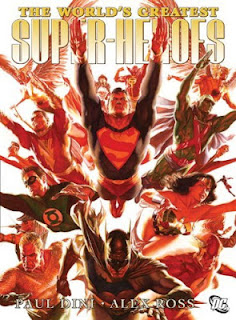
Review: World's Greatest Super-Heroes hardcover/paperback (DC Comics)

Người đăng: Unknown on Thứ Năm, 6 tháng 6, 2013

World's Greatest Super-Heroes by Paul Dini and Alex Ross[Guest reviewer Zach King blogs about movies as The Cinema King]

I've spent the past few months looking at DC's newest version of the "Greatest Stories Ever Told" trades, which sought to collect the best and the brightest of DC's most iconic characters. As far as iconic goes, though, you could do worse than Paul Dini and Alex Ross, the creative team behind The World's Greatest Super-Heroes, which collects the pair's six oversized graphic novels on top DC characters facing real-world problems.

While The World's Greatest Super-Heroes isn't a part of the twelve-book "Greatest Stories" series proper, both projects seem similar -- collect in one volume a snapshot of the characters that encapsulates the heart of who they are and why they're heroes. The latter is especially significant; aside from fleeting references, there's not a super-villain in the whole book.

Instead, each tale finds a hero faced with an everyday threat like hunger or poverty or just loneliness; these are stories, beautifully rendered by Ross's photorealistic paints, that recall the Norman Rockwell-esque "day in the life" chapters of Geoff Johns's JSA, catching the heroes on their more low-key days and positing interpretations so down-to-earth that they'd fit right at home in the hyper-realist Nolanverse.

The style of each is the same, with the stories functioning more like picture books than comics. Panel divisions are subtle and infrequent, allowing Dini's internal monologues to meander over Ross's lush artwork. It's not inconceivable to picture reading this book to a child before bedtime, and indeed some day I plan to do precisely that. Even for adults, though, there is much to enjoy in this surprisingly earnest and delightfully iconic book.

The sum of the parts being more than the whole in this series, let's take a look at what's inside this volume.

Superman: Peace on Earth (1998)

How else do you begin? One of my most treasured Christmas presents many years ago, Peace on Earth finds Superman recognizing the disparity between Christmas as a time of giving and the world as a place of great need. With the means to feed the entire world, Superman sets out to end world hunger. Tragically, it's a story that we know is doomed to failure, for the same reasons that Superman could only arrest Hitler and Stalin "out of continuity" in the pages of Look magazine. But it's also a familiar storyline, since we've seen Superman wrestle with his inability to do everything almost since his origin. What makes the story succeed isn't any originality of purpose but rather the compelling and earnest narration Dini writes for Superman; the prose passages which pepper Ross's paintings strike a proper balance between godlike Superman and humble Clark Kent, and we feel his shortcomings just as tangibly as we revel in his triumphs. The book is filled with new classic moments like Superman's descent from the sky with a Christmas tree balanced on his shoulder, and it's to Dini and Ross's credit that these moments never feel campy or anything less than genuine. Peace on Earth succeeds further by reminding us that the value of a superhero lies not in what he does but in what he motivates us to do; Superman's Christmas gift to us, in line with Grant Morrison's concept of Superman as the Ideal Man, is the example he sets.

Batman: War on Crime (1999)

If I had to list my top ten Batman stories from any medium, much of that list would include works authored by Paul Dini. Although I love Christopher Nolan's "Dark Knight Trilogy" to death, Dini's work with the character (both on television and in the comics) seems to touch something closer to the character's central nature, with every story being recognizable Batman-fare. War on Crime is a quintessential distillation of what I believe is the heart of Batman -- the pain of loss and the determination to prevent others from feeling that loss (as distinct from, say, Nolan's interpretation of Batman as a symbol to inspire positive change).

Aside from one-panel cameos from Alfred and The Penguin, Batman is the only recognizable face in this story, and his narration anchors the story in a voice which is clearly pained but with grim optimism coloring his action. Dini wisely keeps the action small, with Batman struggling against local crime and waging a battle for a young boy's soul in the process; it's a story that works well because of how uncompromisingly good Batman's quest is as he pauses mid-battle to offer a kind word of encouragement to a young man who has also lost his parents to gun violence. Alex Ross makes expert use of the shadows here, judiciously deploying streams of light to accentuate the hopefulness which is inherent in Batman's mission. Ross's photorealistic shadow play matches perfectly the tone of Dini's script, but Ross also does great work with Bruce Wayne out of the costume, making Bruce Wayne as much of a commanding presence as his cape-and-cowled alter ego.

Shazam!: Power of Hope (2000)

At first, the writing in this story seems odd, overly enthusiastic with too much gee-whiz for my tastes. But when a full-page splash reveals that the story is narrated by Billy Batson and not Captain Marvel (the hero currently known in the New 52 as the somewhat more cynical Shazam!), Paul Dini reveals that he's playing with narrative voice in a way the series hadn't seen before. And it's to great effect; the childlike exuberance of Captain Marvel's narration gives the story more weight when Captain Marvel volunteers at a children's hospital to restore hope. It's a story that probably wouldn't work were it not for Dini reminding us that Captain Marvel is still essentially a child.

Surprisingly, and to the story's credit, Alex Ross creates a Captain Marvel that is leaps-and-bounds more approachable than his Kingdom Come rendition of the character. His heavy eyebrows and wide grin carry none of the malice of brainwashed alternate future, instead posing like a child in front of a mirror after a muscle man marathon. Billy, however, sometimes looks too old, which takes some of the thunder (no pun intended) out of the shift in identity. The transformation scenes are staggering, however, and it's difficult not to feel a tugged heartstring or two when Captain Marvel realizes that he can't save everyone but can share the gift of hope with all.

Wonder Woman: Spirit of Truth (2001)

The fourth Paul Dini/Alex Ross pairing is somewhat stronger than the Captain Marvel one, in part because Wonder Woman's a more potent character with a clearer mission. Her role as "ambassador to man's world" has sometimes been a nebulous one, but Dini takes full advantage of it with Diana as a kind of goodwill tourist, assessing the world's problems from the vantage point of the disadvantaged. The character's compassion and dedication to the powers of good are so compelling that it's almost a disappointment when Clark Kent shows up, as if to say that Wonder Woman can't carry a story on her own. It's entirely untrue; her quest is more intriguing and more realistic than most in the book, and Ross's artwork steps up to match. His Wonder Woman is beautiful and majestic, the scenery striking, and her goals for humanity attainable. While I'm impressed with the "daughter of mythology" approach that Brian Azzarello and Cliff Chiang are bringing to the New 52 incarnation of the character, I didn't realize how attached I was to this version of Wonder Woman, and I'm glad to have such a nutshell encapsulation delivered by such able creators.

JLA: Secret Origins (2002)

It's a bit difficult to review this chapter as a separate entity, since it's equal parts warm-up for Liberty and Justice and two-page origins for the characters who didn't get their own solo books: The Flash, Green Lantern, Aquaman, Martian Manhunter, Green Arrow, Hawkman, The Atom, and Plastic Man, as well as a few second-stringers lumped in on a JLA origin page. They're concise and effective, but none is truly distinctive, aside from the Plastic Man page which plays with voice in the same way that Power of Hope did. That these are not distinctive is not a knock on the quality, however, but the Dini/Ross team has been turning in consistently good work throughout this volume, and Secret Origins is no exception.

JLA: Liberty and Justice (2003)

Surprisingly, and unfortunately, Liberty and Justice is the one book in this volume that never really works. In part, it's because the format is substantially different from the others; instead of relying on the interaction between narration and silent panels, Liberty and Justice is structured much more classically, with traditional speech bubbles competing with the narration boxes for attention. The result is that it's harder to focus on Alex Ross's gorgeous artwork; after a whole book of his work, I was eager to see his Justice League in full force, but too many overfull panels prevent the full effect from being felt.

What's more, we know that a Justice League needs a large threat to combat. What we get here is an odd plague which seems sinister and extraterrestrial but which disappointingly never manifests itself as anything more than a stubborn space flu. We don't, for example, get the Starro combat promised by the back cover; instead, it seems that the League is called in, overreacts, and then moralizes about their actions to a hostile United Nations. There are plenty of wonderful moments, as when Superman saves a suicidal jumper (anyone who knows me knows I'm a sucker for these kinds of moments, as in All-Star Superman or Young Justice), and it's not that the story is a dull read. But it's a disappointing note on which to end the book, two great creators who are turning work that is somewhat less than.

The World's Greatest Super-Heroes is padded out with pages from Alex Ross's sketchbook, most interesting when it details his process of photo referencing with shots of his models, and the book concludes with a few luscious gatefolds that this collector was too timid to tear out. It's a delightful package, a fantastic coffee table book on the order of Ross's Mythology, and despite its anticlimactic ending, it's a wonderful read.

I had purchased this book when the word "Flashpoint" was just another teaser word that signified another crossover I probably couldn't afford. But now that we're more than a year into the New 52, it's difficult to read this trade without your glasses seeming a little rosier. Love it or leave it, this interpretation of these characters is a thing of the past, and I can think of no better send-off than The World's Greatest Super-Heroes, a loving tribute by two master craftsmen.

This concludes the "Greatest Stories" series, but fear not -- I'll be back with more Criminal reviews and more very soon. Thanks as always to our gracious host and to the readers who've been following along!

More Greatest Stories reviews: Superman Vol. 1 and Vol. 2, Batman Vol. 1 and Vol. 2, Wonder Woman, Green Lantern, Flash, Justice League, Shazam, Batgirl, Superman/Batman, and Joker.
More about

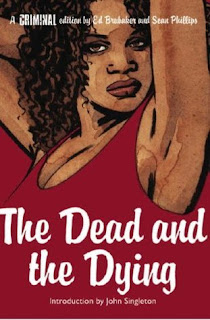
Review: Criminal Vol. 3: The Dead and the Dying trade paperback (Marvel Comics)

Người đăng: Unknown on Thứ Hai, 27 tháng 5, 2013

Criminal Vol. 3: The Dead and the Dying[Guest reviewer Zach King blogs about movies as The Cinema King]

On first glance, Criminal Vol. 3: The Dead and the Dying is a set-up for disappointment. The volume is short -- collecting only three issues -- though the editors have tried to obfuscate this by using noticeably thicker pages. What's more, this the third Criminal collection marks a soft reboot of sorts, with the single issues renumbering back to #1 (no, no Pandora cameo to be found).

What might turn off some readers is the fact that this trade collects three chapters billed as stand-alones, straying from the longer format of the first two volumes, which might lead readers to treat it less seriously. But as usually happens with these Criminal trades, The Dead and the Dying is a marvelous surprise that's almost impossible to put down.

What the book doesn't tell you right away -- and I almost feel bad revealing it here -- is that the three stories aren't stand-alones. Instead, they're interlocking parts of a larger story, and a great deal of the book's enjoyability comes from tracing the way these three stories are related. In the first, "Second Chance in Hell," we learn about boxer Jake Brown and his strained friendship with mob heir Sebastian Hyde. The second, "A Wolf Among Wolves," introduces Teeg Lawless, the father of last volume's Tracy Lawless, and explains how he came to work as an enforcer for the Hyde family.

The final story in the collection, "Female of the Species," fleshes out the character of Danica Briggs, the unlikely femme fatale who enmeshes herself in the book's events and turns out to be more human than any of her lovers know. "Female of the Species" pulls the book's threads together, explaining Danica's motivations and fleshing out her connections to Jake, Sebastian, and Teeg.

The most potent feeling channeled by this volume is that of epiphany. There are many moments of intersection among these three stories, moments when puzzle pieces click into place. Some take the form of repeated panels (almost outdoing Watchmen in this regard), while others fill in storylines the reader hadn't noticed. For example, in "Second Chance" Sebastian Hyde vows to find those who had wronged him, and in the next panel one such enemy turns up dead. But while readers fill in that Sebastian was the killer, "Wolf" reveals that Teeg was the triggerman, a clever and satisfying twist that deepens the shared universe feeling of Center City.

After reading The Dead and the Dying, I have to wonder if Brubaker has a master story in mind. Before this point, it seemed that Criminal was going the route of Sin City, with standalone installments set in the same gritty locale. But seeing how deftly Brubaker puts the pieces together here, I can't help feeling that there may be an overarching narrative developing. (Update: I've since discovered that there is an unwritten "final" Criminal story named Coward's Way Out, suggesting to me that the series is going to end where it began.) This book explains Teeg's coldness toward his sons -- a surprisingly touching moment rendered by the noirish narrator -- and backfills the rise of the Hyde family, pointing to an interconnectivity beyond the Undertow Bar (owned, of course, by Jake).

The artistic consistency on this title is not to be underestimated here. Sean Phillips returns for this volume, and I can't be happier about that. One of my only complaints about The Invisibles was the rotating artistic team which led to an overenthusiastic jam session and characters who could look wildly different from issue to issue (here's looking at you, Lord Fanny). So the continuity provided by Phillips is a welcome presence. Sebastian is instantly recognizable as a young man who will eventually grow up to become the crime boss from the end of Lawless, and the use of visual repetition reverberates throughout the book, echoing across pages when you least expect it. Criminal is subtler than his gory Marvel Zombies, but it's no surprise that Brubaker keeps him around -- Phillips is comics noir.

If I had doubts about the longevity of my interest in Criminal after Lawless failed to surprise me, Criminal Vol. 3: The Dead and the Dying restores my dedication to the series. Brubaker and Phillips prove that they continue to innovate, within both the crime noir genre and the comics form. Center City may be populated by the dead, but the series is alive and well.
More about

Review: Joker: The Greatest Stories Ever Told trade paperback (DC Comics)

Người đăng: Unknown on Thứ Năm, 23 tháng 5, 2013

The Joker: The Greatest Stories Ever Told[Guest reviewer Zach King blogs about movies as The Cinema King]

Up to this point, the "Greatest Stories" series has profiled the best and brightest of the DC Universe. But when the series takes a turn toward the villainous, it's in many ways appropriate that DC's most iconic villain gets the "Greatest Stories" treatment in The Joker: The Greatest Stories Ever Told.

Perhaps even more so than with Batman, it's a bit difficult to assess what makes a Joker story "great" since I'm a staunch proponent of Grant Morrison's theory that The Joker is "super sane," reinventing his personality almost every day; as such, it's not hard to reconcile a Joker who builds sandcastles with a Joker who guns down Barbara Gordon.

But perhaps it's just that the relationship between The Joker and Batman is (literally) so black-and-white that it's difficult not to create an interesting match-up between the two. As for the contents of this volume, it's safe to say that each story in here is significant in one way or another; there are no real duds, and readers new and familiar will get a strong sense of who this character is -- just in time for Scott Snyder's big Joker story "Death of the Family" over in the New 52's Batman title.

The sum of the parts being more than the whole in this series, let's take a look at what's inside this volume.

"Batman Versus the Joker" (Batman #1, Spring 1940): It's no surprise that we begin with The Joker's first appearance, but what is surprising is just how fully formed the character is While The Joker's creation has been a point of contention for Batfans, writer Bill Finger and artist Bob Kane both craft a dynamite introduction to the character who has, aside from a goofy period in the Silver Age, remained mostly unchanged. The story's formula is familiar -- Joker vows to kill prominent Gothamites -- but its familiarity points to its influence on numerous adaptations (including The Dark Knight and an Steve Englehart remake reprinted later in this anthology). Kane's Joker is more morose and of somber countenance than readers might be prepared for, but he's never unrecognizable as Batman's greatest foe.

"The Joker's Comedy of Errors" (Batman #66, August/September 1951): Here might be the weakest story reprinted in this collection, because it doesn't seem to have been chosen for its importance to The Joker's character -- there's no "first" in this story, nor is his plot against Batman and Robin particularly compelling. No, it seems the editors chose this story because of its popularity on the Internet for its repeated use of the word "boner." Of course, the word meant something entirely different in 1951, but that doesn't stop the occasional snicker -- even from this reader, who usually considers himself above toilet humor. Finger's plot is overly involved, and Lew Schwartz's art stockier and cheekier (literally, The Joker's cheeks are huge here) than most, but the tale is ultimately not a terrible one. It's just that the editorial insight here seems sophomoric at best.

"Joker's Utility Belt" (Batman #73, October/November 1952): The story begins with a full-page teaser splash by Dick Sprang, in which Batman and Robin are menaced by perversely large Joker heads springing from an oversized utility belt. It's one of the most iconic Joker shots ever drawn by one of the definitive Joker artists, and the story by David V. Reed introduces a gimmick that, while abandoned in later stories, amps up the dark mirror in which The Joker reflects Batman. The story is cleverer than I was expecting, finding unique ways to utilize the bizarre gags that pack The Joker's utility belt. And while I've lamented the fact that this series doesn't reprint full covers, the inclusion of the hydra-like Joker's belt is "great" enough.

"Crime of the Month Club" (Batman #110, September 1957): Dave Wood and Dick Sprang take The Joker into new territory with this story, which casts the Clown Prince of Crime as a criminal consultant, auctioning off his master plans to the highest bidder. The premise is intriguing and given sufficient attention despite the brevity of the story, and it plays up one of my favorite Joker traits -- he always has a back-up plan. This is no "dog chasing cars," but rather the master strategist he always lies about being. Sprang's art again is classic and cements the angular grin which is The Joker's trademark.

"Joker's Last Laugh" (Detective Comics #332, October 1964): It's hard to believe that The Joker's signature laughing gas wasn't introduced until 1964, but here it sees first light -- this time as a powder which is (spoiler warning) easily defeated by a strong antihistamine prescription. While Sheldon Moldoff's pencils here are less compelling than Sprang's (indeed, Sprang is a tough act to follow), he's quite good with facial expressions, a key skill to have in a story where characters frequently erupt into spontaneous laughter. And the story also includes the rotating jail cell gag, which sums up The Joker's whole relationship with law enforcement but also raises serious questions about the security of Gotham's police station.

"The Laughing Fish" / "Sign of The Joker" (Detective Comics #475-476, February -- March 1978): If we're excluding The Killing Joke (if only for reasons of length) and Mad Love (on the grounds that it's more a Harley Quinn story), this might be my favorite Joker story of all time, so I'm elated to see it included here. It's easily the "Hey Jude" of Batman/Joker stories, because it's included on every top list and performed at every available opportunity. I gushed at length about this Steve Englehart and Marshall Rogers story in my review of Batman: Strange Apparitions, but it bears repeating that these are near-perfect stories, even thirty-some years later. Here is The Joker's dead-serious attempt to copyright fish, his trademark entrance in a stretched panel surrounded by laughter, and his spooky and dogged pursuit of the copyright officials. But it's also a great Batman story, giving us a snapshot of the Dark Knight's life at this time, as well as providing a look at the state of Gotham City as a whole. The story echoes The Joker's debut with a series of announced homicides, and its adaptation into an episode of Batman: The Animated Series only reverberates its iconic and greatest nature. It's a story that every Batfan needs to read.

"Have a Dreadful Birthday, Mr. Joker" (Batman #321, March 1980): After "The Laughing Fish," any story might feel like a comedown, and unfortunately for Len Wein and Walter Simonson such is this case with "Dreadful Birthday." It's not that it's a bad story; there's no shift in tone with the oversized (notice a trend?) birthday cake to which The Joker's hostages are tethered like candles, and the exploding boat finale is probably the most familiar version of the classic "We haven't seen the last of him" trope. It feels familiar, but it might just be a chicken-and-egg case of a spot-on distillation of this kind of story. What's more, Simonson's Joker is a wonderful interpretation, even more elongated than Rogers's, if it can be believed. While I may be sad that we didn't get anything from The Joker's solo series, the inclusion of Simonson in this story might atone for that.

"Laughter After Midnight" (Batman Adventures Annual #1, 1994): Throughout this series of reviews I've been clamoring for more representation from the DC Animated Universe, so it's wonderful to see that interpretation of The Joker represented here. I've long contended that the Dini/Timm approach to The Joker is the best and most accurate in any media adaptation -- even including Heath Ledger's wildly original Joker -- and it's telling that I still hear Mark Hamill's voice in my head when reading this and every other story in the collection. This story finds The Joker making his way home after yet another ignominious defeat at the hands of the Caped Crusader. John Byrne apes the style of the DCAU so cleanly that I had to double-check the artist wasn't Bruce Timm. It's a great story, one that I missed in my days reading the original series, but it's also a perfect peek into the odd blend of dark humor and deadly evil that made this interpretation of The Joker so beloved -- and so great.

"New Year's Eve" (Batman: The Long Halloween #4, March 1997): One of the earliest Joker stories in the post-Crisis canon (being that The Long Halloween is essentially "Year Two," only The Man Who Laughs is earlier for my money), this story combines many of my favorite characteristics of a Batman story: a dead serious Dark Knight, an eccentric Joker with a lethally insane plan, Jeph Loeb's writing, Tim Sale's art, and snow. While the whole issue isn't reprinted, the parts relevant to the collection unite seamlessly, such that you'll be hard-pressed to find the edits without a copy of the original on hand. Sale takes The Joker's facial elongation to its absurd nadir, such that The Joker's chin dangles near his navel by the end of Dark Victory, but it fits within the cartoonized world of the story; Batman is similarly exaggerated, muscular beyond plausibility but unmistakeably our hero. Considered by many a definitive Batman story, The Long Halloween does justice to The Joker and ought to encourage readers who had never read it before.

"Case Study" (Batman: Black and White, Volume 2, 2002): Ah, Alex Ross -- it's been a while since we saw you around these parts. Here Ross teams up with Paul Dini for a classic Joker origin story -- classic in that it's entirely plausible but probably not true. Riffing on Batman '89, Dini and Ross cast pre-chemicals Joker as a cunning and ambitious mobster whose last days as The Red Hood only made him more audacious. It's a nice nod to The Killing Joke, too long to be reprinted here but undeniably worthy of the "Greatest" appellation, but Dini puts a new "multiple choice" spin on Joker's possible origin, which is too clever to spoil. Ross's artwork is, as ever, stellar, even in black-and-white; his Joker reminds me of Jack Nicholson, which couldn't be less of a bad thing.

"The Joke" (Batman #614, June 2003): It's been said that Batman: Hush, of which this is the seventh chapter, is a retelling of all the iconic Batman moments in one epic story. If that's the case, "The Joke" represents the moral issue at the heart of the Batman/Joker conflict: Should Batman kill The Joker? Writer Jeph Loeb uses his internal narration style to its maximum potential here, stepping inside Batman's head as he beats The Joker near death; using Batman's memory to cycle back to some of The Joker's most notorious moments. It's a tidy package that interrogates what separates Batman from The Joker, but as an entry in this collection it also encompasses stories (i.e., The Killing Joke and A Death in the Family) that were too long to be included but still immensely significant. And the superstar artwork by Jim Lee doesn't hurt, either; Lee plays with shading and line thickness to emphasize the emotional shifts between memory and reality. As a part of one of my all-time favorite Batman stories, "The Joke" is also a wonderful summation of this complicated relationship.

"Slayride" (Detective Comics #826, February 2007): After fully exploring the Batman/Joker dynamic in "The Joke," Paul Dini returns to the writer's chair with "Slayride," another Christmas story in which The Joker abducts Robin Tim Drake and holds him captive during a series of brutal holiday crimes. Don Kramer's artwork in particular stands out for how well he makes The Joker look insane and evil without compromising his more clownish features. Dini is the master of the one-and-done Batman story, having honed his craft on The Animated Series, and this story is both thrilling and unforgettable; it's not difficult to picture this as an episode of the cartoon, although it's more violent than fans of the show will expect. It is, however, a great note on which the book can close, showing us what The Joker is like in the modern era -- still spooky and still uncomfortably funny.

Up to this point, Shazam! The Greatest Stories Ever Told was probably my favorite "Greatest Stories" collection, with Superman/Batman: The Greatest Stories Ever Told as a successful close second, with neither book wasting a story and instead presenting a highly canonical approach to the character's (or team's) history. But now I'm almost certain that The Joker: The Greatest Stories Ever Told is my new favorite, in part because the character is so strong but also because the editors have really done a bang-up job acknowledging every major interpretation of the character while providing each of his most significant moments without reprinting some of his longer appearances.

Indeed, I can't think of a story that's missing, no glaring omissions that got short shrift here; the only major story absent is the O'Neill/Adams tale "The Joker's Five-Way Revenge," but that's reprinted over in Batman: The Greatest Stories Ever Told, Volume One. I can't kvetch about the DCAU not being represented, since the editors rightfully recognize that The Joker, more than anyone, became a star at the hands of Dini and Timm; on that note, though, I might have liked a bit more Harley Quinn in this trade, since she only appears only peripherally in three small appearances here. And the Grant Morrison fan in me can't help but wonder why "The Clown at Midnight" didn't make the cut, although it's either too weird or too recent to merit inclusion.

All told, The Joker: The Greatest Stories Ever Told is as near to perfection as this series ever came, hitting all the important beats without wasting pages on unrewarding stories. It's a first-rate primer on the character -- exactly what I wanted from this series -- and it's excellent for all readers who want to know what The Joker is really all about. Just don't gaze too hard into the abyss, lest ... well, you know.

We've reached the last of the official "Greatest Stories" collections, but there's one more entry in this review series. No, it's not a post full of my complaints about missing stories. For the final entry in this series, I'll be reviewing The World's Greatest Superheroes, a collection of the oversized Paul Dini/Alex Ross OGNs which seems to fit nicely as a coda to the "Greatest Stories" line. Stay tuned!

More Greatest Stories reviews: Superman Vol. 1 and Vol. 2, Batman Vol. 1 and Vol. 2, Wonder Woman, Green Lantern, Flash, Justice League, Shazam, Batgirl, and Superman/Batman.
More about

Review: Criminal Vol. 2: Lawless trade paperback (Marvel Comics)

Người đăng: Unknown on Thứ Năm, 16 tháng 5, 2013

Criminal Vol. 2: Lawless (Marvel Comics)[Guest reviewer Zach King blogs about movies as The Cinema King]

I came out of Coward, the first Criminal volume from Ed Brubaker and Sean Phillips, with a compulsion to seek out more crime comics, especially the ones by this creative team. The second volume, Lawless, continues developing the shared universe in which these stories occur with considerable inventiveness, but it is for a number of reasons an overall less entertaining read than its strong predecessor.

After a military scandal which led to his untimely departure from the service, Tracy Lawless returns to Center City to avenge the murder of his brother Ricky. All he knows is that his brother Rick was betrayed by a member of his own crew, so Tracy infiltrates the gang to learn the truth about his brother's death. But as Tracy takes Rick's place in the gang, he learns that his brother's past was more complicated -- and more twisted -- than he expected, even as his investigation leads him to the most corrupt of the city's real power brokers.

As a follow-up to Coward, Lawless has a very high bar to match; I was extremely impressed with Coward and quickly understood why the series was gaining high marks for originality. How, then, do you do an original sequel? Brubaker negotiates that territory by opening up a new corner of Center City rather than following up with Leo and the rest of the gang from the first trade.

If Coward was Brubaker's reexamination of the heist story a la The Italian Job, Lawless is his revenge film in the vein of Get Carter. But in Lawless, Brubaker doesn't do as much as I was expecting to subvert the genre. While he does play with expectations by making the case about who Rick actually was rather than who killed him, the central mystery of the triggerman is quite transparent; anyone with a passing familiarity with noir revenge films will probably spot the culprit right off.

But even a predictable Brubaker story is still a first-rate read. Tracy's voice is clearly different from Leo's, and the narrator is hard-boiled without clutching cliches in his teeth. More interesting, though, is the way that Brubaker plays with time in Lawless. Coward was more linear, its protagonists haunted by a past we dispensed with in the prologue, but in Lawless the book itself is haunted by an intrusive past that appears without warning, disorienting the reader and forcing us to restabilize the narrative.

Take the book's first page, which opens with Tracy standing over a dead body. A few panels later, we see the murder itself; by the end of the first chapter, we see the moments before the murder. This wibbly-wobbly approach to chronology is initially jarring, but it smartly helps us to understand Tracy's relationship to his past so that his surprising decision at the end of the book at least seems justified. It's clear that there is more to Tracy's story yet to be told, so I'm eager to see this character recur in the shared universe of Criminal.

Brubaker is again teamed with Phillips, and it's a peanut-butter-and-jelly partnership that makes absolute sense, like Morrison/Quitely, Lee/Kirby, and Moore/Gibbons. Phillips's use of shadows fits perfectly with the neo-noir vibe, cultivating a sense of danger melded with intrigue. His facial expressions are subtle and sketchy, expressive without too much distracting detail. Better still, each character has a unique look, with signature expressions that help the reader keep everyone straight while getting a sense of who's telling the truth and who's lying. At home both in the bedroom and in a shootout with the cops, Phillips's art solidifies itself as an essential component of the Criminal ambiance.

Though it doesn't break new ground in the same way that the first volume did, Lawless retains a readability that raises the profile of crime comics; I haven't read something as deceptively straightforward since Frank Miller's Sin City, with both doing exciting things in the realm of capeless comics. If the recent move toward creator-owned comics produces more books like Criminal, I'm all for it.
More about

Review: Criminal Vol. 1: Coward trade paperback (Marvel Comics)

Người đăng: Unknown on Thứ Hai, 15 tháng 4, 2013

Criminal Vol. 1: Coward[Guest reviewer Zach King blogs about movies as The Cinema King]

When I first began to read comics as a very young child, the lure was simple -- Batman. Get anything with Batman on the cover. I expanded my net as my knowledge of the characters increased. As I got older and my budget got tighter, I matured into seeking out specific creators -- first writers, then artists as my aesthetic palate became more sophisticated.

Now I'm at what might be a third age in my maturation as a comics reader; I'm deliberately and specifically seeking out creator-owned work. It's not a political move, strictly speaking, since the bulk of my pull list is still company-owned. But I'm now conscious of the freedoms afforded to creators who own their own work, and with many of my favorite creators moving there exclusively, I can feel my palate refining once more.

As a fan of Ed Brubaker's work, particularly on Gotham Central, and having "met" Sean Phillips in the Marvel Zombies series, I was excited to dive into Criminal, their ongoing crime noir. Gotham Central it ain't, but by the end of the first volume, Criminal Vol. 1: Coward, the series more than lives up to the hype.

Coward starts out as your typical heist story. After a bank job goes wrong, Leo is contacted years later by a few dirty cops who offer him the opportunity of a lifetime -- the time and location of black diamonds being transported out of evidence. With a bad feeling in his gut but owing a favor to Greta (the widow of a crew member on the bank job), Leo takes the job -- and regrets it as soon as the deal, inevitably, goes sour. On the lam with a wounded partner, a junkie Alzheimer's patient, and a suitcase full of the wrong loot, Leo reevaluates his position but vows to continue to live by the rules that have kept him alive so far.

Coward is one of those books that you need to finish in order to "get" it. I'll be perfectly honest: halfway through the book I almost put it down. "I can't do six volumes of this," I told myself. The book was full of cliches and heist narrative stereotypes (most of which I recognized, oddly enough, from Inception of all places), and I didn't see them being used particularly well. Strictly speaking, I'd never read a crime comic before, and Coward wasn't impressing me.

But when everything goes to hell right around the end of Chapter Two, Coward becomes impossible to put down. Brubaker reveals that none of the apparent cliches were performing as expected, and when he reduces the cast down to Leo and Greta for a few scenes we find that this is a noir with a heart as much as a gut feeling. All of a sudden I find myself just one more voice among many echoing how clever and ingenious Criminal is, but I can't help it; the book is infectious, provided you stick with it.

On art duties, Sean Phillips is doing solid, gritty work that recalls the best of Gotham Central. Phillips pulls no punches; this book is not for younger readers, and Phillips knows it. Blood sprays, scarred torsos, and drained corpses proliferate in this book, and Phillips captures all of them in stark visceral detail that'll make you cringe at least twice. It's apparently a great creative partnership; Brubaker thanks Phillips at the end "for drawing it the way I see it in my head," and if that's completely true it bodes well for the future of the series.

Though Criminal consists of mostly standalone stories in a shared universe, it's evident that Brubaker and Phillips are building a world and an accompanying ambiance. Though I don't fully understand the meta-levels of "Frank Kafka, Private Eye" -- a comic-within-a-comic a la Watchmen -- I do see that I'm reading a longer story than just the fate of Leo. More interesting are Leo's "rules," since any noir fan worth his or her snuff knows that an alternate code of conduct is what brings us back to noir. Leo's rules are self-centered, smartly so, the consequence of generations of thieves and pickpockets raising each other. And when the rules are broken, the story gets more twisty and more interesting.

It's gritty noir, yes, but it's emotionally compelling as well. Though Leo starts off as just another hard-boiled narrator, his attachment to the mentally-impaired Ivan humanizes him, as does his obliging devotion to Greta and her young daughter. Greta is perhaps more intriguing; Brubaker wisely avoids the femme fatale trope for this outing, instead opting for a much more compelling and more human character whose materialism is matched only by her maternalism.

And it's the mark of a great story that, when characters die, I'm sad to see them go. Dickens likened the relationship between book and reader to a friendship, and while the characters in Criminal: Coward aren't exactly buddy figures you become attached to them in very subtle ways. It's impossible to say when I made the shift from rolling my eyes at Leo to rooting for him; it's probably when he too realizes that he's in a different kind of plot altogether, but it's to Brubaker's credit that he doesn't write moments designed as "insert empathy here" scenes. Instead, the power of the story and Phillips's sympathetic pencils do the work for you.

All you have to do is keep reading. After a few pages, you'll find it impossible to stop.

[Printed on glossy paper, but without full covers. In a way, the lack of covers is a credit to the trade, since it encourages you to treat it as a graphic novel and not a "mere" collected edition. In short, this is a book that fosters the one-sitting read.]

Later in the week, the Collected Editions review of China Miéville's Dial H Vol. 1: Into You. Thanks!
More about

Review: Superman/Batman: The Greatest Stories Ever Told trade paperback (DC Comics)

Người đăng: Unknown on Thứ Năm, 4 tháng 4, 2013

Superman/Batman: The Greatest Stories Ever Told[Guest reviewer Zach King blogs about movies as The Cinema King]

Say what you want about DC's Trinity or the Big 7, but for my money the superhero team-up tradition that started with the Justice Society of America reached its logical apex when Superman finally met Batman nearly fifteen years after they debuted on the scene. Though their relationship has changed significantly since the Silver Age, this partnership is enough to make your average comics fan say, "Avengers, schmavengers."

Published in the midst of the highly popular team-up series that began with Jeph Loeb and Ed McGuinness's "Public Enemies" arc, Superman/Batman: The Greatest Stories Ever Told seeks to gather the best of the Man of Steel and the Dark Knight. And perhaps fittingly for a book centered around the World's Finest, this trade is one of the best in the series, hitting all the important notes and serving as a strong primer for what this partnership has looked like over the last 60 years. While some of the stories haven't aged very well, each justifies its own inclusion beyond the one-page introduction, and none is a wasted reading experience.

The sum of the parts being more than the whole in this series, let's take a look at what's inside this volume.

"The Mightiest Team in the World" (Superman #76, May/June 1952): Where better to begin than at the beginning? It's hard to believe it took almost fifteen years for Superman and Batman to cross paths in a shared universe, but Edmond Hamilton's script doesn't worry about why they've never met before. Indeed, the story doesn't worry much about how they meet; the gimmick with an illuminated porthole revealing secret identities is a stretch, but it lets the story focus on the working relationship that forms quickly between the two. The story's iconic nature is aided by the always-capable pencils of Curt Swan, and the wonderful concept is executed so well that it's telling to see the story paid homage fifty years later at the end of this collection (more on that in a bit).

"Superman's and Batman's Greatest Foes" (World's Finest Comics #88, May/June 1957): After the World's Finest teamed up, it was only a matter of time until the World's Foulest -- Lex Luthor and The Joker -- did so as well. Hamilton's back on story duty, and this one is a bit more paint-by-numbers than its predecessor: Lex Luthor and The Joker wreak nefarious mischief by pooling their resources, confounding the World's Finest by seemingly going legitimate and inventing cybernetic Mechano-Men. Though the story doesn't break new ground like its predecessor, kudos to Hamilton for keeping me guessing on what the two were actually up to. Dick Sprang's artwork is more cartoony than Swan's, especially his Joker's elongated face and brutally high shoulders. Ultimately it's an important story, and a well-told one, at that.

"The Composite Superman" (World's Finest Comics #142, June 1964): Hamilton and Swan (the World's Finest in this collection?) reunite to create the foe who is most recognizably a Superman/Batman rogue, The Composite Superman -- half Superman, half Batman, and with all the powers of the entire Legion of Super-Heroes. Coming from a reader who was only aware of the Composite Superman as the large rocket built by Hiro Okamura in Superman/Batman: Public Enemies, finding out the "secret origin" (as it were) of this character was a real treat. The story isn't entirely successful, relying a bit too much on keeping the audience in the dark in a ham-fisted kind of way, and while the conclusion falls a bit flat, the introduction of the character is iconic in its own right and serves as required reading for any Superman/Batman aficionado.

"The Cape and Cowl Crooks" (World's Finest Comics #159, August 1966): I imagine one of the hardest challenges in a superhero team-up is finding a foe worthy of a combined effort; The Avengers had to go intergalactic with Loki and the Skrulls Chitauri, but in this story Hamilton and Swan go for the hat trick with the Anti-Batman and Anti-Superman collaborating to . . . well, it's not really clear what they're after. They deliver toys to the prisons of Metropolis and Gotham, and they lead the World's Finest on a merry chase, but they're not a major threat. The visual gimmick of wearing modified costumes of their opponents probably locked them into this collection, but the ending is, like most Silver Age stories, extremely predictable and more than slightly gimmicky. This is really the only story that doesn't work on at least some level, and one wonders if there's more potential in these two characters than is employed in this one-off.

"The Superman-Batman Split" (World's Finest Comics #176, June 1968): I've no doubt that this story is in the collection because it's illustrated by Neal Adams, arguably the artistic master of the post-Silver Age DC Universe. It's unfortunate, then, that the editors chose not to reprint the original artwork but opted instead for Adams's more recent altered versions, which are inked more heavily and with less grace than the originals (there are, interestingly enough, entire sites dedicated to scanning unaltered Adams artwork). The story by Cary Bates, in which multiple aliens split the allegiances of Superman and Batman, isn't entirely engaging; its major twist is a touch predictable, but it's great to see Batgirl and Supergirl joining the World's Finest with Robin and Jimmy Olsen for a regular Justice League of Awesome. The story is infectiously fun and multiplies the action -- a trend I've noticed throughout this volume -- but I can't help but feel that the original inks by Dick Giordano have been distractingly overwritten to the detriment of the reader.

"A Matter of Light and Death" (World's Finest Comics #207, November 1971): This story posits an interesting question -- can Batman stop Clark Kent from taking out a hit on Superman? It's a head-scratching premise by Len Wein, who pitches an incredibly original concept in this story, and even though the execution is a bit too protracted to be truly exciting, the central mystery will likely keep readers engaged. (Pay very close attention, though; the answer of why Clark Kent wants Superman dead is delivered in one quick panel in the midst of a long monologue.) Dick Dillin's artwork is effective but didn't distinguish itself to my eye the way that Adams or Swan did earlier (or Byrne and Sale, later). While the master villain is difficult to take seriously in a post-mindwipe world, the threat posed to Superman is tangible enough that Batman's involvement feels invaluable.

"One Night in Gotham City" (Man of Steel #3, November 1986): Now this is what I'm talking about. When I started reading comics, this was my first Batman/Superman team-up, and its inclusion here is practically a given. As an older reader, I realize now just how hard John Byrne is working to distance the post-Crisis World's Finest from the Silver Age's "super best friends" approach (including a cute wink at being friends "in a different reality"), but Byrne's efforts pay off in this creation of a new and starkly original take on the world's greatest partnership. Superman is, if it can be believed, more earnest than ever, and Batman is shady and suspicious without being the distrustful caricature that appeared in most post-No Man's Land tales. The art, too, is elegant, bespeaking just how influential Byrne's Superman reboot was to the pre-Flashpoint DC Universe. Heads up, Warner: if there's to be a Superman/Batman film after Man of Steel, "One Night in Gotham City" is the perfect place to start.

"A Better World" (Batman & Superman: World's Finest #7, October 1999): This story, written by Karl Kesel and illustrated by Peter Doherty, was part of a maxiseries (I still remember the in-house ads from monthlies at the time) which placed the post-Crisis World's Finest at important moments in DC continuity; here we check in just after Superman returns from Exile and while Batman mourns the death of Jason Todd. It's a time of quiet and reflective transition for both heroes, with each pondering the nature of their "no killing" rule, and Kesel nails the tense dynamic between two men who are too strong to admit how wounded they are but who know they can rely on each other for support without asking. The art by Doherty is a little weird; Bruce and Clark's faces look too similar out of costume, and a panel with The Joker looks like a bizarre comical anticipation of Lee Bermejo's Joker. But Kesel's script is the draw, finding compelling dialogue between the two with nary a super-crisis in sight. After reading this story, I'm sorry to see it's so hard to find; hopefully it's in the reprint rotation over at DC, especially after the Dave Gibbons miniseries of the same name was recently reprinted.

"When Clark Met Bruce" (Superman/Batman Secret Files 2003): It'd be blasphemy not to include anything from Jeph Loeb's run, and this one-off two-pager introduces Loeb's narration style over a story about how young Clark Kent almost met young Bruce Wayne. It's a storyline comics have always flirted with -- Jor-El met Thomas Wayne in a later issue of Superman/Batman, while Clark met Bruce after winning some kind of 1920s contest in Generations -- but this story, illustrated by Tim Sale in top Superman for All Seasons mode, demonstrates just how far apart these two men began life; it's sold by some great coloring by Mark Chiarello. While it might be a bit of a surprise pick, considering how important much of Loeb's Superman/Batman work was to continuity, it's a small treat which puts a different spin on the World's Finest.

"Stop Me If You've Heard This One . . ." (Superman/Batman Annual #1, December 2006): The book closes with a retelling of "The Mightiest Team," recasting Superman and Batman's first meeting aboard that cruise ship as a high-stakes multiversal assassination scheme, with the Crime Syndicate, Deathstroke, and . . . Deadpool? Joe Kelly and a jam session of artists spend so much time winking at continuity and company crossovers that it's difficult not to have a little bit of fun, and having just read the story on which this is riffing the reader gets even more out of the experience. While the story is almost assuredly out of continuity, the tone Kelly sets never lets that be troubling; in fact, the revelation of just how this story "happened" is a real crowd-pleaser. In short, it's a fun way to end the book and show us just how far these two have come since their "first meeting."

If there's one thing true about comics fans, it's that we can always find something to complain about. With that in mind, there are a few stories that might have been included here -- or which could comprise a second volume. Segments from The Dark Knight Returns or Kingdom Come could prove interesting in relation to Byrne's "One Night in Gotham City." I'm partial to the team-up from The Batman Adventures #25, in which the "Super Friends" take down Maxie Zeus and ginger clone Lex Luthor, and the precedent set by the Shazam! collection makes it not unfeasible. And even though I knocked the Trinity in my introduction, there's probably room for a Trinity story in here showing how Wonder Woman's presence affects the dynamic between the two.

But if my biggest complaint about the volume is that there's more good stuff out there, the editors have done a rather fine job, particularly because it makes me want to read more rather than just complain about what I don't have; indeed, I'll be first on the pre-order list if DC decides to release a second volume. Unlike many of the collections in this series, Superman/Batman: The Greatest Stories Ever Told benefits from a strong historical focus and hits all the major iconic moments. It's a great read for fans old and new, especially in light of the success of that other superhero team-up from last summer.

Next time around, justice takes a holiday as the Clown Prince of Crime steals the stage in The Joker: The Greatest Stories Ever Told. Stay tuned!

More Greatest Stories reviews: Superman Vol. 1 and Vol. 2, Batman Vol. 1 and Vol. 2, Wonder Woman, Green Lantern, Flash, Justice League, Shazam, and Batgirl.
More about

Review: Batman: The Greatest Stories Ever Told Vol. 2 trade paperback (DC Comics)

Người đăng: Unknown on Thứ Hai, 31 tháng 12, 2012

[Guest reviewer Zach King blogs about movies as The Cinema King]

After Superman got his sequel, Batman's back with Batman: The Greatest Stories Ever Told, Volume 2. You'll recall the first volume was something of a success for me, with a strong Bruce-or-Batman theme holding the book together, and in some ways a second Batman book is more unsurprising than the second Superman volume.

Unfortunately, Volume 2 doesn't have a strong unifying hook like the question of his identity in Volume 1. What the book does have, however, are a few odd editorial choices (a recurring problem with this series) but many very good stories that, while not first choices for "greatest," still prove entertaining reads for the discerning Bat-fan.

The sum of the parts being more than the whole in this series, let's take a look at what's inside this volume.

"Secret Origins Starring the Golden Age Batman" (Secret Origins #6, September 1986): Rather than simply dive in like the second Superman trade did, and rather than reprint the first origin story -- and recognizing, perhaps, that Year One is unexcerptable -- the editors choose this offbeat tale which delivers the origin of the pre-Crisis Batman of Earth-Two. Roy Thomas selectively retells the first Batman stories, playing up Bruce Wayne's theatrical training and his love affair with Julie Madison; the update works, retaining some of the original lines (especially my favorite, "A fitting end for his kind") with Marshall Rogers lending decidedly more modern artwork to this strong retroactive origin story. Smartly distinguishing itself from Year One, "Secret Origins" is a surprise but ultimately wise choice to open the book.

"Professor Hugo Strange and the Monsters" (Batman #1, Spring 1940): The stalwart of Arkham City, Hugo Strange, makes his first appearance in this story, which is a good representative sample of Batman's Golden Age -- evil scientists, horroresque beasts, Batman's own inventive gadgets, and the Dark Knight's cavalier attitude toward killing his foes ("He's probably better off this way"). Bill Finger's story is still entertaining but doesn't quite live up to the Matt Wagner remake Batman and the Monster Men, in part because Bob Kane's artwork, while stubby and unrefined in a nostalgic way, is crammed into panel structure that is both puzzling and frustrating. Additionally, the story isn't quite fulfilling because it ends on a cliffhanger, but as a first encounter with one of Batman's greatest foes the story almost makes up for its faults.

"The Career of Batman Jones" (Batman #108, June 1957): This is one of my favorite Silver Age stories, and whenever a friend balks at my idea to name my firstborn son "Batman" this is the story I cite. Recently reintroduced to pre-New 52 continuity in Battle for the Cowl, Batman Jones decides to take up his namesake's crusade against crime and actually gets in a bit of training with the Caped Crusader and Boy Wonder. While Finger's story wraps a bit too quickly for my tastes, Sheldon Moldoff's artwork is quintessential Silver Age, with wide eyes, dimpled cheeks, and strong shoulders. It's almost a shame that this character was only used this once, since the story is so enjoyable.

"Prisoners of Three Worlds" (Batman #153, February 1963): If only because it wasn't included in The Black Casebook, I'm grateful to see this reprinted, and it's a good counterpoint for "Robin Dies at Dawn," which was included in the first Batman volume, in that both are (ostensibly) Batman's most famous encounters with the Silver Age's extraterrestrial population. While the science behind this story is tricky at best (I had a difficult time tracking which space-rays did what to whom), the concept by Bill Finger is intriguing and literalizes the mind/body dynamic examined in the first trade. What this story is most remembered for is likely the emotional moment between a dying Batman and Batwoman; though it's brushed away by a rather sexist final panel, Grant Morrison wasn't wrong in picking up that there was certainly something deeper with Kathy Kane. A hokey story, but saved in its earnest execution.

"How Many Ways Can a Robin Die?" (Batman #246, December 1972): Unfortunately, this Frank Robbins tale is rather forgettable, such that I forgot, in writing this review, that it wasn't "Robin Dies at Dawn." The inclusion of this story in this volume seems to be a kind of wink/nod at the perennial peril in which the Boy Wonder has been placed over the years. Here Batman is tricked into chasing wax dummies of Robin into death-traps, but the villain is never quite compelling, nor is his plot ultimately intelligible. A better choice might have been "Daughter of the Demon," a similar Robin-in-danger story which introduced a certain Demon's Head to the canon.

"The Batman's Last Christmas" (The Brave and the Bold #184, March 1982): I mused in the last review that Batman seems oddly at home in Christmas stories, and here the editors test that theory again but layer on a multiversal wrinkle by teaming Batman with the Huntress of Earth-Two, his own daughter/niece (however you want to reconcile their relationship). While it's an interesting idea to team these two, the case they investigate is overly complex but with a surprisingly simple answer; the real problem is that this doesn't quite feel like our Batman. He doesn't mind being called "Uncle Bruce" while taking down a mugger (shouldn't this be a superhero faux pas?), and he quits the heroing game without investigating claims of his father's corruption. While the Jim Aparo artwork is strong, Mike Barr's story never quite catches on, but then I was never a fan of Year Two either.

"All My Enemies Against Me!" (Detective Comics #526, May 1983): If the Batman "Greatest Stories" trades have seemed a little light on the famous Rogues Gallery, this oversized story more than atones for that sin of omission (as does the fact that The Joker gets his own Greatest Stories volume). Orchestrated by The Joker (and writer Gerry Conway), all your favorite rogues team up to take down Batman once and for all. Really, other than Ra's al Ghul and any character created post-1983, they're all here. At first, it seemed that would be incentive enough to include this as a "Greatest Story," but the story quickly becomes more important once you realize that the young boy helping the Bat-family is Jason Todd ...  and his parents are the ones spying on Killer Croc. Don Newton's artwork is gritty but a real treat to see what he does with each of the villains. "All My Enemies" is a surprise inclusion, one that probably wouldn't have made my personal list, but it's one I'm more than happy to have in my collection now.

"Of Mice and Men" (The Batman Chronicles #5, Summer 1996): I'm a fan of Alan Grant's work and Scott McDaniel's art, but there's something about this story that never quite feels right. Here we have Alfred bonding with a young Bruce Wayne over -- what else -- comic books and what it means to be a hero. But there are problems; Alfred is too glib about his calling, and Bruce's pivot from last angry boy to champion of the oppressed never feels natural. While it's not a bad idea to include stories where Bruce Wayne is the ostensible star (last volume did it quite well with "24/7"), there must be better stories out there than this one, which closes on a groan-worthy forced reference to the inevitable fate of the Waynes.

"Cave Dwellers" (Batgirl: Year One #4, May 2003): Here's a choice that's curious on several levels. For one, it's a Batgirl origin story, which leads me to wonder why it wasn't included in Batgirl: The Greatest Stories Ever Told. For another, Batman's a peripheral figure at best; there's even more Boy Wonder than Caped Crusader. But on one more level, the story serves as an interesting counterpoint to "Batman Jones," in that here we see how Batman has evolved from the Silver Age's avuncular father figure with a man-cave full of cool gadgets to today's highly distrustful guardian of his city who has a lethal-response training room in his basement. That said, it's asking a lot for the reader to intuit why this story and not some more apparent choice. I'm a huge fan of Batgirl: Year One, but I can't help feeling this trade would have benefited from a more Batman-centric choice.

"Citizen Wayne" (The Batman Chronicles #21, Summer 2000): Who knew Brian Michael Bendis ever wrote a Batman story? Or ever worked for DC, for that matter? Best known as the guy who reinvented Spider-Man in Ultimate fashion for the House of Ideas, Bendis remodels Batman as a Citizen Kane homage, with Wayne as Kane, and familiar faces like Jim Gordon, Dick Grayson, Selina Kyle, and The Joker filling in roles from Orson Welles's masterpiece. At six pages, the story is economically tight, and the levels of allusion demonstrate one of my favorite elements of the Batman mythos -- just how malleable the subject matter truly is, how the "idea' of Batman always works regardless of the setting.

Are these the greatest Batman stories ever told? In short, no, but then the honest-to-goodness greatest stories -- Year One, The Killing Joke, The Dark Knight Returns, and any of the long story arcs from the "triangle era" -- wouldn't fit in a single trade with other stories beside. In fact, I'm not sure that this volume is better than its predecessor; some of the stories are less memorable, and some aren't quite Batman stories. But as a "runner-up" volume, it's not all bad. There's plenty to like, although there are still a few stories I'm sorry to see didn't make the cut.

For one, I'm flabbergasted that "The Man Who Falls" is missing from these trades, since it meets all the apparent requirements -- brief, iconic, and not widely reprinted (you'll have to go to either the Batman Begins trade or Secrets of the Batcave). And after seeing the DC Animated Universe represented in other "Greatest Stories" collections, I'm sad to see no love for that era in the Batman trades, particularly since I know I can't be alone in thinking that those comics contributed to what was for me one of the definitive portrayals of the Dark Knight. It was recently pointed out to me that Jeph Loeb and Jim Lee's Hush is essentially "Batman: The Greatest Stories Ever Rewritten" with every classic Batman moment included (the fight with Superman, the death of a Robin, the moral dilemma of killing the Joker), so it's a bit surprising not to see it represented, either.

But all told, I'm a sucker for Batman stories, and so I'm inclined to give Batman: The Greatest Stories Ever Told, Vol. 2 a thumbs-up as I did with the first volume. Certainly the lack of a thematic link allows a few oddball choices to slip through, choices which might have made more sense if we'd been given an introduction to answer the question, "Why these stories at this time?" But none of these stories ever dips below the level of forgettable; there's nothing offensively bad (i.e., Lovers and Madmen) or ridiculously out-of-character (The Dark Knight Strikes Again), and even casual Bat-fans will find something to enjoy in this trade -- and I'm betting it's "All My Enemies," the surprise hit of the collection.

Next time, we get our second team-up of the series when we take a closer look at the Worlds' Finest partnership in Superman/Batman: The Greatest Stories Ever Told. Stay tuned!

More Greatest Stories reviews: Superman, Batman, Wonder Woman, Green Lantern, Flash, Justice League, Shazam, and Batgirl.
More about