Hiển thị các bài đăng có nhãn David Finch. Hiển thị tất cả bài đăng

"Who Will Tell Me What I Need To Know?" - Last Thoughts On The Avengers, Brian Michael Bendis, Character, Dialogue and Counter-Point (Part 8 of 8)

Người đăng: Unknown on Thứ Sáu, 14 tháng 1, 2011

1.

I chose to discuss "The New Avengers" # 11 not because it's a typical example of Brian Michael Bendis's work on the franchise, but because in many ways it's not. In truth, and for reasons which we've already begun to discuss, it's a profoundly untypical example of a BMB Avengers script. After all, a simple majority of the pages that Mr Bendis has written for the various Avengers titles are fundamentally straight-forward and paternalistic. Those elements of experimentation and decompression which some choose to see as markers of Mr Bendis's style as a whole are in truth less representative of his work in toto than we're often told.


Yet even in its most taxing, post-modern and unpaternalistic form, as in much of "Ronin Part 1", I'm convinced that Mr Bendis's work is deliberate, controlled and often largely successful in its designs. In particular, I'd argue that the characterisation in The New Avengers # 11 is every bit as distinct and consistent as the writer's most trenchant of critics would argue that it's not.

It's an opinion that can be discussed with reference to the 5 page, slow-moving scene between Matt Murdock and Steve Rogers in the comic, which at first sight seems to be an awful indulgence of talking heads, text-saturated panels and stiff storytelling, and which yet ultimately turns out to be something far more valuable indeed.


2.

If I've learned anything from the writing of these past few pieces on the Avengers, it's that the way in which a comic book succeeds or not in telling a story can rarely be understood with reference to one or two particular components isolated from the work as a whole. We discussed, for example, how Stan Lee's characterisations were charmingly convincing when presented within the context of his work with Jack Kirby, despite the fact that there were on occasions problems with the consistency of the voices that he gave some of his characters. But that those problems exist in "The Coming Of The Avengers" is, in many ways, irrelevant, because what matters is how the various constituent parts of the comic book work together to create an overall effect.

And if we can accept the validity of the storytelling principles which, working in combination, constitute "paternalism", then Stan Lee and Jack Kirby's "The Avengers" # 1 is surely a splendid piece of work, regardless of any flaws which might be revealed if the comic is held up to this analytic principle or that.


Yet, sometimes I wonder whether the very presence of the non-traditional and even post-modern aspects of Mr Bendis's work obscures for some the value of the mainstream comic books he writes. Even now, almost a decade on from his first appearance as a scripter of a conventional superhero title, the very presence of those divergences from the paternalism which has marked the superhero genre since 1938 can muddy the purposes to which his innovations are put. So many of us, and I include myself here, for I don't always find this business easy, are so habituated to paternalism that we register anything that doesn't sit with the familiar paradigm of traditional storytelling as unwelcome, as an indulgence, as laziness, as even constituting a mark of disdain towards the audience.

Now, I'm not arguing that the breaking with paternalism in many of today's superhero books is always done for good reasons and to good effect. But where Mr Bendis's work is concerned, it just can't be said that he's unable to write in the paternalistic style, or that his innovations with it are careless and artless. We know that's not true, for we've seen him deliver issue after issue of often traditionally-styled and usually bestselling superhero books over the past decade, and only a critic who insists that everything should be produced solely for their own taste could fail to respect that achievement. And so, when Mr Bendis does break substantially with the broad principles of storytelling exemplified by Stan Lee and Jack Kirby's "The Coming Of The Avengers", it's worth asking why he should be doing so, rather than assumming that he's failing in some spurious responsibility to work within the tried-and-trusted narrative tradition established in the Marvel Comics of the early Sixties.

"Ronin Part 1" is certainly not a traditional, paternalistic comic-book. But everything's that on display in its pages is there for a reason, for a specific purpose. It's not a haphazard conceit, but a different and equally valid approach. And rather than judging it for what it's not, for the degree to which it doesn't do things as Stan'n'Jack did, it ought to be valued for what it does achieve, and for how very well it does so.


3.

Firstly, I thought we might consider the issue of characterisation in the duologue between Matt Murdock and Steve Rogers in "Ronin Part 1", and the value of the dialogue that Mr Bendis uses to ensure that each of the superheroic alter egos on display is quite distinct and individual in comparison to the other.

And, to start with, it ought to be said that there is indeed a great deal of dialogue in this scene, and that it's the sort of concentrated wordage which can lead to Mr Bendis being labelled as a "wanna-be screenwriter" who yet fails to ensure that his readers can clearly tell one individual on display from another. Mr Bendis, we're so often told, is in love with the lines he creates for his characters to such a degree that he forgets to edit his rambling in order to ensure that his readers always know who's talking, and why they're saying what they are.

If that were so, then it's hard to grasp how Mr Bendis should have done such a fine job of keeping the distinct characters of Murdock and Rogers so clear and recognisable across the often densely worded panels of this five page exchange. After all, it can't be argued that Captain America and Daredevil have such immediately distinct personalities and voices anyway when they're out of the character-sharpening focus of their costumes. and that's especially true as far as their dialogue is concerned. In truth, as with most of the superheroes who's identities were initially fixed in the early-to-mid Sixties during the Marvel Revolution, each superhero has a great deal in common with the other, and that's a process that's in part continued ever since. For while we might feel confident that we could identify a sentence that, for example, Matt Murdock wouldn't say, can we be so sure that we know what he would say in a particular situation. Do we know what verbs and nouns Steve Rogers is more likely to use than Matt Murdock? Have we a fixed and trasnparent grasp of the way Rogers and Murdock express themselves, or in truth, us everything really rather more conditional and subjective?

How to tell the two of them apart? They're both working class kids from New York brought up to show respect to others, they're both rather melancholic, perplexed and yet determined individuals, often to the point of obsession, and it can't be said that either of them has a well-developed and pronounced sense of humour when in the presence


of acquaintances. More challenging yet, neither carries any extremes of dialect or vocal idiosyncrasies of the kind which would permit one to be told immediately from the other in the way that, for example, Reed Richards and Ben Grimm can be, or Thor and the Hulk. They're not even truly differentiated by extremes of class, both having risen in the world considerably since their youth, and now that Rogers has apparently adapted so completely to the present day that the language of the Forties has fallen from him, why, what is unique about these people? In truth, any scene which places Matt Murdock and Steve Rogers together, out of costume and away from jeopardy, will by its very nature pose the writer considerable challenges where the business of making each character appear to be quite immediately different from the other while staying true to themselves is concerned.

Of course, the paternalistic tradition would suggest that much of this problem could be side-stepped by simply showing both characters in action while wearing their various costumes. A clear difference between the personalities of Captain America and Daredevil might in such a way be far easier to establish. They could discuss their concerns as they punched their way through a fight scene with, say, robots, or during a roof-top be-costumed stake-out. But, as we'll soon discuss, the structure of "Ronin Part 1" as a whole requires both characters not to be shown in costume, not to be shown in action, and not to be shown in anything other than a public, open environment. Furthermore, as we've discussed before, the scenes in the book which aren't concerned to show Ronin's adventures in Tokyo from the perspective of a deaf woman are designed to serve in counter-point to Maya's experience of the world, to be full of sound, crammed with words, conversations, human beings communicating with ease without having to focus one on the other, and so on. All of these formal requirements greatly limit what Mr Bendis and Mr Finch can show here, though I hope you'll agree that such writerly conceits are made entirely worthwhile when the achievement of the scenes of Ronin in Japan are considered.


Working within such constraints, Mr Bendis can't afford to let his characterisation slip to the degree that Mr Lee's did in "The Return Of The Avengers". He has to use dialogue alone to create distinctive, separate characters, and he has to do so in panels designed to be still and word-heavy. If he doesn't, Ronin's adventurous sojourn overseas loses much of its force, because it would no longer stand out in such total contrast to every other scene which frames it. And, just to add more complications to the problems Mr Bendis faced when writing this scene, he's denied by the conventions of modern-day comicbook scripting the opportunity to produce the most purple of dialogue so as to paint, for example, Steve Rogers as a cornball patriot and Matt Murdock as an entirely self-obsessed vigilante. Though the contemporary writer of superheroes still has the freedom to create character with relatively broad brush-strokes, creating believable personnas for Murdock and Rogers in this scene with the kind of pulp-era conversations which Stan Lee used so effectively in "The Coming Of The Avengers" is denied to Mr Bendis.


4.

Admirably, Mr Bendis's dialogue never shirks the fact that these characters are in many way rather similar where their speech and behaviour is concerned in a situation such as that shown. He accepts that both Murdock and Rogers are terribly serious and doesn't try to pry the two personalities apart by artificially making one behave in an untypical fashion. To be frank, these are dour men when they're engaged upon the business of their costumed profession, and suddenly deciding to create a convincingly jovial personality for Steve Rogers would never work.
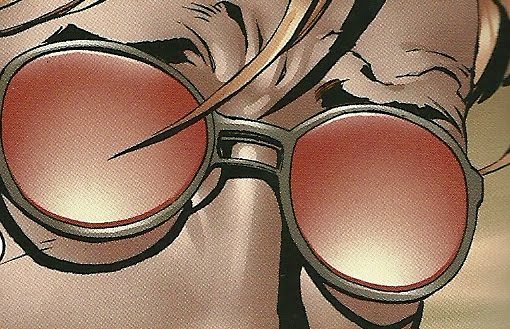

Instead, there are three main ways in which Mr Bendis creates consistent difference between these two superheroes. The first is that he works from the fundamental premise that both Daredevil and Captain America are in essence moral actors. They both view themselves and their actions in terms of different but quite coherent sets of principles. (They might not be entirely rational principles, especially in Daredevil's case, but they are coherent.) Murdock is of course a somewhat lapsed Catholic, and Rogers is an old-school Republican democrat and patriot. When both men act and speak in this conversation, therefore, they do so with reference to beliefs beyond their own likes and dislikes, beliefs which in fact ground and inform their likes and dislikes. So, where Murdock is concerned, his fundamental drive is to avoid being morally culpable for harm done to others. As he tells Rogers;

"There is no way on God's green planet I will put you, Peter Parker, Luke Cage and the others in my line of fire. I will not do it. Because even if we saved the world from an alien invasion ... saved every life on the planet in a flurry of heroism not seen since the days of mythology ... and Jesus himself came back and joined the team .... the next day all of you would be sucked under a bus ... just for knowing me. I can't do it."


In essence, Murdock is as selfish as he can be, because he's claiming the right not just to control his own destiny, but those of others who would most probably quite happily choose the being-sucked-under-a-bus option if they could save the world in doing so. He's so obsessed with the weight of his own guilt that he fails to notice that by not joining the Avengers, he's committing a sin of omission, permitting evil to triumph because he failed to act. A better Catholic might understand that all choices are tainted, and that the lesser evil is sometimes the necessary one to opt for.

By comparison, Cap's essential democratic pragmatism is constantly counter-pointed with Murdock's individual-minded, Catholic obsession. It's notable that Rogers constantly articulates what the current state of play is and the immediate problems at hand, while Murdock races off down tenuous chains-of-consequence. Rogers wants to solve problems, not create ideal worlds, and so he's a creature of compromise where Murdock exists informed by religious ideals that only he can apparently negotiate, the ultimate protestant in a catholic's guise. When Daredevil is quick to declare what he can't do, Captain America responds camly and repeatedly with the question "What can you do?" And when Murdock explains that his conscience will not allow him to act as Daredevil, Rogers's humane response is not to challenge that, since freedom of conscience is an American right and virtue, but rather to suggest alternatives. Most tellingly, that alternative is explained in terms relevant to Rogers's own beliefs, referring as he does to "this flag and this country" just as Murdock is quick to reference, apparently without realising it, "God's green planet" and "Jesus".


Secondly, Captain America and Daredevil are shown to be separate individuals by their manner. Rogers expresses himself with the politeness and even deference owed to another member of the community who isn't an intimate acquaintance. In doing so, he refers to Daredevil as "sir" and "Mr Murdock". And when he does decide that its productive to express himself, he limits what he states to concrete summaries of events and definite proposals. He never attempts to impose his will on Murdock, either through his words or his body language. Murdock, on the other hand, is quick to try to dominate the conversation and always presumes that their discussion must be phrased and understood in terms of his own preoccupations. He doesn't wait for Rogers to explain why he's suggested a meeting, for example, but launches straight into "If this is about me joining the Avengers again .. my answer remains the same ... ". Rogers's manner assumes that there is a common solution which both can not only subscribe to, but which both will want to reach. Murdock has already assumed the worst, defined how he's going to cut it off at the neck, and is already defensive about what it is he assumes the conversation will be about. He bristles with a controlled but corrosive despair, forever looking forward to situations which he cannot control but which are his fault, while Roger's calmness comes from a level-headed, solutions-focused approach to life. He knows what his tools might be, he has a sense of what his goals are, and all he's concerned to do is to negotiate the most sensible path between the first and the latter.


Finally, the two are differentiated by body language in addition to the different facial features and dress that's shown by Mr Finch, though this isn't the body language of the paternalistic school. As we've mentioned, and as we'll return to, this scene has to be one that's delivered in a highly restrained manner, and yet, within that requirement, it's clear that it's Daredevil who is the over-wrought party, the regular invader of Captain America's personal space, the emotionally-driven individual who believes himself to be responding rationally while doing something else at least in part. And so, for example, Rogers never raises his hand to or towards Murdock, while Murdock actually begins their talk by extending his right hand as if to push the good Captain away, and later points at Rogers while discussing the harm representatives of the US Government have done to him. Later, Murdock clasps his hands to emphasise his frustration with the patient persistence of Rogers, and then raises them to the heavens to express the weight of the burden he feels he's carrying. Captain America, only the other hand, keeps his frame still, his arms by his side, and the closest he gets to any show of emotion is to frown at certain points in their discussion.

This is not a paternalistic approach to such a scene, but that doesn't mean that this sequence is acted out by two indistinguishable characters spouting a great deal of waffling wordage. Rather, in its own deliberately restrained fashion, this is a scene which is very precisely framed and presented to illuminate the differences between two physically and linguistically similar individuals. Of course, the reader knows that there's a world of difference between Mr Murdock and Mr Rogers. But to show that fact so carefully and succesfully under the self-designed conditions of restraint which Mr Bendis has created for himself is no mean feat at all.


5.

A great deal of the reason why the conversation between Rogers and Murdock takes the form it does depends upon the role that the scene plays in "The New Avengers" # 11 as a whole. We have, of course, started to dicsuss this. And by presenting such a quiet and still sequence, Mr Bendis and Mr Finch are asking their readers to trust them that such a wordy, subtle scene exists for a purpose, or rather a series of purposes, beyond what can be at first grasped from the pages at hand. This is, of course, an entirely different method of storytelling to the paternalistic approach, which doesn't trust its audience to delay its gratification for whatever reason or to the slightest degree. But then, we've already discussed how "Ronin Part 1" is a comic book designed to be read at least once, firstly for the narrative being unravelled, and then, secondly, with that knowledge of the text illuminating the deaf Ronin's experience of the Marvel Universe. This is, as is of course obvious, a very different but equally effective form of storytelling to that of Stan and Jack. Not worse, not better, but different and effective.


6.

There are a host of reasons why the scene between Murdock and Rogers is staged in the fashion it is. Firstly, we know, not least from Mr Bendis himself, that any books he writes which contain largely silent scenes are also likely to be packed with densely worded sections, in order to ensure that readers aren't faced with read-in-a-minute comic books. Secondly, where this particular chapter is concerned, we can see that, just as Stan Lee used his dialogue to shape the pace at which his readers enjoyed his tales as well as to keep them engaged, BMB uses his crowded word balloons to a particular effect. In "Ronin Part 1", there's a deliberate and persistent counter-point created between the almost-entirely text-free scenes of Maya in costume and the text-heavy scenes elsewhere. Thirdly, there's a great deal of expositionary dialogue to be delivered in this issue, and the structural requirements of the tale allow Mr Bendis to take this opportunity to fill the scenes between Cap and both Matt and Maya with a great deal of background information as well as character detail. (In essence, that's an advantage that the other formal requirements upon the style he adopts provide him with.)


And if anyone should doubt that this particular comic was constructed in such a deliberate fashion, I'd suggest they look at the other contrasts and counter-points between scenes across these 22 pages. One or even two of these might be the accidental product of two creators working together on a monthly comic book, but all of them? Consider, for example, how the scenes set in New York all occur in broad daylight, all happen in public spaces, all show costumed superheroes out of their long-johns and behaving as responsible citizens, and all play out in environments where ordinary man and woman are free and safe to go about their everyday tasks. The scenes in Tokyo, by contrast, all occur at night, and the environments where Ronin is shown acting as a superheroine are entirely free of bystanders, who would be neither safe nor welcome on the top of trains, or while climbing walls, or during the infiltration of the hideaways of secret criminal organisations. And where Steve and Matt and Maya are all in civvies in NYC, everyone we know in Tokyo, including "Madame Hydra" and the Silver Samurai, are in costumes and engaged upon business which typical human beings simply can't involve themselves in.


In "Ronin Part 1", the danger of the undercover assignment that Ronin undertakes in Japan is constantly accentuated by the comparison with the lack of threat in the scenes set in New York City. Even the fact that Central Park is a bright public space marked by great green swathes of wild greenery, while the dark-skied rooftop temple gardens in Tokyo where Ronin spies on Kenuichio Harada are private and artificial and constrained, is evidence of forethought, of careful construction, showing Maya's existence in America to be a far less dangerous and threatening one than that of her adventuring in Japan. One world is the world of citizens, and openness, and negotiations held in public. The other is one of illegal organisations and super-criminals, of private deals and terrible secrets, and through moving the reader backwards and forwards from the first to the second, Maya is shown to be both a remarkable character and an impressive and yet vulnerably isolated protagonist.

Of course, it's not a contrast between Japan and America that's being made here, but one which uses carefully chosen and abstracted elements of the urban traditions of each to highlight a more general difference between protagonist and antagonist, hero and villain, predator and prey.

And so, no, I simply can't believe that that much evidence of forethought, design and careful execution is all a matter of chance. Mr Bendis is surely rather bringing a different set of skills to that of the paternalistic pallet here, consciously building on and even at times replacing traditional storytelling approaches to produce particular and intended effects. The results may not always be blindingly obvious at first glance, or even successful for 100% of the time. But "Ronin Part 1" has to be regarded as something more than identikit decompression, as a few windy, indistinct speeches and a few lazy fight scenes thrown together in a few hours to please a supposedly stupid, superhero-obsessed redearship.


I don't believe that of the writer, and I don't believe that of the audience either.

And though Mr Bendis's approach may not always be to my taste, just as Stan Lee's work isn't, it's undoubtedly a skillful and effective one, and it produces results which more traditional methods often can't.

And at times, such as in "Ronin Part 1", those results can be thoroughly impressive, and even breathtaking.

I would've thought we'd all - all - have been celebrating such craftsmanship, such daring, whether we enjoyed the process and its results wholeheartedly or not.

My best splendid best wishes to all, and my wishes for a general and life-enhancing "Stick together!" too. And my thanks to the minor chapter of the massed ranks of the BMB-haters for giving up and not sending any deletable comments over the past few days. As Timmy Thomas once told us, and then told us again, why can't we live together?

.
More about

"Who Is This?":- Some Thoughts On Brian Michael Bendis, The New Avengers 11, "Decompression", "Paternalism" & Silence - Part 7 (Of 8!)

Người đăng: Unknown on Chủ Nhật, 9 tháng 1, 2011

1.

We've discussed the page scanned in above before, and in some depth too, both here on the blog proper and in the comments section as well. (*1) We've talked of how frustratingly static these panels might seem to be to a reader brought up in the paternalistic tradition of storytelling, and also of how that very stillness might work to focus the reader's attention more closely on both the content and the meaning of what's going on in such panels, serving to push Mr Bendis's words to the very forefront of the audience's attention. And we've also touched upon something of the role that the page as a whole plays in the pacing of the story being told, serving as a still and quiet interlude between the tension of the preceding scene and the grimly intense super-violence of the ninja punch-up which follows.


But what we've not touched upon is perhaps the very cleverest aspect of this page, namely how it uses the expected conventions of Mr Bendis's writerly style to achieve far more than is initially obvious. At an initial glance, this page may appear to be nothing other than a typical example of one key aspect of "decompression" (*2), presenting as it does a fairly dense amount of information in a relatively static scene. But there's far more going on here than simply the matter of one character lecturing another about the details of a coming mission, just as there's far more going on in both the form and content of "Ronin Part 1" as a whole than it first appears. For, yes, "The New Avengers # 11" is indeed divided up into sections dominated by wordy talking heads and text-light scenes of derring-do presented against spectacular backgrounds. But despite, perhaps, the expectations of our more cynical preconceptions, these various components of Mr Bendis's style are being used here to do much more than simply dump an alternating pattern of information-rich but movement-starved pages and hectic but data-thin action scenes before the reader's gaze.


Because, put simply, what the reader is also being given in the scene of Captain America and Ronin, and indeed right the way through the contents of this particular comic book, is something of the sense of what it might be like to be a deaf super-heroine engaged on a mission to work with The Avengers. It's not always an obvious business, and in places Mr Bendis and Mr Finch are exceptionally careful to obscure what they're doing at the very same moment as they're actually doing it, as I'll try to explain. But in addition to all those typical ingredients that we might expect to find in a Brian Michael Bendis script, "Ronin Part 1" uses the opportunities presented by what we might call, for want of a better term, "decompression" to present something quite other than what's at first explicitly on the page.

And this depiction of the experience of the world by a deaf super-heroine is one which it would be exceptionally hard to present and yet not cause a great deal of attention to be paid to if Mr Bendis were using the paternalistic style of story-telling instead.

*1:- Especially in "Making Sense Of Brian Michael Bendis's "Avengers", in the December 2010 archive to your left.
*2:- I know, no-one really refers to "decompression" anymore, and there are of course serious problems with the term. But it's grand shorthand for what's happening to a degree on the page here, and so I use it as I use "paternalism", to save having to constantly redefine what I'm babbling on about as I go. Mea culpa.


2.

The again-above page that we're focusing on is of course designed around quite different principles to those which grounded and drove Stan Lee and Jack Kirby's work on The Avengers 45 years ago, when the property was first developed. And we've spent some time recently discussing the many advantages that that paternalistic approach which they so wonderfully developed offered to creators of superhero books. But there are effects which Mr Bendis's less traditional approach can achieve which would be far more difficult to manage using the groundrules of 1963, and the way that the above panels describe something of Ronin's experience of deafness would be an example of one of those. For what initially seems to be a rather lazy and repetitious organisation of figures within these panels is soon revealed to have a quite specific and deliberate purpose. Or, to put it another way, this page isn't organised this way because neither Mr Bendis nor Mr Finch could be bothered to present panels which contained action, movement, and a sense of how both participants in the scene are reacting to the situation. It's not an example of work by two complacent creators who believe their work to be so splendid even in its least-exciting form, that they're not concerned to entertain their readers. Instead, what we're seeing here is a deliberate choice designed to create a specific effect.


For in the stillness and focus of this sequence of panels is something of how Maya Lopez, the second Ronin, experiences the world. And this isn't achieved despite the audience seeing nothing but the back of Ms Lopez's head, but because of it. For the fixed camera angle, if you will, of these panels forces us to accept Maya's experience of the meeting as the defining one. She's our point-of-view character, and our gaze is fixed unchangeably on Steve Rogers, just as is hers. And so her stillness and her silence isn't an indulgence or an example of laziness on Mr Bendis's part at all. Rather, he's striving with Mr Finch to find new and productive ways of having his characters interact on the page: it's the opposite of complacency, it's experimentation. And here, the interaction is all one way because, firstly, Maya is deaf. She's unmoving because she's focusing on Steve Rogers, on his mouth to tell her what he's saying, and upon his body language to inform his language with a greater breadth of meaning. We're being shown how the world for Maya collapses to a specific point when she's communicating with others. Skyscrapers might collapse outside the building, but Maya will remain still, receiving the Captain's precise and fixed orders, interpreting his communication, remaining in control of a challenging situation through discipline and focus.


3.

It's something that the reader may not be able to pick up on at first reading, because Maya's identity is undisclosed, though some in the audience may be able to deduce who she is from the clues present in what Captain America is saying. In this, the scene, and indeed the whole book, serves as an example of something which Mr Bendis is always keen to achieve, namely the comic book which reads well and entertainingly while still offering something more than just 5 minutes of speedy flicking from one well-designed page to the next. In "Ronin Part 1", for example, much of that extra value is offered by the fact that the comic can be read in two distinct ways. Firstly, as a relatively quick read along decompressed lines, and, secondly, as a comic which presents a measure of how a deaf super-heroine might experience the Marvel Universe. Initially, it would be impossible for most readers to understand the relationship between the storytelling choices and Maya's deafness, because those same choices also serve to keep the identity of Captain America's colleague secret. But once that fact is known, the scene has a more touching and informing meaning to it beyond the functional one of keeping one participant's identity, and indeed gender, secret.


So what's particularly impressive is that Mr Bendis and Mr Finch achieve this evocation of defaness while keeping two apparently separate mysteries running in the text at that same time, namely "Who is the person that Captain America is talking to?", and "Who is Ronin?". The fact that the answer to each question is Maya means that both writer and artist have to tread extremely carefully, but they are assisted by the fact that Mr Bendis had, in all good faith but mistakenly, informed his audience that Daredevil would soon be joining the Avengers, and by the classic misdirection of having Matt Murdock in "The New Avengers # 11" appear to consider taking on a second costumed identity so he could fight with Steve Rogers and company. Yet the success in keeping the two enigmas separate can be shown by the fact that the page we've been discussing above is followed by a largely wordless fight sequence starring Ronin, and yet the connection between Cap's guest and superhero/heroine is never obvious. And this despite the fact that the continuity-wise reader might well suspect that that was a woman talking to Cap, and that that woman is the character previously known as "Echo", a suspicion which the largely soundless pages which follow might be expected to reinforce.


In truth, Mr Bendis is actually playing with the decompressed style in pulling off this mixture of snare and enigma, because he knows his readers will expect a relatively text-light fight scene, meaning that he can present the soundless adventures of the deaf Ronin in Tokyo from her point of view to an audience that isn't expecting a great many words on the page in the first place. That these pages are actually almost entirely-wordless is a fact which can therefore pass unnoticed, and, later, once Maya's identity is revealed, the same pages can be read in a quite different light according to the new knowledge of her identity and disability.

This in itself is, surely, evidence that flatly contradicts the opinion expressed in some quarters that Mr Bendis's scripts are simply the result of a writer who ad-libs plots and dialogue without any significant measure of craft and control. For here he hides the real identity of Ronin in plain sight. In doing so, Mr Bendis lives up to the first responsibility of the creator of a mystery, by presenting the reader with all the data they need to understand what's going on, while also just turning the reader's eyes away slightly from the point that they should be focusing on in order to make sense of events. And to do so while representing Maya's deafness without giving away essential plot details or patronising her disability is a clever business indeed.


4.

How is this matter of representing deafness achieved? If we look again at the scan above, for example, we can note again how Maya's head is held absolutely still at panel-left as she focuses on Steve's lips, while his words are crowded towards the right-hand edge of each frame. Each panel is therefore on a second, informed reading concerned with Maya's need to make sense of the words in a far more deliberate and challenging, if on occasion also advantageous, manner than those with typical hearing. Captain America and his words don't appear to her as they might to someone with typical hearing, for no matter how fast she is at lip-reading, and we can assume it's exceptionally fast indeed, she still has to focus on what the words are as well as their meaning, where others don't. What's more, Mr Finch is making it obvious that Rogers is himself focusing on Maya's situation in order to make himself as clear as possible, emphasising his points with deliberate hand gestures. And so, what seems on the one hand to be almost a caricature of a decompressed page, and what appeared at first to offer hardly any visual information at all, is actually something quite different, is a page that's intense instead of stilted, is quietly incident-packed rather than a static indulgence. Indeed, contrary to initial impressions, it's a page which reveals as much visually as it does through dialogue, and it expresses what text would struggle to achieve in such an illuminating fashion.


This attempt to represent the world through the POV of a deaf heroine without compromising the central mystery of the book can surely also be seen in the wordless pages relating Ronin's adventures in Tokyo. Again, at first reading, these appear to be typically text-light "Bendis" action scenes conforming to the tradition of the "illustrated screenplay", and they certainly do function as that. They follow the conventions of "widescreen" storytelling as synthesised by Ellis and Hitch on the first volume of The Authority in 1999, and present the superheroic deeds of recognisably human characters set against spectacular and detailed backdrops. And to those who are both more familiar with and more comfortable with traditional comic-book storytelling, the question seems to be "Why haven't these admittedly beautiful and often thrilling visuals not had text added to them?".


Yet, it seems to me that such a question on the reader's part assumes that Mr Bendis, when he's writing, simply doesn't ask himself whether text should or shouldn't be presented to the reader. To wonder why text is absent is to presume that a great deal more text is necessary, or at the very least desirable, and that can result in the reader missing the potential on the page for other methods of communicating information to come into play. (*3) And that's certainly what's happening here, as I'm sure many folks have mentioned before, although I must admit I've neither noticed the matter previously nor read the words of anyone else who has. I'm very late to the party, I know, but I can't help that. What I can do is emphasise what seems to me to be a technically impressive use of the conventions associated with decompression to attain effects which the paternalistic approach couldn't so effectively achieve. For to read, for example, the double-page spread showing Ronin crossing Tokyo at night and to grasp that the panels are silent because Maya can't hear a single thing is to experience an action sequence like no other in comics. All of sudden, as the penny drops, the isolation and bravery, determination and capability, of this Ronin are emphasised to a phenomenal degree, and a sequence which at first seemed to suggest to the reader that Daredevil might be back in a familiar far-Eastern setting becomes something quite else, something quite magical, and silent, as shown in Mr Finch's panel depicting a horde of Miller-esque ninjas attacking Ronin from behind under a ghostly bright, night-sky-dominating full moon.


Ultimately, the creation of a soundless world for Ronin to move through presents the reader with an environment that's far more frightening than a typical and equivalent scene of jeopardy in any other superhero comic book, because this one takes place in a setting that this brave and supremely capable deaf girl always lives in, a world unlike the one that most of the audience inhabit. It's a world where our protagonist can't rely on sound to warn her of approaching danger or to guide her movements in perilous situations, and it's a stage where the typical reader would struggle to survive in for a moment. And so, what seems to be nothing more than yet another post-Claremont, post-Miller trip to Japan is transformed into something quite else, and this reader's regard for Maya/Ronin is increased every time I re-read these pages. For she can not only survive, if at first only just, but eventually prosper in these most challenging of circumstances with a profound disability, and both text and art accentuate this achievement time after time.


Take a look, if you would, at Mr Finch's panels of Ronin's Tokyo sojourn and note how they're so often concerned with the experience of sound. The wind in the trees in the foreground as Ronin leaps from one rooftop to another, the silence of a garden and temple complex on a rooftop, the roar and rattle of a Tokyo train and the slipstream that roars around it, the hub-bub of a capital city's centre at night, the conversation between the Samurai and Madame Hydra which is blocked from her gaze. These are aspects of the world which Ronin navigates through with skill and determination, but all those different textures of sound, both subtle and extreme, are completely unknown to her. She's of the world, undoubtedly, but not as someone with typical hearing would be.

*3:- I hasten to say that, regretfully, that was how I at first read this book. It seemed to me to be careless of the reader's needs and dismissive of decades of comic-book storytelling techniques. Obviously, I've changed my mind quite considerably.


5.

This surely isn't the work of a writer who churns out scripts in a careless style as so many seem happy to argue. It's certainly not the achievement of a "Hollywood reject" as one embittered, and deleted, commenter felt compelled to state to me earlier this week. Rather, it's a comic book that's been produced by a craftsman who has fused some specifically selected aspects of film writing with others more traditionally designed for the telling of stories on the printed page in comic books. Indeed, "Ronin Part 1" is the work of a storyteller applying his knowledge to a series of quite specific effects and doing so, in collaboration with Mr Finch, in an utterly successful fashion. And it's a job done well, and modestly too; there's nothing in the text that shouts at the reader of how well the experience of a deaf superheroine has been represented here. The whole matter is left in the reader's hands, to recognise or not according to taste and reading style. And the success of the work is every bit as much the result of the kind of fusion of control and innovation that marked Stan Lee and Jack Kirby's achievements, though of course their skills and their results were very different things.


Yes, Mr Bendis's work isn't often paternalistic, but it also isn't empty in any way of incident, information and value. It just often delivers those vital matters through different styles of storytelling to those pioneered by Stan and Jack in the early Sixties. And so much of his work does have to be read in a quite consciously different way to how theirs could be, but then, so did those very first radical books of Marvel's Sixties revolution when considered in comparison to the Silver Age DC comics which preceded them.

And just as today we've long since learned to love and admire the writing styles of Lee and Broome, and Eisner and Moore and a thousand others too, so it surely might well be time for some of today's more fractious comic book fans to recognise that it isn't a question of paternalism or decompression, as if it ever were, but a matter of how the two approaches, and a thousand more, might be respected and hybridised, one with the other, so that we can experience, enjoy and learn from the results of more and more dead smart fusions of craft and innovation.

To be continued, and concluded too.


My sincere thanks to everyone who's paid a visit to this piece. I wish you a splendid night, and, as always, the very best measure of sticking together!


.
More about

Making Sense of Brian Michael Bendis's "Avengers" (Part 5, & yet Part 1 too!):-"I Have No Idea What Is Going On Here Or What You People Want From Me."

Người đăng: Unknown on Thứ Năm, 30 tháng 12, 2010

continued from yesterday;

19.

It's easy to stereotype Brian Michael Bendis's work on the "Avengers", or, at least it is until the slightest effort is made to engage with the almost seven years of scripts that he's provided for the franchise. For even a passing familiarity with that mass of work provides evidence of not so much a single Brian Michael Bendis as a whole series of them, each connected by a clear family resemblance, but each to a greater or lesser degree quite distinct from the other. One Mr Bendis is something of a traditionalist, producing time-travelling epics with John Romita Jr which quite deliberately riff off of obscure Seventies Marvel titles, while another Mr Bendis seems closer to an angst-obsessed Chris Claremont preoccupied by alternate-realities and doomed relationships. On the one hand, there's the Brian Michael Bendis who can in part be associated with decompressed storytelling, and on the other, there's a writer whose work often flatly contradicts such a judgement, producing pages and pages of text-heavy storytelling as well as notably intense superhero punch-ups.

But there is one approach to storytelling that's remarkably rare in Mr Bendis's scripts for the various Avengers titles, and that's the paternalistic one used by Stan Lee and Jack Kirby in the earliest days of the property. That's not to say that Mr Bendis is ever contemptuous of such a traditional approach. But it does seem that his work on "Earth's Mightiest Heroes" starts from the premise that his readers have at the very least read a fair good number of the more than 40 years of Avengers stories approached in the paternalistic manner, and that given such familiarity with the form, his playing with the formula will inevitably pay greater dividends than his merely replicating it. It surely can't be, as some folks would have it, that Mr Bendis simply doesn't want to write


more traditionally Lee/Kirby-esque stories. For all that he's obviously fascinated by narrative traditions from far beyond those of comic-books, and for all that he enjoys hybridising them with those of the superhero tale, Mr Bendis must surely be credited with recognising that forty and more years of conventional storytelling had helped paint the Avengers into something of a cosy and overly-familiar corner. In that, his determination to shake up the form as well as the content of "The Avengers" has far more in common with Stan Lee and Jack Kirby's mission on the Marvel books of the early Sixties than is often recognised.

Change was necessary, and change was as stimulating for all the creators involved as it was for their audience. With three different Avengers comics currently selling almost a quarter of a million titles between them every month, it might be thought that Mr Bendis's experimentation and achievement would be granted a touch more critical attention and respect than sometimes seems to be the case.


20.

The sheer degree of radicalism in Mr Bendis's approach can be seen in the page scanned above from "New Avengers" # 11. If any single side of his work could serve as an example of everything that the paternalistic approach isn't, then this would surely be it. It's a set of panels produced in collaboration with artist David Finch in which nothing that's obviously visually enticing occurs beyond the passing subtleties of Steve Rogers everyday body language, and in which the dialogue is as prosaic and undramatic as might be imagined. The panel angle is static, the background is banal and unchanging, and the viewer is denied even the virtue of seeing the responses on the face of whoever it is that Captain America is talking to.

It is, at first glance, a page apparently designed to not attract the reader's attention. Because of that, it's certainly easy to imagine how Stan Lee might have responded to receiving such a submission in 1963, for the audience of children and precocious adolescents who were buying the Marvel Comics of the period could have no interest in anything so seemingly dull. It's almost motionless, the language is largely disconnected from any broad emotional terms, and making sense of what's being said relies on a deep knowledge of MU continuity - Fisk, Murdock, Harada - and of non-comics genre terms such as "intel" too.


Yet it's absolutely telling that this peculiar scene is followed by three pages of wordless ninja-fighting, an incredibly kinetic, brutal and bloody sequence which, although quite unlike anything ever presented by Lee and Kirby, is still recognisable as an eye-catching and thrilling spectacle. In that, it's pure comicbook-action eyecandy. We'll chat about the fight-scene itself in the new year, but for the moment, it's worth noting that Mr Bendis has obviously not abandoned the responsibility to entertain so much as reformulated the ways in which entertainment might be generated. Unlike the paternalistic approach to storytelling, where constant action, eye-catching invention and perfect clarity are the guiding principles, Mr Bendis is presenting his readers with a far more opaque and challenging approach to grabbing and holding the audience's attention.

It's obviously not an approach which would, or ever could, appeal to the young boys who served as the audience for the first issues of The Avengers, but, of course, young boys rarely read comic books such as The Avengers anymore, and the challenges faced by today's writers and artists are in so many ways quite different from those facing Mr Lee and his staff in the early Sixties.


21.

It seems to me that Brian Michael Bendis's approach to The Avengers begins with a judgement that the manner in which a modern-day superhero comic is told is at least as important as what the content of the story is. By that I don't mean that story is an unimportant matter for Mr Bendis, for that's obviously not so. But he does seem to proceed from a profoundly post-modern starting point, namely that his readers are massively familiar with both the narratives of the superhero tale and those of adventure stories from a host of competing genres and mediums too. To retell in The Avengers the familiar, fifty-year old superhero traditions seems to Mr Bendis, we might presume, a quite futile and indeed alienating business, for his audience as indeed for himself.

For in a very real sense, Mr Bendis isn't choosing to ignore the many components of the paternalistic approach as he is deliberately innovating within it. He's not so much ignoring tradition as he is relying on it to inform his development of it, just as be-bop often relied upon the deep structure of classic songs to inspire and ground its experimentation. Mr Bendis is reliant upon his readers being skilled and knowledgeable experts where the traditions of the superhero comic book is concerned, so that his audience can interpret where his playful redrafting of the form diverts from tradition, and where it does not. This reliance upon


the audience to collaborate in the storytelling process, rather than to sit back and function as passive consumers, can be seen in the four panel scene starring Cap and the back of Ronin's head which we touched upon above. The very fact of the page's stillness draws attention to the importance of the details of the scene, and that constant and unrevealing back of a mysterious head raises questions which foreshadow and inform events that will weave in and out of coming issues. And once the enigma of the unnamed subject of Captain America's briefing becomes more pressing, Steve Roger's relatively undramatic words will become important sources of data to solve the question of who the unnamed character is.

Or; the very stillness of the scene accentuates the need for the reader to focus on it, and sets up questions and partial-answers which will inform the pages to come.

More so, it's a sequence which will inevitably appeal to any reader who has, or who wants, a keen knowledge of Marvel's continuity. All those references to people and events in the Marvel Universe are there to snare the curiosity of an audience trained to want to draw connections between the different areas of their comic book knowledge.


And, finally, that excessive stillness and quiet also has a quite deliberate structural purpose. While Lee and Kirby were dedicated to maintaining two speeds - fast and very fast - throughout their tales, Mr Bendis knows that carefully rejigging the traditionally obvious progression of events in the superhero tale intensifies the reader's involvement in what otherwise would be a predictable narrative. Playing with the sequence of chronology in his tales as he does here, shifting time and place, from the past in NYC, on this page, to the present day in Tokyo, on the next, throws the reader and forces them to more actively make sense of what they're experiencing. And by unexpectedly juxtaposing the incredibly static with the disorientating action-packed, as occurs when the stillness of the interview suddenly shifts to a dust-up in Japan, surprise and enigma are introduced into "Ronin Part 1". It's a process that his readers can of course cope with, because they have a mental map of how a standard-issue, traditional superhero tale would normally progress, but it's a different enough experience to create a measure of unfamiliarity and even mild shock. In effect, Mr Bendis is playing games with his audience's expectations, giving them the promise of what they know they want to entice them in, while presenting enough of a deliberately fractured reading experience to make the familiar seem fresher than it otherwise might. It's a playfulness which draws in a knowledgeable audience and forces them to engage with a tale which in its own basic terms is absolutely conventional, and which could easily be told in a straight-forward and paternalistic, and yawningly quite predictable, fashion.


22.

One of the advantages of approaching superheroes in such a post-modern way to a willing, conspiratorial audience is that the storytelling forms can be invigorated even as they're messed with. Mr Bendis, for example, injected a substantial dose of the narrative conventions associated with the thriller genre into this run on the Avengers. To do so in a bog-standard superhero narrative would be a potentially interesting experiment. To do so in a story that's already structured around long-running mysteries and unconventional story-telling is as wry a business as it is logical. An audience who're already juggling unexplained and unexpected jumps in time and setting are far more likely to engage with the appeal of double and triple-agents, secret organisations and "intel" missions overseas. This may not be the "pure" form of the superhero team-book narrative, but that's what gives it its energy and, I've no doubt, its commercial allure. In that, form and content are far better matched in "Ronin part one" than first appears to most entrenched lover of the paternalistic form, and what's at hand is in its own way every bit as deliberate and functional as Lee and Kirby's work was in its own day. Attention is grabbed, questions are posed, a measure of intensity is created, and a mass readership engaged.

In performing his post-modern business, Mr Bendis builds upon rather than rejects paternalism, and does so to offer his often-jaded audience the promise of the unfamiliar as well as, rather than instead of, the comfortably well-worn. The super-villains and their world-threatening schemes are still there, the heroes are still vulnerable alone and undefeatable if they stand together in the end. Much of the raw material is exactly, and respectfully, as it always was. Yet without abandoning responsibility for directing his audience's attention, he does abandon the belief that he's solely responsible for how the reader will perceive what's happening on the page. He is in fact a writer who often demands that his readers work harder than they might otherwise do in making sense of what they're reading, and the degree to which he manages to encourage them to do so is one measure of how successful Mr Bendis's work might be regarded as being.


It's not an approach without its own challenges and problems, and we'll discuss some of those soon. But it is a far more innovative, clever and functional design than labels such as "deconstruction" might indicate. As a starting point to writing the adventures of a team of superheroes in the 21st century, it offers endless possibilities, and helps to explain, perhaps, to a greater or lesser degree, why Mr Bendis apparently has so many different styles when his books are regarded over time. In the very best post-modern sense, his knowledge of the basic form allied to his determination to mess purposefully with it means that he can constantly reinvent the form that he's playing with, and thereby produce a significant range of variations on the traditional themes.

And reinventing the form without losing track of its traditions is only, after all, what Stan Lee and Jack Kirby did, and regardless of how each might be ranked in importance against each other, change in 2004 was as absolutely necessary for the superhero genre's survival as it was in 1961. In the case of Brian Michael Bendis, the key to re-developing the genre was not simply to deliver more and more of what had gone before. In fact, it appears that Mr Bendis seems from the off to have identified the over-familiarity of the superhero genre as the major obstacle to the commercial success of "The Avengers". The very business of folks dressing in costumes and punching each other with super-strength in teams was no longer of itself particularly fresh or interesting. And if superheroes behaving superheroically in a post-Lee and Kirby fashion has become so by-the-numbers as to seem conservative and dull, then what is there left to focus on? If there's few ways to have one costume fight another without calling up a thousand or more similar battles from the past, then something else needs to be presented as the focus of the superhero comic.


For Mr Bendis, it seems obvious that what interested him most was not the behaviour of superheroes in combat so much as the behaviour of and interaction between superheroes as people. And for him, the evidence of his stories would argue that he's most fascinated with how superheroes get along with each other while facing the challenges of an insane world in a recognisably everyday fashion. He's just not as interested, as Lee and Kirby themselves were, in placing the superhero in front of a backdrop of a mundane everyday existence and showing in imaginative detail how their powers function and develop. Mr Bendis is rather fascinated by what it's like to live as a superhero amongst other superheroes, and by matters such as what having breakfast, lunch and dinner is like when your table-mates are mutants, aliens and super-people.

Where once action was the purpose of the superhero tale, and characterisation its essential seasoning, the Avengers stories of Brian Michael Bendis have tended to operate on quite the opposite principle. And where the rules of paternalistic storytelling once demanded constant excitement and clarity, Mr Bendis is far more concerned to break up the progress of the traditional narrative while encouraging his audience to collaborate with him on making sense of the events and enigmas that he's putting before them.


To be continued in the New Year, taking a look at how Mr Bendis approaches some of his action scenes, and considering some of the problems associated with a more post-modern approach to superhero comics too.

Stick together! And have a splendid day, as well as a Happy New Year! There'll be a little holiday best wishes expressed here tomorrow and then it's on into 2011! Gosh ....

.
More about