Hiển thị các bài đăng có nhãn Final Crisis. Hiển thị tất cả bài đăng

Review: Final Crisis Aftermath: Escape trade paperback (DC Comics)

Người đăng: Unknown on Thứ Hai, 7 tháng 6, 2010

Final Crisis Aftermath: Escape takes an approach to this particular story that's apropos but at the same time remarkably byzantine, and its ties to Final Crisis are at points the most thematically solid and other times the most entirely loose. The bottom line is that down the road I'll be interested in what writer Ivan Brandon is selling with Escape -- it has ties to many of DC Comics' recent run of spy/intrigue series that I've enjoyed, like Checkmate, Suicide Squad, Birds of Prey, and Manhunter -- but the route it takes to get to its end is entirely bizarre.

[It's near impossible to talk about Escape without spoiling it. I mean it. You've been warned.]

Escape is a mystery, and as such Brandon puts the reader in the role of the protagonist, solving the puzzle. The thing about a puzzle, though, is that it only works if you're significantly intrigued by the journey to solve the puzzle, or if the solution to the puzzle is satisfying enough to justify the work involved in making the journey. In the end, I like what Escape promises for the hero Nemesis and the DC Universe going forward, but the story itself is a tease -- it all turns out to be a big test -- and the main player isn't so mysterious if you have a good handle on DC Comics history. I might've enjoyed Escape more if the story here were condensed to two issues and the rest started Nemesis in his new role; instead what we have is a six-chapter advertisement for Brandon's upcoming Nemesis book that follows.

Basically, if you liked Final Crisis #7, Escape is the book for you. It's told, as Final Crisis #7 was, non-sequentially; the crossover event offered "experimental" storytelling, and Escape picks up on that storytelling, though in mimicking Final Crisis, Escape feels a bit less "experimental." Similarly, Final Crisis discussed the idea of characters in limbo, and Escape discusses characters in limbo -- Nemesis' faceless opponents, and Nemesis' struggle to overcome his own facelessness and become a force in his own destiny (read, "get his own series"). Final Crisis played with classic Jack Kirby stories in the modern era; Escape offers Kirby "shout-outs" throughout. But in each case, Escape feels slightly "less than," perhaps because it comes to no great conclusion in the end; if Escape had built upon these ideas (as Brandon's Nemesis series might), instead of just carrying them forward, I might think differently.

As well, the story elements of Escape seem inspired by Final Crisis, but don't build in a way that's well-tied to Final Crisis. For instance, Countdown to Final Crisis created a new OMAC and Buddy Blank on an alternate Earth; Escape deals with OMAC, but never makes clear if this is the most recent OMAC or Kirby's classic (and the latter, as inexplicable as that may be, seems the more likely). Also, Escape follows the new Global Peace Agency, but doesn't jibe with Final Crisis -- Amanda Waller, for instance, is part of the GPA in Final Crisis but is refused membership in Escape. These are little details, but they add up; Escape is "about" this Final Crisis concept, but not really connected to it.

Good for DC Comics, seriously, for publishing a book that no one without a fair knowledge of the DC Universe is going to be able to understand. I recognize the value of jump-on titles, but I also value continuity and I don't mind being rewarded with a story that uses Jack Kirby esoterica or includes Peacemaker and Spy Smasher without copious explanation. At the same time, I cannot imagine someone without that knowledge coming back, especially in the single issues, after reading issue one. Escape is pure publishing risk on DC's part, mitigated maybe a little bit by the words "Final Crisis" in the title, and I appreciate the risk even as I'm slightly astounded that they took it.

Commenter Jeff whet my interest the other day with his mention of the interrelated Suicide Squad, Manhunter, and other titles from the late 1980s; I think it shows the good number of spy stories DC's been publishing for a while now. If the stories of Nemesis and the Global Police Agency continue, I'm probably in -- I just wish Final Crisis Aftermath: Escape had a bit more meat on its bones for this story's first outing.

[Contains full covers]

Coming up ... a guest review on horseback. Don't miss it! (And, out of curiosity, what was your favorite Final Crisis Aftermath book?)
More about

Review: Final Crisis Aftermath: Ink trade paperback (DC Comics)

Người đăng: Unknown on Thứ Năm, 3 tháng 6, 2010

Whereas I didn't much care for the flipness and, ultimately, lack of consequence in Final Crisis Aftermath: Run!, I found I liked writer Eric Wallace's Final Crisis Aftermath: Ink despite a somewhat similar premise. Both Run! and Ink spin-off from characters with very specific roles in Final Crisis -- Human Flame being a zero-grade villain who becomes a heavy hitter, and Tattooed Man being a former villain who becomes a Justice League hero. I was impressed with the thematic weight of Ink, however, and it's enough to make me want to follow Wallace and the Tattooed Man one book more, despite the controversy that's sprung up.

[Contains spoilers]

Wallace deviates Tattooed Man Mark Richards well from the established anti-hero tropes. For one, Richards is not a reluctant hero; rather, in his conversion from villain to hero since Final Crisis, he appears to have embraced with some amount of pride his role as a Justice Leaguer. Second, unlike Starman Jack Knight, for instance, where everyone around Jack roots for him to take the hero role while he pushes it away himself, I found it fascinating how Richards struggles to be a hero even as he's constantly hampered and mistrusted.

It's not just Richards' difficulties with the racist Liberty Hill police force, but even his neighbors turn against him when he saves drug addicts and prostitutes alongside the innocent. This last bit is a nice touch; Wallace's police in the story are dutifully corrupt and the gangs expectedly bloodthirsty, but Wallace ultimately allows that no one in the story is entirely unsullied (tied to Richards' own troubled heroism) in the prejudices of the Liberty Hill community itself.

Indeed Richards learns that being a hero, as the saying goes, isn't all it's cracked up to be. I wouldn't say Richards exhibits Booster Gold-level pridefulness, but he enters the story with expectations to a certain extent as to the respect heroism will bring him, and ends the story not only having had to give up his family and community, but also taking on some aspects of his former villainy in the pursuit of heroism. Wallace allows for any number of reasons for Richards' dual gain and loss in becoming a hero, from his former bad guy status, to Richards' approach more akin to vigilante Batman than superhero Superman, to the color of Richards' skin (I'm reminded of the question Wonder Woman asked in Phil Jimenez' Paradise Found, "Do you think Kal could act as Superman if he didn't ... appear as he does? If he looked like ... Steel?").


All of these make for a complicated story that demonstrates the complicated way in which Richards' successes and failures are intertwined, leaving open the question of whether Richards is a victim of fate -- with a different life, he could have been a different hero -- or of the circumstances he created. Through much of the story, Wallace suggest to the reader that someone else controls Richards' tattoos and uses them to murder, but we learn in the end that the fault has always been Richards' own. Both Richards and the villain Synck gained their powers through painful experiences, but whereas Synck's power is all external (he controls others who battle for him), Richards' is internal -- the tattoos are a manifestation of his own inner strength. This is good and bad; Richards defines his own path to heroism, but has to deal with the consequences that come with that path.

This multi-facetedness is more than enough to make me want to follow both writer and character (and artist Fabrizio Fiorentino's sketchy, appropriately moody art) to Wallace's new run on Titans. Now, I know already about "thing one" that happens and also "thing two" -- as relates to Richards, I'd be more disturbed if it wasn't Wallace writing, but Ink is enough for me to trust Wallace and any changes he might make to Richards, so I'm more content to wait and see than if I felt a new writer had some in and made unnecessary changes. As for that other thing, I'll hold off commenting on that now, too; the operative thing, however, is that whereas I might not have picked up Titans right away before, I enjoyed Final Crisis Aftermath: Ink enough, more than I thought, to give Wallace's next book a try.

[Contains full covers, including page showing connected covers together]

Now that I finally got a copy of Ink with all its pages intact, just one more Final Crisis Aftermath left for me, and that's Escape. One review, coming up!
More about

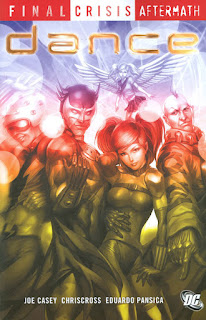
Review: Final Crisis Aftermath: Dance trade paperback

Người đăng: Unknown on Thứ Hai, 12 tháng 4, 2010

In terms of epilogues to Final Crisis, Final Crisis Aftermath: Dance is more what I was expecting than the similarly-bannered Run! Writer Joe Casey (of whom I've been a fan ever since his post-Ending Battle run on Adventures of Superman, in which Superman avoided using violence for some half-dozen issues) builds well upon the thin foundation Grant Morrison laid down for the Super Young Team in Final Crisis, and offers strong statements about youth, culture, and superheroics in the twenty-first century.

[Contains spoilers for Final Crisis Aftermath: Dance]

In one of my favorite moments of Final Crisis, Grant Morrison caught me completely by surprise in introducing the Super Young Team as the Fifth World equivalent to Jack Kirby's Fourth World Forever People. Whereas Kirby styled the Forever People after that era's hippies, Morrison created the Super Young Team as an answer to a culture (theirs and ours) raised on superheroes -- the Super Young Team aren't the young members of the Justice Society, wearing the costumes of their elders as a tribute, but rather the Super Young Team has absorbed superheroes as cosplay, as toys, as fashion (the striking Killing Joke-cover jacket and Young Team leader Most Excellent Superbat's Superman-symbol costume are just two examples).

The key, however, that makes Dance and the Super Young Team so enjoyable is even as the team is definitely irreverent, and even as in their inception they've deconstructed superheroics almost as far as the concept will allow, they still want -- almost desperately -- to fight for what's right. Dance finds the Super Young Team with newfound fame after their role in Final Crisis, but it's this very role that drives the team to want to shake off fame in favor of good deeds (though still look good doing it). Joe Casey could have written a story about spoiled superpowered kids who learn the value of work over six chapters; instead, it's a story about superpowered kids who struggle to defy society's assumptions about them and do better than what's expected, and this struggle is infinitely fascinating.

Dance reminded me in part of Blood Pack, an enjoyable miniseries in which a handful of the heroes from DC's Bloodlines crossover joined, essentially, a reality show. DC published Blood Pack over ten years ago, and our culture's media involvement has only become more saturated. Casey takes the Super Young Team from a rave at their new headquarters to a comic book convention to, later, an Oprah-like talk show where they discuss the team conflicts; in every situation, it's more about the public's ability to be around the Super Young Team than the team themselves -- in becoming heroes (or perhaps celebrities), they themselves are as irrelevant as the Justice League are to them.

Even Superbat's narration throughout the book comes in the form of "tweets" to himself; even his private thoughts, effectively, are public consumption. While Casey's story doesn't delve much into international politics, I thought it interesting that the reason for the book's overriding conspiracy (apart from a clever but poorly explained master villain) was to disguise the relatively minor damage that occurred to Japan in Final Crisis; that is, Japan uses the twenty-four hour publicity of the Super Young Team as a ruse meant to keep publicity away from its own secret shame, only to have it revealed the shame isn't all that shameful. As with the Super Young Team's own conflicted values, this interplay between the public and private made Dance a gripping read.

Here's the big statement: superhero teen team comics are not dead. Lately when I've read Teen Titans I've begun to think they're dead, but Final Crisis Aftermath: Dance has changed my mind. Dance is edgy and smart, and a commentary on what it might be like to be a young superhero outside the pale of sidekicks and clones -- and Dance reflects comic book conventions and manga and all sorts of things not DC Comics-specific, and I like seeing those elements interact with this universe. If Final Crisis was meant to be ground-breaking, Dance breaks ground, and I'd sooner pick up a series with these characters than the same old thing.

[Contains full covers]

Unfortunately, my copy of Final Crisis Aftermath: Ink was missing pages (which made for a confusing read, I assure you) so I had to return it to my LCS and have them order another. Instead, coming up we'll delve back into some Superman, and maybe a few surprises. Don't miss it!
More about

Review: Final Crisis Aftermath: Run! trade paperback (DC Comics)

Người đăng: Unknown on Thứ Hai, 5 tháng 4, 2010

Matthew Sturges' Final Crisis Aftermath: Run! is probably not a book for me. It's a bloody dark comedy and crime story, but without the hint of nobility I think you find in Gail Simone's Secret Six, in contrast, or even in Sturges' own villain-focused Salvation Run. I struggled to decide whether Sturges tries to make a larger point here about the ongoing struggle between DC Comics' heroes and villains, or if the focus is simply madcap action. Disappointingly, as well, there's no sense in the book that DC intends to do more with the featured villain, the Human Flame, making me wonder whether Run! wasn't really intended as nothing more than a venue to capitalize on the Final Crisis name.

Run! has an aesthetic that I like. In as much as is possible in comic books, Sturges tries to present the book in real-time (or, at least, tells us how much time elapses between each scene), and keeps the Human Flame on the go the entire time -- running from the mob, heroes, and fellow villains. Flame gets continually beat to a pulp, managing each time to escape and find himself new and increasingly more dangerous powers that pull him out of one predicament and into the next, with increasingly explosive results. Part picaresque, part satire, Run! is a glimpse of the DC Universe through the eyes of an Inferior Five-level villain; as Green Lantern John Stewart describes him, Flame is an amateur wildcard who gains infinite power for one shining moment, before crashing and burning in defeat.

The premise does sound promising, and as such it's difficult for me to discern where it goes wrong. Perhaps it's Flame's lack of remorse; Flame continues an ongoing diatribe throughout the book where he wonders, even, if his part in killing the Martian Manhunter counts as murder since the victim wasn't human. I don't need my villains to be reluctant, necessarily, but Flame is a brute -- not a funny brute like Lobo (even if he's meant to be) and not even skillful like Lex Luthor, the Joker, or Vandal Savage in Sturges' Salvation Run, and as such I'm not driven to follow or root for him in a "it's good to be bad" kind of way.

Second, while I think artist Freddie Williams likely achieved the intended tone in this book -- giving every punch that the Human Flame gives or receives a cartoony quality -- the presentation didn't work for me either. As with Flame's personality, there's just no place for me to hang my hat; Williams' Flame is suitably ugly, as are his villainous allies and the filthy holes in which they have to hide away -- but with all the and ugliness, I'm not sure what I'm supposed to like. Granted, it's a dark, dirty story, but if the characters don't try to be in some way likable and the art doesn't try to be in some way attractive, I'm not sure what's in it for me as the reader to stick around.

At the core of Run! is that infamous moment in Final Crisis where, at the Human Flame's request, the villain Libra kills the Martian Manhunter. It's a startling scene meant by writer Grant Morrison to be different from your typical superhero death, like when Max Lord killed Blue Beetle; Beetle dies triumphant, whereas Libra dispatches the Manhunter with brutal swiftness and zero theatrics. Libra dies in Final Crisis, such that it's Flame who emerges as representative of this new, tougher villainy; around the middle of Run!, when Flame kills some of the sillier villains of the DC Universe (including the Condiment King), shouting about the villains' "stupid code names," it seems indeed that Flame will be the harbinger of this new era of DC Comics villains.

Unfortunately, Final Crisis itself failed to shake the DC Universe. Whereas the line-wide "One Year Later" event after Infinite Crisis made something of a difference in the DCU, DC's half-hearted attempt to keep Final Crisis from bleeding over into the monthly books have left a kind of confused space -- Batman's dead and characters mention having been possessed by Darkseid, but there's no residual affect of all the people of Earth having had to live in refrigeration, for instance.

To wit, it's almost a "running" joke in Run! that Libra has disappeared, given that it was never quite clear to the reader from Morrison's end who Libra was or what Morrison's really intended with him. The Human Flame, therefore, is a hanging chad, the remnants of an incomplete plotline, the representation of a good thought by Morrison that unfortunately, in a shared universe, never got picked up the way the sensibilities of Infinite Crisis did.

Sturges does his best with an intentionally farcical comic about a D-list villain and his near ridiculous lust for power (and also the frustrations the Justice League face trying to catch low-level villains), and I've no doubt that was enough for some (I don't mean to be humorless -- Sturges notes on his blog that "If you can’t see the fun in seeing kindly nurses getting punched in the face . . . well, let’s just say that’s the classy part of the story," and I understand he's shooting for a certain kind of valid humor here; I'm just not sure it makes the book). But Run!'s opposite number, when you think about it, is James Robinson's Cry for Justice, which shows the trauma of the Manhunter's murder from the Justice League's perspective, and whether you like Cry for Justice or not, it has the cache and impact that Run! does not, relegating Run! to footnote status on the buy pile.

If Final Crisis Aftermath: Run! really resonated with you, I'd like hear about what made it work for you. For me, I couldn't escape the idea there wasn't much here that it was really crucial for me to have experienced, and maybe a different book deserved my dollar instead. That's no fault of the writer's, necessarily, just how I felt in the end.

[Contains full covers]
More about

Review: Final Crisis: Legion of Three Worlds hardcover/paperback (DC Comics)

Người đăng: Unknown on Thứ Hai, 23 tháng 11, 2009

[Contains spoilers for Final Crisis: Legion of Three Worlds.]

As should come as no surprise, Geoff Johns and George Perez's Final Crisis: Legion of Three Worlds is a big book of caped and costumed superhero fun. Johns not only takes the opportunity to bend the classic Legion of Super-Heroes mission alongside twenty-first century social issues, but also amends what many readers will see as poor choices made by DC Comics in the time leading up to Final Crisis. Be warned, however -- even as I'd venture there's something here for everyone, to really understand every detail of this story requires a knowledge of DC Comics' Legion lore that this reader, to be sure, didn't have.

Johns succeeds with the Legion here much in the same way he did with Green Lantern: Rebirth, reviving the classic interpretation while preserving the modern versions. All three Legions get a place -- the newest Legion as stories from Earth-Prime, the Zero Hour Legion shunted to a parallel Earth though remembered through the remaining speedster XS, and the classic Legion as the new continuity. In this, and in some slight of hand involving the Final Night crossover and the modern Superboy and Supergirl's meetings with the Legion, Johns establishes that all the Legion stories you love still did happen, won't be forgotten, and are integral to the current Legion. Most everything included (sorry, John Byrne Superman years) and very little left out.

In the past, Legion has always paralleled themes of racial and global harmony, as teenagers from different "worlds" join to live and work together. Johns' new Legion status quo has xenophobia run rampant on Earth (similar, we could say, to issues facing the United States) while the rest of the universe looks to disassociate itself from Earth because of their xenophobia (much the same, again, to the tarnished reputation of the United States world-wide). Into this comes Johns' Legion, young adults from different backgrounds working together against the push and pull of their own planets; it's a small tweak, but one that revitalizes the relevancy of the Legion much the same as the Green Lantern series has been an allegory for the plight of New Orleans post-Hurricane Katrina.

The big news however, at least for me, is that Johns uses Legion of Three Worlds to resurrect Superboy and Kid Flash, both controversially killed since Infinite Crisis. I already knew about the resurrections, but I was quite surprised that Superboy's return related to Starman's actions in Justice Society. Much the same, I knew Kid Flash Bart Allen would be back via Brainiac 5's lightning rods, but not that the original, "forgotten" team up of the three Legions involved rescuing baby Bart and his cousin Jenni from the Reverse Flash. Johns ties together plots from this past year's Superman and Justice Society with nary a thread left hanging -- rare in these days -- and the execution is very, very impressive.

Legion of Three Worlds follows the classic Legion recruiting some Multiversal help to defeat the rampaging Superboy-Prime of Infinite Crisis fame. Prime recruits his own Legion of Super-Villains, allowing Johns to delve into extreme Legion apocrypha and spotlight even more esoteric Legion characters. It's here unfortunately where Legion of Three Worlds shows the difficulties inherit especially in the classic Legion series: there's just so many characters and relationships. That Wildfire has an unrequited love for Dawnstar I get, and also that Lightning Lord is Lightning Lad's brother, but when we get into the White Witch/Black Witch/Mordru situation, I for one was hopelessly confused. One hopes that in Adventure Comics or wherever the Legion may appear next, Johns and subsequent writer Paul Levitz have the space to take things more slowly and let new readers get to know the characters better.

In truth I've kept up better with the post-Zero Hour and Infinite Crisis Legions, who largely take a back seat in this tale. Indeed there are some nice moments, both "cute" -- the inclusion of the every grouchy Gates, that the second Ferro Lad is just called "Ferro" and that we once called Phantom Girl "Apparition" -- and also that Johns cleans up some trailing Legion plotines, like the second Lightning Lad stuck in Element Lad's body. But the two alternate Brainiacs, who get the most screen-time, spend much of it bickering at one another in a rather rudimentary way -- the second Brainiac sits in awe of the adult Legionnaires, while the third Brainiac has only snide comments for anyone over the age of eighteen. It's a very rough distillation of the temperament of the two Legions -- likely all Johns had space for -- but the result feels somewhat simplistic.

Regardless, Legion of Three Worlds deserves a special place alongside George Perez's JLA/Avengers and likely also JLA/Titans, Kingdom Come, and Green Lantern: Rebirth. All of these are books that deftly celebrate DC Comics minutia through echoed words and phrases, recreated postures and poses, and more in-jokes packed into the background than you'll find anywhere other than an issue of Ambush Bug. The book begins in the thirty-first century Superman Museum, and the artifacts here -- Dubbilex, the Tangent Superman, Superboy's original jacket -- are just a taste of what's to come. There's material here for DC readers from the Legion's beginning to just a few years ago; something in this book is sure to delight.

The book is tagged as a Final Crisis crossover, but the cross occurs in one direction only. Final Crisis references Legion of Three Worlds (turns on it, even), but Legion in no way references Final Crisis, and in fact largely contradicts some of the comics that follow in Final Crisis's stead. This should worry the reader not at all. Final Crisis and Legion do eventually match up a couple months down the road, and the offending scene in Legion is easily dismissable. Chalk it up to all the time paradoxes that go on in Legion of Three Worlds; the incongruity is a blunder, but it doesn't overshadow what's otherwise a well-written, well-drawn story that celebrates the DC Comics history it's built on.

[Includes full, variant, and unused covers]
More about

Review: Final Crisis: Revelations hardcover/paperback (DC Comics)

Người đăng: Unknown on Thứ Hai, 5 tháng 10, 2009

There's few things I like more than a comic by Greg Rucka, and especially a comic by Greg Rucka that includes Renee Montoya as the Question, and also references Renee's history with Gotham Central. By virtue of its Final Crisis ties, this story didn't strike me as quite at the level of its Question: Five Books of Blood predecessor, but Final Crisis: Revelations has got a lot going for it nonetheless.

Revelations tries its best to explore the spiritual side of Final Crisis. Thematically (if not completely on the page), Final Crisis looked at free will and how, in a world of tabloid news and Internet journalism, we daily cede ourselves to the real-life equivalent of Darkseid's Anti-Life equation. Revelations finds God's agents--the vengeful Spectre and the merciful Radiant--impotent against the Anti-Life equation precisely because, the Radiant explains, God imbued mankind with free will and it's mankind who has to take it back. Greg Rucka's voices of the people, the Question and the Huntress, battle the epitome of human evil, the biblical Cain, for mankind's ability to make their own choices.

It sounds riveting on paper, and the story does deliver plenty of what most fans bought the story for: the first meeting between former Gotham Central partners Renee Montoya and Crispus Allen in their new roles as the Question and the Spectre respectively. Rucka's dialogue shines here with Renee's sometimes snappy, sometimes self-effacing one liners, and I continue to enjoy the backdrop of his haunting Religion of Crime.

Rucka also makes the smart decision to separate Renee from the shadow of Batwoman a bit, and instead brings in the Huntress (whom he wrote to great success in the Huntress: Cry for Blood miniseries). Rucka doesn't spend too long on Huntress's religious background, but longtime fans knows she has one (as does Renee, for that matter), and it makes the character a perfect fit for this spiritual story. Much of Revelations brings to close plotlines begun around Infinite Crisis, and it's fitting to find Huntress in a church here just as she was during that earlier crossover.

Different from Final Crisis: Rogues' Revenge, which I thought made great use of the Final Crisis background, Revelations is a good story that feels hampered by Final Crisis. Despite that the Crime Bible mythology had its origins in Apokolips in 52, the role Darkseid plays here, and his relationship to the story's villain Cain, is never completely clear and seems largely tacked on. As with Countdown to Final Crisis and Death of the New Gods, the end of Revelations seemingly solves the Final Crisis on its own, and it's hard to see the necessity of Revelations as part of Final Crisis rather than its own entity.

In addition, the Final Crisis timeline severely hampers the story; Renee and the Spectre could've fought Cain any day of the week, but setting this during Final Crisis severely restricts the story's ability to breathe. Revelations ends up taking place only over a couple of hours, much of it spent with Renee and the Huntress running dizzyingly in and out of a church. Renee and the Spectre get a little time to chat, but there's not as much reflection as I would have liked; let's not forget Renee nearly drank herself to death, at one point, feeling guilty over the death of her former partner.

To be sure, however, I did appreciate some of the work Rucka tries to do on the Crispus Allen Spectre. Like Will Pfeifer and David Lapham before him, Rucka doesn't seem quite the rules and abilities of this new Spectre, but he does pick up on the rather quick death of Allen's son in Pfeifer's miniseries, and applies good story logic to why this death might have been so quick. Was Allen indeed meant to let the Spectre kill his son, the Radiant wonders. Was it a test that Allen failed, or did Allen's son's death prevent further deaths down the line?

They're good questions (as Renee is wont to say), though Rucka doesn't answer them so much as open Allen's eyes to new spectral abilities, such that everything's copacetic in the end. Not, perhaps, the explanations I was hoping for, but at least Rucka begins to distance the Spectre from the Lapham/Fleisher incarnation (not before he takes revenge for the murder of Martian Manhunter, however), seemingly moving the character toward a cosmic interpretation more comfortable with the Justice Society.

(I did wish, however, Rucka hadn't created this opposite number for the Spectre, the Radiant--equally undefined, I've some doubt we'll see her used much again in the DC Universe, and it frustrates me when an author creates a new character when there are so many in the DCU waiting to be used; Radiant might've been the 1990s Superman character Kismet, for instance, or someone else.)

[Contains full and sliver covers, Crime Bible page from Final Crisis Secret Files]

So--while Revelations didn't quite pack the punch of the Final Crisis crossover Rogues' Revenge, fans like me of Greg Rucka's new Question will surely be glad for this volume, and eagerly awaiting the next.
More about

Review: Final Crisis: Rogues' Revenge hardcover/paperback (DC Comics)

Người đăng: Unknown on Thứ Năm, 3 tháng 9, 2009

I wonder if Geoff Johns would hesitate if someone asked him which characters he preferred to write, the Flash or the Rogues?

[Contains spoilers for Final Crisis: Rogues' Revenge]

In Final Crisis: Rogues' Revenge, writer Geoff Johns reunites with artist Scott Kolins and proves sometimes you can get the band back together again. Johns' five-year run on The Flash remains one of my favorites (see my retrospective of Johns' Flash run), and in Rogues' Revenge he not only returns most of the series' main supporting characters for a final bow, he also builds on a couple of the characters in the process. Add to that Rogues' Revenge's perfect position as a bridge between the disparate Countdown to Final Crisis and the miniseries itself, and it combined for a story I literally didn't want to end.

Even more clearly than in Flash, Johns demonstrates here the dichotomy of the Flash's Rogues. These are quite remarkably deadly foes, as Johns proves in the brutal second chapter when the Rogues torture and decimate a group of replacements. At the same time, they are to a one wracked with guilt over having killed the Flash Bart Allen, believing in a warped sense of fair play where they don't kill anyone who wouldn't kill them in turn. But we can't forget that each Rogue emerged from a terrifyingly damaged family situation, so much so that Captain Cold hardly blinks before ordering the death of his own father.

What we find is a group of bad guys near unquantifiable among the other villains of the DC Universe. While every other villain (including, Johns points out, Superman's Lex Luthor) joins Libra in Darkseid's cult of evil, Captain Cold quips that he doesn't believe in evil, only "different shades of grey." All of this is Johns' invention -- the Rogues weren't nearly so complex in previous eras -- but indeed it helps to define them as something different that the patients of Arkham and the Sinestro Corps. The Rogues are on one hand rational villains who commit crimes only for gain, not maliciousness; but they're all also on the bleeding edge of plum crazy, and Johns doesn't let us forget it.

At first I thought it something of a waste that DC included the already-collected Captain Cold profile at the end of this book, but Johns offers so much detail about Cold here that I found myself reading that story again. Johns' posited Cold in his Flash stories as leader of the Rogues and the antithesis of the Flash Wally West -- from a broken home like Wally, Cold is essentially what Wally could have become if not for the guidance of Barry and Iris Allen. Though Cold's arc essentially ended in Flash, Johns unexpectedly brings Cold's abusive father into the scene, and pages of violence are followed by quiet interaction between Cold and his father -- which itself gives way to more violence. The sequence is, if you'll forgive the pun, chilling, and cements Cold as an oft-overlooked villain worth watching.

I also appreciated that Johns took a few pages to fill in a gap in the history of the Weather Wizard. Whether by design or the fallout of retroactive continuity, the Weather Wizard's origin has historically been a little murky; he's at different times been believed to control the weather either on his own or through a staff invented by his brother, who either died of a heart attack or whom the Wizard himself murdered. In Rogues' Revenge, the Rogues end up in the selfsame observatory where Wizard's brother died, and Johns finally reveals the truth -- no big surprise, and indeed the entire scene in the observatory was hardly necessary, but I appreciate that Johns took the time to tie up this loose end.

Like DC Universe: Last Will and Testament, Rogues' Revenge serves as a mediator between Countdown to Final Crisis and Final Crisis, neither one of which itself quite fit into DC Comics continuity. The Rogues murdering Bart Allen was one of the lynchpins of Countdown, and this series addresses that in terms of Final Crisis, as Libra takes special interest in the Rogues for having killed a speedster. This volume acknowledges not only the death of the first Trickster from Countdown, but also the Pied Piper's semi-comprehensible ties to Darkseid's Anti-Life Equation in the same series.

(As a side note, one has to acknowledge that DC Comics has had a pretty rough time of it in the run-up to Final Crisis. Fans generally panned Countdown to Final Crisis, and for the success of Sinestro Corps War there was also the failure of Amazons Attack; more than a handful of the One Year Later titles were cancelled. With Batman RIP and New Krypon, DC seems back on track, but I remember the outcry over the death of Bart Allen, and in that way the Rogues represent a trying time for DC. When Captain Cold delivers a lethal blow to the comics-arbiter of Bart's demise, Interia, in thanks for "one $%@#$@-up year," I have to think the Rogues are getting their revenge on a couple of levels.)

[Contains full covers, Captain Cold and Zoom reprint stories]

Final Crisis: Rogues Revenge is hardly a necessary story. It doesn't add much to Final Crisis on one hand, and likely isn't essential before you read Flash: Rebirth on the other. But this is a good story, a good crime story, a good DC Universe villain story, and hands down one of my top recent favorites.
More about

Review: Final Crisis Companion trade paperback (DC Comics)

Người đăng: Unknown on Thứ Hai, 10 tháng 8, 2009

DC Comics set up Grant Morrison's Final Crisis unlike the crossovers that immediately preceded it. Rather than cross into monthly titles like Infinite Crisis did, the story limited itself to a small selection of one-shots and mini-series. Unlilke The Sinestro Corps War, which also featured companion one-shots, the Final Crisis specials for the most part told side stories the reader didn't need to understand the main story itself. DC did some reconfiguring of the Final Crisis hardcover before it's release, moving the more important Superman Beyond and Submit to the hardcover; what remained for the Final Crisis Companion was Resist and Requiem, along with the Final Crisis Secret Files and Sketchbook.

Constant readers know what a fan of Greg Rucka and Eric Trautmann's Checkmate I was, so for me this essentially a collection of the Checkmate-focused Final Crisis: Resist with a couple other things thrown in. While Resist doesn't entirely have an opportunity to approach some of the political issues of the Checkmate series -- it's hard to step in between China and North Korea while Darkseid's taking over the world -- White King Mr. Terrific plays a lead role and has to make an enjoyably wrenching moral decision that's picked up, I understand, in JSA vs. Kobra.

Being a Checkmate side tale, Rucka and Trautmann also take the opportunity to focus on a lesser-known Checkmate operative, Snapper Carr. Keith Giffen revealed Snapper as a Checkmate agent in 52 Aftermath: The Four Horsemen, but we haven't seen Snapper and his teleportation powers in Checkmate-proper before. I also appreciated that, as in the Checkmate series, the writers populated the story with random DC Universe guest stars, including Firehawk and the Wonder Woman villain Cheetah.

Resist takes place between the pages of Final Crisis and only barely makes a ripple in the main story; the rest of the contents of the Final Crisis Companion coincide even less. Len Wein's depiction of Darkseid in the Secret Files story inexplicably plucking Libra from obscurity only deepens the mystery of why this character was necessary for Final Crisis; one guesses this had more to do with Grant Morrison appreciation for Len Wein (who created Libra and also wrote the Seven Soldiers-inspiring Justice League story). And while I enjoyed the sketchbook and script pages, I might've liked to see more of Morrison and J. G. Jones' commentary on the series in the main hardcover than just their comments on issue one here.

Final Crisis: Requiem offers the other bright spot in this book, as Peter Tomasi relates the death and funeral of the Martian Manhunter. Any sorrow here is overshadowed by any reader's clear belief that J'onn J'onzz will be resurrected before too long (as opposed to Superboy's shocking and sad death, at the time, in Infinite Crisis), but Tomasi makes up for the lack of emotion with a good helping of nostalgia. Tomasi remembers and includes J'onn's good friend Gypsy, believably sets up Green Lantern and Green Arrow for JLA: Cry for Justice ("My favorite Martian," indeed), and combines well the various disparate Martian Manhunter series. I enjoyed Tomasi's work on Nightwing, and his contribution here is equally as good.

(Let me insert a completely random note here about Brad Meltzer's DC Universe: Last Will and Testament, which was to be included in the Final Crisis Companion and was later removed. The story is a brilliantly haunting homage to Meltzer's Identity Crisis in turning again to Batman, Robin, Nightwing, and Starfire; and also in a moving confessional scene between the Outsider Grace and Rocky of the Challengers of the Unknown. Most of the issue follows Geo-Force, however, taking revenge for Deathstroke's corrupting of his sister some twenty years ago (our time). It's not a terrible concept, and it plays out in a shockingly violent manner, but Geo-Force has been so off the radar of late, even despite Meltzer's Justice League stories, that this feels terribly random and mildly fannish, as if Meltzer himself has been waiting to avenge Terra all this time.)

Readers wanting the full picture (and Checkmate fans) will find some pleasant stories in the Final Crisis Companion, but this book is not quite the companion that some other volumes have been.

[Contains full covers]

Thanks for reading!
More about

Further thoughts on Final Crisis from the Collected Editions blog

Người đăng: Unknown on Thứ Năm, 6 tháng 8, 2009

[Contains spoilers for Final Crisis]

Being in addition to my official review of Final Crisis, some looser, free-floating thoughts on the book:

It took me about a week to read Final Crisis. Lately I've been annoyed at how quickly I can read some trade paperbacks, often an evening, which I chalk up not to the speed of my reading but the thinness of the trades. I blanched at the cost of this hardcover, higher than most, but I feel I received my money's worth in time spent reading.

That Final Crisis took me longer to read I credit both to the amount collected, ten issues, but also to the complexity of the story. Ultimately I enjoyed the story, and managed to glean some meaning from it beyond the superheroic plot, but certainly this was one of the most complicated comics books I've read in a while. Grant Morrison mentioned in a Newsarama interview that he wanted to "leave our boring ... connective tissue" in the story, but it often seemed the story became the most sparse at the complex moments it needed most detail -- the end of Superman Beyond, for instance, or the last chapter of the book.

I debated (and ultimately omitted) a paragraph in my formal review of Final Crisis that considered whether the comic was subjectively "appropriately complex," or too complicated. Oftentimes a comic book's complexity is considered commensurate with its value -- comics have been for so long considered the playthings of children that for a comic book to "talk up," even over the head of its audience, is a sign of worthiness. In Final Crisis, I vacillated between admiring Morrison's genius and suspecting the book was a collection of overblown nonsense. Are we so desperate to say "look how smart comics are" that we'll trumpet anything that uses big words, even if the joke's actually on us?

I've read Morrison's work long enough to know he's got something here, of course. But I wouldn't hand Final Crisis to a new comics reader. Though not as steeped in DC Comics lore as its immediate predecessor, Infinite Crisis, Final Crisis demands so much of the reader's understanding (rightly or wrongly) of the interaction between comic book words and pictures that a new reader would be lost. When a comic isn't accessible to new readers, I feel it's not "supporting the cause," if you will -- but don't comics readers deserve once in awhile a book that rewards dedication? There's "hard novels" and "easy novels"; why not the same for comics, even DC comics?

It's this uncertain space that Final Crisis occupies. I want to recommend it wholeheartedly, even feel that I should, but a part of me wasn't completely sold. (I feel guilty even as I write this.)

The packaging of Final Crisis certainly presents itself as not quite superheroics as usual. Compared to the wildly colorful Infinite Crisis hardcover jacket and the equally colorful Infinite Crisis printed case, Final Crisis is very stately -- a moody JG Jones image on the front jacket, a couple small faces on the back, and a paper case with bright red stamping. I'll be curious to see the inevitable Blackest Night hardcover collection -- will its case, too, suggest "I'm a book, not just a comics crossover," or back to business as usual?

DC's made a controversial decision to put a great big spoiler on the front cover of this book. In my opinion, it's to tie the book that much closer to Morrison's Batman RIP without actually saying so, but certainly it greatly separates the reading experience of those who read this in monthlies from those who read this in the trade. In the Internet age, I knew what was coming, but I wonder if anyone avoided spoilers all along just to get to the front jacket and groan. As it is, Batman's unfortunate incident isn't really the penultimate rising action of the book anyway; that comes in a rather unlikely fight between Supergirl and Mary Marvel, and Kalibak and Tawky Tawny (which works, amazingly enough).

Indeed the whole of the Final Crisis collection has a sort of uneven tempo -- Final Crisis #1-3 are sort of traditional superheroics, then WHAM! Superman Beyond blasts cosmic hyper-realism all over the page, then WHAM AGAIN! Final Crisis: Submit is a gritty tale of social politics, before rejoining a more natural flow from superheroics to cosmic action. Morrison writes each of these genres well, but there's a scattershot feel to the first six issues that, again, I'm not sure a new comics reader would know how to handle.

Infinite Crisis had ground-breaking moments, as did Green Lantern: Rebirth, but I believe I can point to them on my shelf and say "there, comics." Not entirely so with Final Crisis; I find myself looking slightly askance at the book, not unlike with Identity Crisis (though even that I'm more sure where it fits in the canon than Final Crisis). "I liked Final Crisis," I say, with a pause ... but then again?
More about

Review: Final Crisis collected hardcover/paperback (DC Comic)

Người đăng: Unknown on Thứ Hai, 3 tháng 8, 2009

[Contains spoilers for Final Crisis.]

You almost destroyed the universe. Yes, you.

Well, maybe not you, and maybe not the universe. But Grant Morrison argues in Final Crisis that collectively, we all came pretty close to doing DC Comics irreparable harm.

Whether dense or confusing, repetitious or ground-breaking, one thing I'm sure about Morrison's Final Crisis (the seven issues of which are collected here along with Final Crisis: Superman Beyond and Final Crisis: Submit) is that it earns its place as the conclusion of DC Comics's "Crisis" trilogy. The 1985 Crisis on Infinite Earths removed from continuity DC's Multiverse concept of multiple Earths, deemed too confusing by fans and creators, and introduced an era where comic book stories had to clearly fit into established continuity or bust. 2005's Infinite Crisis resurrected the Multiverse after twenty years, offering fifty-two worlds where nearly every DC Comics concept could peacefully coexist. As a coda, Final Crisis sends one clear (well, mostly clear) message: Don't mess with the Multiverse again.

Through the omnipresent Monitors of DC Comics mythology, Morrision directly implicates the reader in a failure of imagination. Morrison describes in Superman Beyond that the Monitors had no concept of story or imagination until they encountered the DC Universe (in the artwork, we see specifically Crisis on Infinite Earths). The power that imagination might have, Morrison writes, on the Monitors' "immense awareness without limits or definition" is so great that they built a statue of impenetrable metal around the concept such that story-telling ought not spread unchecked "like contagion." Morrison, who himself proceeded to ignore the 1985 "no more Multiverse" edict in his run on Animal Man, points his finger at the reader just as his fourth wall-breaking characters often do -- so afraid were we of the power of infinite possibility that we allowed a twenty-year walling off of DC Comics' Multiverse concept rather than let our imaginations run wild.

In Final Crisis this fear of imagination manifests itself in the vampire Monitor Mandrakk, and Mandrakk's defeat only comes when the characters allow themselves to imagine again. Captain Adam -- similar to Watchmen's Dr. Manhattan -- realizes the nature of the Multiverse isn't pejorative "dualities" but rather "symmetries" only once he "let[s] go of limits [and] expectations." The Monitor Nix Uotan forgets his Monitor powers, and Morrison delivers Uoton's reminder in the form of a mysterious hairy-armed creature (a monkey with a typewriter, possibly), who intones, "If your superheroes can't save you, maybe it's time to think of something that can. If it don't exist, think it up. Then make it real." That Morrison resurrects here the Flash Barry Allen, long considered a symbol of the wildly imaginative Silver Age of comics, personifies the statement.

Indeed Final Crisis presents what it preaches -- a miniseries with no lack of wild ideas, from vampire gods to tunnels through universes, miracle machines run on song and humanity protected from destruction in ice trays. That the term "Kirby-esque" (for legendary wild-idea-ed comics creator Jack Kirby) is applied to Final Crisis is no coincidence, since Morrison's story centers on and then builds from Kirby's creation of Darkseid and the Fourth World New Gods, OMAC, Kamandi, and others.

So omnipresent are Kirby's creations in DC Comics that they may very well (at no fault to Kirby) limit new writers' ability to conceive of new concepts -- that Morrison hides the entropic Darkseid within police officer Dan Turpin, long considered a stand-in for Kirby himself, is no coincidence. Morrison's Final Crisis not only challenges the limits of imagination, but also ends Kirby's Fourth World in favor of a new, modern Fifth, clearing the cobwebs both within and without. Unlike Crises before, Final Crisis does not retroactively fix DC Comics continuity; rather, it seems to celebrate that continuity as fine just the way it is, in all its limitlessness (witness the Multiuniversal gathering of Supermen in the end, and Morrison's ode to previously-erased Batman stories in his parallel tale, Batman RIP).

Though the storytelling within Final Crisis is perhaps at times unnecessarily complex, it is at its heart an ode to comic books. At the end of the story, a few Monitors still fear the Multiverse unchecked, but Uotan reminds them, "We almost destroyed this beautiful living thing in our midst. This Multiverse of life deserves its freedom from our interference." This is not nearly the first time Morrison has argued that the DC Comics universe has a life of its own, if nowhere else than in the collective minds of those who read it. Just before Superman faints from exhaustion after fighting the vampire Monitor, he scrawls on his tombstone "To Be Continued," the veritable life-blood of long-form sequential comic book storytelling (and the opposite, to be sure, of "The End").

We find that Darkseid's first weapon in subjugating humanity is the Internet, cell phones, and GPS systems. In the end, humanity can only communicate through newspapers. Lois Lane dispatches to the stars papers which tell of Batman's heroic battle against Darkseid -- in essence, a comic book. In Final Crisis, Morrison tells us, when all else fails, it's the comic books that survive.

[Contains full covers and variant covers, introduction by Jay Babcock, brief sketchbook section]

Join us Thursday for some additional thoughts on Final Crisis, including the trade dress, package presentation, and a broader perspective on the series.
More about

DC increases Final Crisis hardcover price

Người đăng: Unknown on Thứ Ba, 3 tháng 3, 2009

DC Comics has officially increased the price of the Final Crisis hardcover from $24.99 to $29.99. Amazon.com now shows $29.99 as the price, and presumably they'll be contacting customers about the change; no word yet on how comic book retailers will handle the switch.

According to DC, the hardcover will have a new cover image by J.G. Jones showing "the penultimate scene of the series" (which sounds like a spoiler to me, but what do I know?).

Here's the official press release, via Comic Book Resources:
Official Press Release

DC Comics has expanded the contents of the FINAL CRISIS HC, collecting the explosive event written by Grant Morrison.

Now running 352 pages, this title will include FINAL CRISIS #1-7, FINAL CRISIS: SUBMIT #1 and FINAL CRISIS: SUPERMAN BEYOND #1-2, all written by Morrison, along with a new cover by J.G. Jones depicting the penultimate scene of the series.

The FINAL CRISIS HC (FEB090203) is advance-solicited in the February Previews and is scheduled to arrive in stores on June 10 with a price of $29.99 U.S. Because of these changes, this title will be made returnable at a later date.
What do you think of the Final Crisis price increase?
More about

Official Final Crisis hardcover details revealed

Người đăng: Unknown on Thứ Bảy, 28 tháng 2, 2009

Newsarama's got confirmation from Mega Con on the story you originally heard at the Collected Editions blog, that the Final Crisis hardcover will indeed now contain the seven-issue miniseries, plus Superman Beyond #1-2 and Final Crisis: Submit. The Final Crisis Companion, originally supposed to include Superman Beyond and Submit, will have the Final Crisis #1 Director's Cut and Final Crisis Secret Files, along with Final Crisis: Requiem and Final Crisis: Resist.

Read these related Collected Editions stories:
* Final Crisis collection details change, and Batman RIP hardcover news
* Trade Perspectives: Batman: RIP and Final Crisis Further Thoughts
* Trade Poll: Which to read first, Batman: RIP or Final Crisis?
* Final Crisis hardcover solicitation
* How do you want Final Crisis collected?

In other Mega Con news, Dan DiDio and Vince Letterio (Direct Sales) downplayed the possibility of a Young Justice trade paperback right now, though the recent upswing in requests for this makes Collected Editions think it's not too far away ...

So the real question is, with the change in the Final Crisis hardcover's contents, will current orders be cancelled, and will be book be resolicited with a new price?
More about

Final Crisis collection details change, Batman RIP hardcover news

Người đăng: Unknown on Thứ Ba, 17 tháng 2, 2009

If it wasn't clear before that the Collected Editions blog has the best commenters ever, Jeffrey Hardy Quah got his copy of the Batman RIP collection hot off the press and let us know that it contains the Batman story from DC Universe #0. Does this mean that the Superman, Wonder Woman, Green Lantern, and other parts of DC Universe #0 might also be collected in their respective trades? If someone sees it, let us know!

As of today's DC Comics May 2009 solicitations, it seems the Final Crisis Companion's contents have changed to now include the Final Crisis #1 Director's Cut and Final Crisis Secret Files, and no longer reprint Final Crisis: Superman Beyond and Final Crisis: Submit (thanks, Bob Schoonover!).

At the same time, Dylan Palmer points out that the page count for the Final Crisis collection on Amazon has jumped from 240 pages to 352 pages. I don't know that I agree with Dylan that Batman: Last Rites will appear here, but maybe Superman Beyond and Submit instead?

If we get the Final Crisis collections we've been hoping for, that'll set a big precedent for crossover collections to come. Here's hoping!

***

To everyone who emailed about guest blogging for Collected Editions, I've been a little tied up but I'll get back to you soon. And are you following Collected Editions on Twitter yet?

Thanks all - this blog wouldn't be here without you. More reviews coming soon!
More about

Trade Perspectives: Batman: RIP and Final Crisis Further Thoughts

Người đăng: Unknown on Thứ Ba, 3 tháng 2, 2009

A few thoughts on the Collected Edition blog discussion from last week of which collection to read first, continuity-wise, Batman: RIP or Final Crisis:

Among a number of great comments (thanks all!), Spooky notes that "if you want to read the two hardcovers without interruption, then you should read Batman: RIP first, because the majority of it takes place before Final Crisis. But be aware that both hardcovers (when read uninterrupted) spoiler each other!"

Therein, as they say, lies the rub.

The results of our (first ever) Collected Editions blog poll had 90% of respondents for reading Batman: RIP first, versus 10% for reading Final Crisis first. From what I understood from everyone's comments, Final Crisis #5 spoils Batman #683 (at the very end of Batman: RIP) while Batman: RIP spoils the first chapter (I think) of Final Crisis, but not in a major way. If I've got all that right, then indeed Batman: RIP is the one to read first, though I'm not happy about the situation.

This strikes me as a problem unique to wait-for-trading, one we might see come up more and more as more crossovers, and their ancillary titles, are collected in trade. Identity Crisis tie-ins like Flash: The Secret of Barry Allen and JSA: Lost branched off the main story rather than intersecting, but Teen Titans: Titans East and Countdown to Final Crisis Volume 1 intersected and each spoiled the death of a character found in the other book.

I think this comes from an increased effort on DC's end to let independent titles stand on their own during crossovers (Infinite Crisis versus The Sinestro Corps War, for instance), but what we get is the awkward intersection of stories as we see here. It's good, don't get me wrong, for Batman, and good for Final Crisis, but troubling for the trade reader. Ultimately it seems there no perfect order to read these two volumes completely, and I object as a trade reader to having to go back and forth between two volumes to avoid spoilers.

But such is life. Thanks for thinking this through with me. I'll touch on this topic again, for sure, when I read these two books, and I'd love to hear any additional thoughts you may have. New reviews coming soon!

***

Separately, I was re-reading Nightwing: The Lost Year last night -- anyone know if the new Vigilante is supposed to be a character we've already met? I have a sick idea who it might be -- I don't want to spoil it here, but email me at the address at right if you want to know.
More about

Trade Poll: Which to read first, Batman: RIP or Final Crisis?

Người đăng: Unknown on Thứ Năm, 29 tháng 1, 2009

Nobody added a great comment to our discussion about the Batman: Black Casebook trade paperback, regarding the apparent crossover bewteen Batman: RIP and Final Crisis -- and it reminded me that I've been wondering lately, which book should I read first?

I'm reaching out to those who've read Batman: RIP and Final Crisis ... which one should I read first? Which one leads into the other? No spoilers in the comments, please, but I'd love if you'd use the handy poll below to let your opinion be heard!

Which book should be read first, continuity-wise, Final Crisis or Batman: RIP?
Final Crisis
Batman: RIP
pollcode.com free polls


I'll post the results soon. And thanks!

UPDATE: Overwhelmingly, the Collected Editions blog readers chose Batman: RIP to read before Final Crisis -- but Collected Editions respectfully disagrees. As I've noted on our DC Universe Trade Paperback Timeline, some events in Batman RIP may take place before Final Crisis and some during Final Crisis, but the end of Batman RIP can't be understood (even if it's mildly anti-climactic) without first knowing the details of Final Crisis. (The Mister Miracle issues from the third Jack Kirby's Fourth World Omnibus help, too). Read our full post on the issue.
More about

Final Crisis hardcover solicitation

Người đăng: Unknown on Thứ Hai, 15 tháng 9, 2008

Amazon now lists a Final Crisis hardcover for $24.99 at 240 pages, arriving in stores in June 2009. If the page count is right, and each issue of Final Crisis is 40 pages, that doesn't quite add up to seven issues ...

No confirmation of this quite yet on other sites (and strangely the listing only comes up when you search by ISBN, not any other way), but we'll keep watching. More news as it breaks ...

(Thanks to Chris Hilker for the heads up!)
More about

How do you want Final Crisis collected?

Người đăng: Unknown on Thứ Tư, 10 tháng 9, 2008

There's a conversation that you can probably skip about how fans would like to see Final Crisis collected, going on over at the DC Comics Message Boards. The trolls take over pretty quick -- at least six of the replies suggest collecting Final Crisis in some sort of trash receptacle, with a bunch of other responses shushing the previous replies.

I'm curious about this, though, and I've been watching my sources lately for some hint of how Final Crisis might be collected; with all of Countdown to Final Crisis now solicited in collected format, Final Crisis can't be far behind. And as Collected Comics Library reported, Dan DiDio said at SDCC that Final Crisis and its spin-offs will be collected "in the order that makes the most sense to everybody."

Of course, making something make sense to everybody tends, I believe, to make it make sense to nobody. My guess is that DiDio meant "everybody," as in DC Comics and not everybody as in "you and me," otherwise we'd have a mess on our hands.

Here's what I think we can expect:

* Final Crisis Companion -- the one-shots Last Will and Testament, Rage of the Red Lanterns, Requiem, Resist, and Submit

* Final Crisis: Legion of Three Worlds - on its own, or with Action Comics #864 ("Batman and the Legion of Super-Heroes")

* Final Crisis: Rogues Revenge - on its own

* Final Crisis: Revelations - on its own

The only ones I can't figure out are Final Crisis: Superman Beyond and DC Universe #0. Superman Beyond is just two issues, too large to go in the Final Crisis collection and too small to be collected on its own. Ditto DCU #0; I'm not sure DC wants to put a non-Grant Morrison/JG Jones tale in the Final Crisis collection, but maybe so.

Either way, I think we can expect deluxe format hardcovers all around.

How would you like to see Final Crisis collected?
More about