Hiển thị các bài đăng có nhãn Criminal. Hiển thị tất cả bài đăng

Review: Criminal Vol. 6: Last of the Innocent trade paperback (Marvel Comics)

Người đăng: Unknown on Thứ Năm, 20 tháng 3, 2014

[Guest reviewer Zach King blogs about movies as The Cinema King]

I've thoroughly enjoyed the past five trades in the Criminal series, so there's an air of the bittersweet to my encounter with the final (for now) volume in the series. Criminal Vol. 6: The Last of the Innocent is a bit of an oddball as endings go, setting aside most of the Center City trappings that have been the hallmark of the series. Instead of a densely interconnected entry in a larger web of stories, The Last of the Innocent is a largely insular volume in the best standalone tradition, tonally different from the five volumes that preceded it.

But that difference, as has been the case throughout my reading of the series, works in the book's favor; rather than fit comfortably into a particular niche -- highly original though that niche may be -- Ed Brubaker and Sean Phillips team up one more time for a trade that is an engaging read and a powerful examination of themes that Criminal has flirted with but never fully confronted.

The Last of the Innocent introduces us to Riley Richards, a depressive personality with a laundry list of regrets and a devious scheme to reclaim his life from a time before things went awry. Married to Felicity (dubbed "Felix" by her friends), Riley longs for a happier time in his life, when high school offered him fulfillment with his sweetheart Lizzie and his best friend Freakout. But Freakout is a recovering addict now, Lizzie is forever the one that got away, and Felix is cheating on Riley. At his father's funeral, Riley decides that, for his life to flourish, Felix's must end. Riley's unforgivingly methodical plan unfolds with that noir element we've come to relish from Criminal.

Following up on the inclusion of Frank Kafka in Bad Night, Brubaker and Phillips again turn to our own comics as a way to reckon with the modern era. Here, our able creators dissect the legacy of Archie in interstitial flashbacks that render Riley's past as pages from romantic comedy comics not unlike Archie. (In fact, there's a fairly clear one-to-one correlation: Riley/Archie, Freakout/Jughead, Felix/Veronica, Lizzie/Betty.)

Rather than resort to cheap shots at the Archie line (as Alan Moore's satire always seemed to ridicule its source material), Brubaker's story uses these pages as ways to grapple with uncomfortable truths. These pages are set up as comedy, but the jokes are disturbing; it's cute when Riley is hiding from Felix's father, but the patriarch's hatred for his daughter and her suitor are transparent, and the implication that Riley is performing oral sex on Felix under her father's nose is an uncomfortable punchline to the page. But this Archie-fication, we learn, is how Riley remembers his past -- with a veneer of nostalgia that deliberately obfuscates the fact that the good times weren't always consistently so.

The Last of the Innocent is a very smart treatment of the way we choose to remember our pasts, and it's delivered oh-so-effectively by Phillips, who again proves his own style to be malleable; the nostalgia pages look sharply different from the scenes in the present day, and the blending of the two artistic modes communicates in a clever shorthand what exactly we're seeing (the "authentic" past, the [mis]remembered past, or the noirish present). By the end, when the two styles flow together in discordant panels, the effect is one of those things that only comics can do.

All of this is to say nothing of how smartly Brubaker's script delivers the story, as per usual. While I'll admit that this volume felt a little aimless at first, once the plot crystallizes before your eyes you'll realize what an expert craftsman Brubaker really is. His talent at creating plausible characters is so strong that you'll find yourself accidentally sympathizing with Riley, even as he plots his wife's murder and sows trails of deceit to provide himself with an alibi. Even aside from Brubaker's clever characterizations, The Last of the Innocent is his homage to the "perfect crime" genre, and it's painstakingly thought through; as a writer, I found myself asking, "Why didn't I think of that?" which is truly the mark of a terrifically original story.

Like all the Criminal volumes so far, there are standout moments where the plot turns in unexpected and irrevocable ways, and by this the sixth volume Brubaker and Phillips have proved themselves masters of the "plot twist." These moments, which one can distill to a single panel, are simultaneously heart-wrenching and jaw-dropping; the first of these comes with the juxtaposition of Felix's inscrutable face (is it a smile, a sneer, or a concerned frown?) and Riley's narration, "I have to kill my wife." With each of these successive moments (which are so perfectly crafted, it'd be a shame to spoil them here), Riley digs himself deeper as his creators weave the plot together more intricately.

With Criminal Vol. 6: The Last of the Innocent, we reach a kind of closure for the Criminal series; though Brubaker has said he's not done with the world of Center City, these six volumes are all we have of the story so far. Though The Last of the Innocent is remarkably different from the series it "concludes" -- only incidental cameos from Teeg Lawless and Sebastian Hyde tie it to this shared universe -- it is of a consistent quality where fans of the genre will find much to appreciate. Fortunately for readers looking for more, Brubaker and Phillips have collaborated on a number of books, and I for one will be seeking out more of their work.`
More about →

Review: Criminal Vol. 5: The Sinners trade paperback (Marvel Comics)

Người đăng: Unknown on Thứ Năm, 6 tháng 3, 2014

[Guest reviewer Zach King blogs about movies as The Cinema King]

I've commended the Criminal series for continuing to innovate and expand the shared universe of Center City with compelling standalone stories, with the three "one-shots" in The Dead and the Dying standing out as ostensibly the high point of the series.

The back cover of Criminal Vol. 5: The Sinners recalls one of my favorite lines from Grant Morrison's The Invisibles -- "And so we return and begin again" -- when it lets us know that "CRIMINAL's most popular character, TRACY LAWLESS returns in THE SINNERS." In an era of reboots and remakes, a deviation from the highly original work being done by Criminal ought to give any comics fan pause.

Fear not, loyal readers. Even though this collection revisits a familiar face, The Sinners is as enjoyable as the other trades in the series, and you'll barely even notice that this is "another" Tracy Lawless story.

A year into his tenure with Sebastian Hyde, former soldier Tracy Lawless is on his way to becoming "the worst hitman in the world." It's not because he's sleeping with Hyde's wife; rather, Tracy is spending time investigating his targets, making sure they "deserved it." Tracy's losing face with Hyde, who's losing face with his enemies, so the two work out a mutually beneficial arrangement: if Tracy can solve the murders of Hyde's apparently "untouchable" associates, Tracy is free to go. Of course, as with any Criminal volume, the plot thickens: the killers have a surprisingly good (and moral) reason for their actions, and Hyde fails to notice his wife's infidelity because he thinks his daughter Sabrina is sleeping with Tracy. All the while, Tracy is being pursued by a military official looking for a certain deserter in Center City, forcing him to choose between two unpleasant futures: the ever-suspicious shadow of Hyde, or the threat of death in an army that doesn't even want him.

The Sinners is the first Criminal miniseries, after the creators decided to release separate volumes for each story arc rather than rely on consistent sequential numbering. It's a smart shift, since this is a self-contained story even beyond the recurrence of Tracy Lawless. In fact, the story is so accessible that the reuse of Tracy Lawless almost feels superfluous; I don't want to say it's just a sales tactic, but there's no reason this couldn't have been a brand new character, since Tracy is a different man after a year with Hyde. For one, he's more reticent, a perfect mirror of his father, whose own internal conflict rendered him inscrutable to others in the same way that no one in the story really knows what to make of Tracy.

And you'd think that after four volumes of this stuff, I'd be able to telegraph some of the fabulous twists and surprises coming withing The Sinners. But no, Brubaker and Phillips have all kinds of wonderful toys at their disposal. There's more going on in these five issues than in a lot of twelve-issue maxiseries. The murder mystery, the question of Mrs. Hyde's fidelity, the looming war with the Triad, and the pursuit of Army Agent Yocum could all have been their own A-, B-, or C- plots in a longer Levitz Paradigm-esque epic. But The Sinners throws all these plots into one noir stew and, miraculously, never shortchanges any of them. Instead, when they all bump into each other, the result is some of the smartest character writing in comics. Brubaker has every one of these voices nailed: gruff Tracy, carefree Sabrina, sinister Hyde, and company-man Yocum.

With Phillips still on art (thank heavens for consistency!), the story is full of fantastic turning points that can only be described as "out of the fire, into the frying pan." In such moments, the story harmonizes delightfully with the art to give a true sense of the magic of comics. When we meet Yocum on a bus into town, the way Phillips renders his features meshes perfectly with his military determination to track down Tracy. Bad to worse. When Tracy stares down the barrel of a Triad gun, we know this situation can only deteriorate, and the bloody shootout that ensues -- aided by the cleverly deployed noir trope of begrudging allies -- doesn't do anything to ameliorate the central problems of the book.

The moment I'll remember forever from this book, though, has nothing to do with the murder mystery or the moral complexities therein. I probably won't remember Mrs. Hyde long after I've finished the series, nor will be haunted by Yocum's quest. No, it's a quiet moment, one that subverts our expectations and does such a wonderful job putting us in every character's head that the scene works even before Brubaker tells us what's happening.

After Tracy rescues Sabrina from a dangerous boyfriend, the car ride home is many things -- awkward, earnest, funny (both uncomfortably and otherwise). It tells us what motivates wild child Sabrina, and we get a wonderful insight into what kind of man Tracy really is; as much as he doesn't like his current lifestyle, seeing Sabrina imperiled triggers his instinctual morality. But it's a moment that goes horribly awry when Sebastian Hyde, impaired by a limited perspective, misunderstands the significance of seeing Tracy drive Sabrina home. The artwork over Hyde's shoulder through his bedroom window as he looks down on Tracy and Sabrina tells us exactly how he's going to react, even before he mumbles, "What the f---...?" It's played perfectly, and the scene would have worked without dialogue because of how well Brubaker establishes the players' motivations and because of how deftly Phillips uses Hyde's body language.

I've described the Criminal series as cinematic, but I think that does a certain injustice to the books, especially The Sinners. While I always meant it as a compliment, a way of saying how smoothly Brubaker and Phillips can tell a story that's as impossible to leave as an engaging feature film, it's moments like Hyde's false epiphany that remind me how integral the comics form is to this series. The scene with Hyde works because we as readers can look away from the panel as the dread creeps in, rejoining the story only once we've realized that the inevitable might be much worse than what we imagine.

But remember, this is a series where nothing is inevitable. I can safely say that I didn't predict a single conclusion to any of Criminal Vol. 5: The Sinners's myriad plotlines, instead only catching glances at the future once these master craftsmen were ready to tell me where it was all headed. And though the book ends on a somewhat dour note, the larger story -- that of Center City and the moral clashes caused by colliding ethical frameworks -- is going to continue in the next volume as Brubaker and Phillips continue weaving this ornate tapestry. But The Sinners is only open-ended in that sense; what readers get is a full story, beginning to end, beautifully told and expertly managed, requiring no absolution for any perceived sins.
More about →

Review: Criminal Vol. 4: Bad Night trade paperback (Marvel Comics)

Người đăng: Unknown on Thứ Hai, 17 tháng 6, 2013

[Guest reviewer Zach King blogs about movies as The Cinema King]

I'm halfway through the six Criminal collections, and the series has been so delightful that I'm considering purchasing the deluxe edition hardcovers even though I've been borrowing the shorter trades from my local public library. At $50 each, though, they're quite expensive, so a part of me has been continuing to read the series to see if the quality drops enough to warrant not buying the deluxe editions.

With the fourth collection, Criminal: Bad Night, I haven't found that qualitative drop-off the cynic in me has come to expect. Instead, Ed Brubaker and Sean Phillips ... well, what can I say about how good this series is that I haven't already said about the first three volumes?

In Bad Night, we get the scoop on Jacob Kurtz, the cartoonist behind the inscrutable Frank Kafka, PI, strips. Presumed guilty after his wife disappeared, Jacob has become an insomniac and a slave to his work; though his innocence was proven when his wife's car crash was ruled an accident, Jacob is dogged by a cop who hates him, to say nothing of the ghostly presence of Frank Kafka himself. As a former counterfeiter, Jacob is kidnapped by one-night-stand Iris and her thug boyfriend Danny, finding himself at the epicenter of a mounting stack of bodies as his tenuous grasp on sanity begins to slip.

Maybe I'm the only one who missed it, but the fact that Tracy Lawless's counterfeiter buddy from Lawless is also the artist behind Frank Kafka came as a great surprise to me, one of those great epiphany moments that I have come to cherish with Criminal. Brubaker continues to fill in gaps by proving just how interconnected all the parts are, and his notes on Center City must look something like Batman's map of Leviathan (from Batman Incorporated [vol. 2] #3). It's like Sin City done realistically; each successive volume expands the web, making Criminal ideal fodder for a TV show now that neo-noir seems to be making a comeback.

Brubaker's use of Frank Kafka is of particular interest because the comic-within-a-comic doesn't fit into the larger story the way you'd expect. Since Watchmen and Tales of the Black Freighter, we've been trained to expect some sort of meta-commentary within the story. In Bad Night, however, it's a breath of fresh air when Jacob admits that the "total artistic freedom" that comes from his contract with Sebastian Hyde (yep, the same Sebastian Hyde we've seen throughout Criminal) has led to a strip that doesn't make much sense. Instead of going the easy route, Brubaker makes Frank a second psyche for Jacob, spending time with him like an invisible friend.

Likewise, instead of rendering Frank realistically to give the book an ambiguous is-he-or-isn't-he angle, Phillips's artwork makes Frank as cartoonish as possible, his permanent scowl and oversized fedora like something straight out of Dick Tracy. Phillips adjusts his style to make Frank an exaggerated caricature in grayscale, cluing us in that Jacob's sanity should always be in question. For Brubaker and Phillips, Frank is the Tyler Durden of Bad Night, and letting us know in advance that he's not real allows the reader to enjoy the book more effectively. It also builds to a fantastic payoff when Frank appears to shoot someone, where any narrative slight-of-hand is betrayed by the artwork, which clues in the reader if they're not taken in by the surreal narrative.

That's not to say that Phillips is slouching on the realism of the comic. Rather, he continues to do great work with facial expressions and body language, particularly in the case of sad sack insomniac Jacob. Phillips also does a great job with Iris, ostensibly the first true femme fatale of the series (after The Dead and the Dying did a phenomenal job humanizing Danica Briggs). Now, I'm not the world's biggest fan of cheesecake art -- Guillem March is about all I can take in my book -- but take a look at that cover. Phillips paints a gorgeous nude Iris, cloaked only in a pink sheet that accents her red hair. This image is a perfect one, since it tells us what kind of a character Iris will be -- especially when we see the gun in her hand.

As with all the other trades in this series thus far, this fourth volume was a one-sitting read -- not that the book was incredibly short or breezy, but because I quite literally could not bring myself to set it aside. And an evening spent reading Criminal Vol. 4: Bad Night is anything but.
More about →

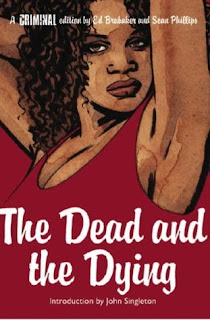
Review: Criminal Vol. 3: The Dead and the Dying trade paperback (Marvel Comics)

Người đăng: Unknown on Thứ Hai, 27 tháng 5, 2013

Criminal Vol. 3: The Dead and the Dying[Guest reviewer Zach King blogs about movies as The Cinema King]

On first glance, Criminal Vol. 3: The Dead and the Dying is a set-up for disappointment. The volume is short -- collecting only three issues -- though the editors have tried to obfuscate this by using noticeably thicker pages. What's more, this the third Criminal collection marks a soft reboot of sorts, with the single issues renumbering back to #1 (no, no Pandora cameo to be found).

What might turn off some readers is the fact that this trade collects three chapters billed as stand-alones, straying from the longer format of the first two volumes, which might lead readers to treat it less seriously. But as usually happens with these Criminal trades, The Dead and the Dying is a marvelous surprise that's almost impossible to put down.

What the book doesn't tell you right away -- and I almost feel bad revealing it here -- is that the three stories aren't stand-alones. Instead, they're interlocking parts of a larger story, and a great deal of the book's enjoyability comes from tracing the way these three stories are related. In the first, "Second Chance in Hell," we learn about boxer Jake Brown and his strained friendship with mob heir Sebastian Hyde. The second, "A Wolf Among Wolves," introduces Teeg Lawless, the father of last volume's Tracy Lawless, and explains how he came to work as an enforcer for the Hyde family.

The final story in the collection, "Female of the Species," fleshes out the character of Danica Briggs, the unlikely femme fatale who enmeshes herself in the book's events and turns out to be more human than any of her lovers know. "Female of the Species" pulls the book's threads together, explaining Danica's motivations and fleshing out her connections to Jake, Sebastian, and Teeg.

The most potent feeling channeled by this volume is that of epiphany. There are many moments of intersection among these three stories, moments when puzzle pieces click into place. Some take the form of repeated panels (almost outdoing Watchmen in this regard), while others fill in storylines the reader hadn't noticed. For example, in "Second Chance" Sebastian Hyde vows to find those who had wronged him, and in the next panel one such enemy turns up dead. But while readers fill in that Sebastian was the killer, "Wolf" reveals that Teeg was the triggerman, a clever and satisfying twist that deepens the shared universe feeling of Center City.

After reading The Dead and the Dying, I have to wonder if Brubaker has a master story in mind. Before this point, it seemed that Criminal was going the route of Sin City, with standalone installments set in the same gritty locale. But seeing how deftly Brubaker puts the pieces together here, I can't help feeling that there may be an overarching narrative developing. (Update: I've since discovered that there is an unwritten "final" Criminal story named Coward's Way Out, suggesting to me that the series is going to end where it began.) This book explains Teeg's coldness toward his sons -- a surprisingly touching moment rendered by the noirish narrator -- and backfills the rise of the Hyde family, pointing to an interconnectivity beyond the Undertow Bar (owned, of course, by Jake).

The artistic consistency on this title is not to be underestimated here. Sean Phillips returns for this volume, and I can't be happier about that. One of my only complaints about The Invisibles was the rotating artistic team which led to an overenthusiastic jam session and characters who could look wildly different from issue to issue (here's looking at you, Lord Fanny). So the continuity provided by Phillips is a welcome presence. Sebastian is instantly recognizable as a young man who will eventually grow up to become the crime boss from the end of Lawless, and the use of visual repetition reverberates throughout the book, echoing across pages when you least expect it. Criminal is subtler than his gory Marvel Zombies, but it's no surprise that Brubaker keeps him around -- Phillips is comics noir.

If I had doubts about the longevity of my interest in Criminal after Lawless failed to surprise me, Criminal Vol. 3: The Dead and the Dying restores my dedication to the series. Brubaker and Phillips prove that they continue to innovate, within both the crime noir genre and the comics form. Center City may be populated by the dead, but the series is alive and well.
More about →

Review: Criminal Vol. 2: Lawless trade paperback (Marvel Comics)

Người đăng: Unknown on Thứ Năm, 16 tháng 5, 2013

Criminal Vol. 2: Lawless (Marvel Comics)[Guest reviewer Zach King blogs about movies as The Cinema King]

I came out of Coward, the first Criminal volume from Ed Brubaker and Sean Phillips, with a compulsion to seek out more crime comics, especially the ones by this creative team. The second volume, Lawless, continues developing the shared universe in which these stories occur with considerable inventiveness, but it is for a number of reasons an overall less entertaining read than its strong predecessor.

After a military scandal which led to his untimely departure from the service, Tracy Lawless returns to Center City to avenge the murder of his brother Ricky. All he knows is that his brother Rick was betrayed by a member of his own crew, so Tracy infiltrates the gang to learn the truth about his brother's death. But as Tracy takes Rick's place in the gang, he learns that his brother's past was more complicated -- and more twisted -- than he expected, even as his investigation leads him to the most corrupt of the city's real power brokers.

As a follow-up to Coward, Lawless has a very high bar to match; I was extremely impressed with Coward and quickly understood why the series was gaining high marks for originality. How, then, do you do an original sequel? Brubaker negotiates that territory by opening up a new corner of Center City rather than following up with Leo and the rest of the gang from the first trade.

If Coward was Brubaker's reexamination of the heist story a la The Italian Job, Lawless is his revenge film in the vein of Get Carter. But in Lawless, Brubaker doesn't do as much as I was expecting to subvert the genre. While he does play with expectations by making the case about who Rick actually was rather than who killed him, the central mystery of the triggerman is quite transparent; anyone with a passing familiarity with noir revenge films will probably spot the culprit right off.

But even a predictable Brubaker story is still a first-rate read. Tracy's voice is clearly different from Leo's, and the narrator is hard-boiled without clutching cliches in his teeth. More interesting, though, is the way that Brubaker plays with time in Lawless. Coward was more linear, its protagonists haunted by a past we dispensed with in the prologue, but in Lawless the book itself is haunted by an intrusive past that appears without warning, disorienting the reader and forcing us to restabilize the narrative.

Take the book's first page, which opens with Tracy standing over a dead body. A few panels later, we see the murder itself; by the end of the first chapter, we see the moments before the murder. This wibbly-wobbly approach to chronology is initially jarring, but it smartly helps us to understand Tracy's relationship to his past so that his surprising decision at the end of the book at least seems justified. It's clear that there is more to Tracy's story yet to be told, so I'm eager to see this character recur in the shared universe of Criminal.

Brubaker is again teamed with Phillips, and it's a peanut-butter-and-jelly partnership that makes absolute sense, like Morrison/Quitely, Lee/Kirby, and Moore/Gibbons. Phillips's use of shadows fits perfectly with the neo-noir vibe, cultivating a sense of danger melded with intrigue. His facial expressions are subtle and sketchy, expressive without too much distracting detail. Better still, each character has a unique look, with signature expressions that help the reader keep everyone straight while getting a sense of who's telling the truth and who's lying. At home both in the bedroom and in a shootout with the cops, Phillips's art solidifies itself as an essential component of the Criminal ambiance.

Though it doesn't break new ground in the same way that the first volume did, Lawless retains a readability that raises the profile of crime comics; I haven't read something as deceptively straightforward since Frank Miller's Sin City, with both doing exciting things in the realm of capeless comics. If the recent move toward creator-owned comics produces more books like Criminal, I'm all for it.
More about →

Review: Criminal Vol. 1: Coward trade paperback (Marvel Comics)

Người đăng: Unknown on Thứ Hai, 15 tháng 4, 2013

Criminal Vol. 1: Coward[Guest reviewer Zach King blogs about movies as The Cinema King]

When I first began to read comics as a very young child, the lure was simple -- Batman. Get anything with Batman on the cover. I expanded my net as my knowledge of the characters increased. As I got older and my budget got tighter, I matured into seeking out specific creators -- first writers, then artists as my aesthetic palate became more sophisticated.

Now I'm at what might be a third age in my maturation as a comics reader; I'm deliberately and specifically seeking out creator-owned work. It's not a political move, strictly speaking, since the bulk of my pull list is still company-owned. But I'm now conscious of the freedoms afforded to creators who own their own work, and with many of my favorite creators moving there exclusively, I can feel my palate refining once more.

As a fan of Ed Brubaker's work, particularly on Gotham Central, and having "met" Sean Phillips in the Marvel Zombies series, I was excited to dive into Criminal, their ongoing crime noir. Gotham Central it ain't, but by the end of the first volume, Criminal Vol. 1: Coward, the series more than lives up to the hype.

Coward starts out as your typical heist story. After a bank job goes wrong, Leo is contacted years later by a few dirty cops who offer him the opportunity of a lifetime -- the time and location of black diamonds being transported out of evidence. With a bad feeling in his gut but owing a favor to Greta (the widow of a crew member on the bank job), Leo takes the job -- and regrets it as soon as the deal, inevitably, goes sour. On the lam with a wounded partner, a junkie Alzheimer's patient, and a suitcase full of the wrong loot, Leo reevaluates his position but vows to continue to live by the rules that have kept him alive so far.

Coward is one of those books that you need to finish in order to "get" it. I'll be perfectly honest: halfway through the book I almost put it down. "I can't do six volumes of this," I told myself. The book was full of cliches and heist narrative stereotypes (most of which I recognized, oddly enough, from Inception of all places), and I didn't see them being used particularly well. Strictly speaking, I'd never read a crime comic before, and Coward wasn't impressing me.

But when everything goes to hell right around the end of Chapter Two, Coward becomes impossible to put down. Brubaker reveals that none of the apparent cliches were performing as expected, and when he reduces the cast down to Leo and Greta for a few scenes we find that this is a noir with a heart as much as a gut feeling. All of a sudden I find myself just one more voice among many echoing how clever and ingenious Criminal is, but I can't help it; the book is infectious, provided you stick with it.

On art duties, Sean Phillips is doing solid, gritty work that recalls the best of Gotham Central. Phillips pulls no punches; this book is not for younger readers, and Phillips knows it. Blood sprays, scarred torsos, and drained corpses proliferate in this book, and Phillips captures all of them in stark visceral detail that'll make you cringe at least twice. It's apparently a great creative partnership; Brubaker thanks Phillips at the end "for drawing it the way I see it in my head," and if that's completely true it bodes well for the future of the series.

Though Criminal consists of mostly standalone stories in a shared universe, it's evident that Brubaker and Phillips are building a world and an accompanying ambiance. Though I don't fully understand the meta-levels of "Frank Kafka, Private Eye" -- a comic-within-a-comic a la Watchmen -- I do see that I'm reading a longer story than just the fate of Leo. More interesting are Leo's "rules," since any noir fan worth his or her snuff knows that an alternate code of conduct is what brings us back to noir. Leo's rules are self-centered, smartly so, the consequence of generations of thieves and pickpockets raising each other. And when the rules are broken, the story gets more twisty and more interesting.

It's gritty noir, yes, but it's emotionally compelling as well. Though Leo starts off as just another hard-boiled narrator, his attachment to the mentally-impaired Ivan humanizes him, as does his obliging devotion to Greta and her young daughter. Greta is perhaps more intriguing; Brubaker wisely avoids the femme fatale trope for this outing, instead opting for a much more compelling and more human character whose materialism is matched only by her maternalism.

And it's the mark of a great story that, when characters die, I'm sad to see them go. Dickens likened the relationship between book and reader to a friendship, and while the characters in Criminal: Coward aren't exactly buddy figures you become attached to them in very subtle ways. It's impossible to say when I made the shift from rolling my eyes at Leo to rooting for him; it's probably when he too realizes that he's in a different kind of plot altogether, but it's to Brubaker's credit that he doesn't write moments designed as "insert empathy here" scenes. Instead, the power of the story and Phillips's sympathetic pencils do the work for you.

All you have to do is keep reading. After a few pages, you'll find it impossible to stop.

[Printed on glossy paper, but without full covers. In a way, the lack of covers is a credit to the trade, since it encourages you to treat it as a graphic novel and not a "mere" collected edition. In short, this is a book that fosters the one-sitting read.]

Later in the week, the Collected Editions review of China Miéville's Dial H Vol. 1: Into You. Thanks!
More about →