a brief introductory note to this conclusion:
 What follows isn't what I intended to publish next on this blog. In fact, I'd written several pieces in this series on"Kingdom Come" which I won't be using now. It's become obvious from the marvellous comments that folks have left over the past few days that I'd only be repeating myself if I did. The points I'd intended to reinforce over the next couple of pieces have obviously been made, or rather, I suspect that folks were always ahead of me anyway! And so, farewell to a few thousand words on why Batman's justifications for his "police state" were clearly spurious, and a few more on how I believe that Wonder Woman is least culpable and most admirable character in the whole book. A chat about Magog and an analysis of how the Kansas Gulag ignored a hundred years of criminal psychology have also been proven to be unnecessary. I'm very grateful to the those who've left the estimable comments which have helped me grasp that a shift of direction would be a good idea. Thank you! Consequently, I've changed tack and jumped ahead to the conclusion of this series. I say this because I hope that the change in direction doesn't jar with anyone who's been kind enough to pop in before, and to give credit where it's due to the folks who have kept me on my toes.
 14.
14.
Force is all that counts in the world of "Kingdom Come", and we're never shown any other means of resolving conflict than force in Mr Waid and Mr Ross's tale. The big men and the big women hammer away at one another for chapter after chapter until eventually the grand and concluding punchup of thousands of metahumans outside Superman's gulag is ended by the Secretary General of U.N. ordering the dropping of three particularly powerful nuclear bombs on all concerned. And even after that point, as we'll discuss, and despite all appearances of a peaceable ending, the story of "Kingdom Come" continues to be that of extremely powerful individuals closing debates with the threat, if not the application, of force.
 It does seem extremely odd that no-one at the closing of "Kingdom Come" thinks to produce any formal, or indeed informal, mechanisms to ensure that the superpowered folks of that world don't decide to resume their profoundly anti-social behaviour. After all, the numbers of the metahumans have only been radioactively culled, not wiped out, and nothing in the book suggests that the various magical and super-scientific processes which produce new super-folks in that comic book universe have been undone. It would be thought that securing some kind of organised peace that could be monitored and policed would be a desperate priority for the poor typical human beings of that Earth.
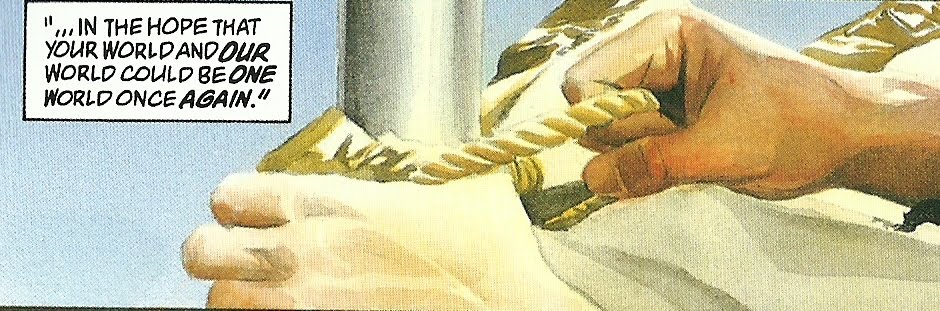
 But we see no particular provision being made in the post-nuke "Kingdom Come" to ensure that the metahumanly strong don't prey on the ordinary citizens of that world. Incredibly, there's not even the slightest sign, as we'll discuss, that the surviving superhumans grasp, let alone accept, the obligation for them to live according to the laws which bind their fellow human beings together; "... we were both wrong." piously declares Superman, who obviously feels that he's being a self-depreciating peacemaker, but, where the facts of lifer and death are concerned, quite the contrary has been true. For the terrible events of "Kingdom Come" close with Superman announcing to the United Nations that he and his fellow metahumans will be graciously retiring into their private lives "in the hope that your world and our world could be one world once again." It's a stirring if vacuous statement, perhaps, but it very much needs to be noted that this is nothing less than yet example of the superhumans dictating terms to super-powerless of the world once again.
 To Superman, there are two worlds which need merging, but there's no recognition that such a process needs to happen under the due process of law, or that one of those worlds was entirely responsible for all the great miseries that afflicted the other. Everyone, "Kingdom Come" is keen to tell us, is to blame, the superhumans for acting like "gods" and the people themselves for believing that the metahumans were "gods". Yet there clearly aren't two sides to this story. Even if the typical people of the world had felt an excess of reverence for the superhumans of the past, it hardly explains or excuses the ten years and more of metahuman attacks on civil society, or, indeed, Superman's disastrous behaviour since returning from exile. Believing that he could act like a god is in its turn a vague but promising first step in trying to understand Superman's actions as he charged across the world assuming the function of metahuman policeman and jailer,
 but it's not actually relevant as a plea for mitigation. The anti-social behaviour of the metahuman community, both before Superman's return, which he was indirectly responsible for, and afterwards, which he was directly responsible for, have come close to destroying human society. It's not a situation where one side's awe and the other sides barbarism are equivalent. The metahumans are responsible for what's effectively been two states of war, one against the typical humans and then a second against each other. Ordinary folks may have regrets about how they unwittingly encouraged or managed their response to these situations, but the metahumans are the ones guilty, to a greater or lesser degree, of a host of incredibly serious national and international crimes.
Yet, having in effect rebelled against every civil authority in the world in their many and varied and catastrophic ways, Superman is now unilaterally declaring that superheroes and metahumans alike will be gracious enough to stop committing all of those national and international crimes in order to pursue a peaceful and quiet existence as private and socially co-operative individuals.
 Certainly, it just doesn't seem to have penetrated Superman's head that his behaviour, his illegality, and that of his comrades, has created a situation so very serious that the U.N. with the apparent consent of the American government has felt it imperative to nuke thousands of its own citizens on its own territory. Kal-El has responded to this admittedly shocking event by spiralling through a series of moods; rage at being atom-bombed, shock and fury about the death of his fellow super-people, love for all of costumed and non-costumed humanity; but he doesn't seem able to understand the central issue that it's mostly his fault it happened. With a great hillside of metahuman bones just a few minutes in time behind him, Superman expresses to the U.N. not so much a guilt-ridden recognition that his serial criminality has led, as it was inevitable it always would, to mass tragedy, but rather that;
"The problems we face still exist. We're not going to solve them for you - we're going to solve them with you - but living among you. We will not longer impose our power on humanity. We will earn your trust - - using the wisdom (Captain Marvel) left as his legacy ..."
 It's the key scene in the book. The surviving, woeful-looking and wounded "heroes" and other metahumans gather before the United Nations, look beneficent and somewhat regretful, and, apparently, all's well.
But all Superman's words prove is that nothing has changed on a fundamental level. Who would trust this sudden about-face from a man capable of punching the moon out of orbit, who, just literally seconds before, was ready to drop the roof of the debating chamber onto every representative's head, regardless of whether they'd protested, as many did, about the deployment of the nuke in the first place? ("Run! He's wielded the doors!") Who would trust a "superman" who in the space of an hour has gone from clueless tyrant with his own prison camp to avenging monster to the loving friend of the people? No matter how traumatised this Superman is, he's clearly not a rational creature at all.
 But more than his instability, it's the dictatorial manner in which Superman announces and effectively imposes the terms of his improvised plan for future co-existence that shows us that nothing much of substance beyond "don't build over-crowded prisons for super-villains" has been learned. Because it simply isn't Superman's place to declare how he and his fellows will be treated from now on. Superman doesn't get to determine his own relationship to national and international law. He and his cronies and camp-followers are guilty as hell where their crimes are concerned. He doesn't seem to understand, but "Kingdom Come" hasn't solely been a learning experience for him; it's actually been a period of world anarchy and social collapse following a decade of social disorder. This "Superman" has returned from exile and arbitrarily removed responsibility from the nations of the world for policing themselves, before brawling his way around the globe and then creating the conditions in the Kansas gulag for an apocalyptic confrontation between one beastly and one slightly-less-beastly army of metahumans. Whether we're talking about Superman's League, Batman's secret policemen or the metahuman recidivists, they've all attained that point of criminality where the best they might expect would be decades in prison. They're guilty of rebellion, mass kidnapping, mass imprisonment without legal sanction, multiple invasions of every single one of the Earth's nations, the illegal annexation of American territory to build the gulag on, the covert assumption of power in several of the USA's major cities ; the list goes on and on, and there's that literal hill of superhero bones in Kansas to raise the spectre of far more serious charges yet. Superman is so guilty of so many things that it's beyond belief. And yet he's setting the terms without forethought or consultation for how the entire world will progress from that point onwards?
 It's so very notable that democratic principles still utterly elude this super-powered idiot, this tyrant who believes that he can impose without debate the terms of his retirement. He neither consults with the men of the U.N. or even his fellow superheroes before declaring the terms of what is in effect a diktat. If he had the slightest grasp of the social contract, he would apologise for his endless crimes, accept that that can never be enough, and ask to be taken away to be detained and tried. An understanding and acceptance of the rule of law could permit no other scenario. His colleagues would then have to consider whether they'd follow suit or whether the undeclared war would role on, for a Superman who believes in human rights couldn't speak without consultation for his fellows. And then, perhaps, the world might decide on a metahuman Truth and Reconciliation policy, with education programmes delivering the basics of law and morality to these costumed moral children, or, perhaps, at the other extreme, there might await a lonely cell, a table to lie on and Kryptonite gas being pumped into the room. But whatever the result of surrender to the authorities, the fact, the unarguable fact, is that what happens from that point onwards is nothing to do with Kal-El and the metahumans at all. They have forfeited their civil rights to the degree to which they must be imprisoned and tried.
 It's the very principle of equality before the law and the sanctity of the state's power that inspired Superman to flee into exile all those years ago. The "hungry" people refused to find Magog guilty despite the law declaring that he was so, and Superman fled in disgust. When he agrees with the law, it's a sacred body of principles guiding right action. But when things go against him, the law disappears from his list of priorities entirely. If Magog had acted as he did, Superman would have delivered him to the courthouse, if he'd not locked him up in a private dungeon for reeducation first. But since Superman himself has committed these crimes, they cease to be important to him.
And so Superman doesn't ever consider that he should surrender to the law. Not for a second. He's still the dictator of his people, whether he can conceive of that fact in those terms or not, and by extension he's the boss of everyone else, and he will the judge of what everybody will do.
 15.
15.
Why does the United Nations accept this diktat?
They must be utterly terrified of him.
I know I am.
Not because he's powerful, but because he's powerful and self-obsessed and ignorant.
 16.
16.Having presented Superman laying down the terms by which everyone will live from now on,"Kingdom Come" clearly wants the reader to believe that a new golden era is arising on Earth. The radioactive desert that was Kansas is to a degree tamed, the endless
metahuman public affrays cease, and the
powerful and the merely human of this world are free to spend their afternoons eating fast food in each other's company in "Planet Krypton", albeit with one group being ignorant of the presence of the other. And "Kingdom Come" is happy to present us with the wondrous rewards that Superman, Wonder Woman and Batman have received in their lives since the destruction of the gulag. Clark and Diana are married and expecting a child, and both appear to have private existences which are both challenging and personally satisfying. Bruce Wayne appears to be deeply concerned with hospitals, prisoner reform and metahuman reconciliation, and he's become a pleasant enough man to even hug Clark at the closing of the tale's epilogue.

These folks are undeniably the heroes of "Kingdom Come". Their actions have been richly rewarded. They are living good lives doing virtuous things and they are happy. It's an illusion that seeks to convince the reader that this world is now reconciled and peaceful, returned to decent and productive ways in which all are equal, as if they were all a great melting pot of surviving metahumans, superheroes and humans being served together in the same metaphorical fast-food joint.

But the text of "Kingdom Come" tells a very different story. There's no evidence that Superman and his cronies have suffered the slightest inconvenience as a result of their many and various crimes. Whereas the likes of you and I may see, and quite rightly, the inside of a jail cell for persistent tax fraud, the Trinity and their friends can take over much of the world and reap not punishment, but excesses of rewards! And the suspicion that the superheroes and metahumans are still very much not equal with others under the law can be easily confirmed. For example, the closest to cooperation between human and superperson we see involves Alan Scott taking his place at a table of delegates at the U.N. Green Lantern, it seems, has created a nation called "New Oa", despite already being a citizen of America and subject to its laws. (That's one way to avoid censure; create an entirely new nation. Not an option open to most of us, of course, but that's one advantage of a magical power ring.) Now, whatever constitution this New Oa has, and I actually suspect that it has none at all, I very much doubt the matter of "of the people by the people and for the people" has come into play in its creation. Alan Scott may have a seat at the high table of international affairs, but he's there as a lord, and not as a citizen.

Green Lantern's fellow ex-superheroes seem similarly oblivious to what they've done and have been similarly rewarded by fate. We see Bruce Wayne, for example, announce to Clark and Diana that he's
"put several members of the Mankind Liberation Front to work in our ad-hoc
hospital.", adding
"They're pulling their weight." An "ad-hoc" hospital is a very strange sounding institution indeed, unless there's a specific emergency underway, and yet the scene in which Wayne makes this declaration is set a year after the Gulag nuke and in a time when there's no sign of turmoil or trouble at all. Why would Wayne have an "ad-hoc" hospital and who is the group that he refers to that owns it with him? More worrying yet, Wayne not only has his strange ad-hoc hospital, but has access to prisoners whom he can put to work against their will there. It's impossible to understand what legal code this might be possible under, but it's not one that the likes of you and I are covered by or subject to. Yet, something very odd has obviously happened where Wayne's relationship to the new post-gulag world is concerned; he's in charge of the fate of Earth's human super-villains!
"You've had no trouble with the MLF?" asked Diana, and Bruce's reply indicates that he's most definitely in charge of the fate of the likes of Lex Luthor. This man, whose various crimes and misdemeanours we've discussed and which we'll briefly discuss again, has somehow ended up with a position of significant authority in the new world's legal system. It's one thing for the old superheroes to somehow be allowed to enter a private existence without facing the consequences of their action, but it's inconceivable that any of them would be given such formal power instead.

But the absolute closer as far as any suspicion that the ex-superheroes are still effectively making up their own rules is that the prisoners being put to work under Wayne's authority are wearing
"inhibitor collars". As Wayne so despicably and yet so smugly announces;
"Mind you, (the prisoners) would be (pulling their weight) .... Inhibitor collars keep the rowdier ones ... subdued."Ah, the utility of that word
"subdued", and all that meaning that's crowded into the notable pause that precedes its appearance. Bruce Wayne is using super-science to conscript criminal labour, and that phrase
"would be" is deeply worrying. It strongly implies threats and menaces. The constitution of this world's America has obviously been rewritten to allow the ex-Batman to do whatever he wants with these criminals, or perhaps he's doing as he used to, which was whatever he wanted to without reference to anyone else. And what Bruce Wayne wants here is to use methods which would be regarded, at the very least, as "cruel and unusual punishments" to press into work what we're told are extremely dangerous individuals. And in a hospital too!

And so, there we have it. The superfolks didn't join humanity, as Superman promised, but they rather continued to exist separate to it and above its laws. They escaped justice and now they define what justice and punishment are. They form their own imaginary nations, they walk where they want without answering to any one else, and some of them even run their sinister work programmes in ad-hoc institutions staffed by prisoners using "inhibitor collars". That neither Clark or Diana understand or are concerned by the things that Wayne is declaring he's involved in can be seen in the way that none of them thinks to protest about what their child's future Godfather is doing. Slave labour? Inhibitor collars? What's the problem?
"Kingdom Come" doesn't end on a vision of superhuman and human reconciled, but we should have always have known that they never would be. For as Kal-El announced to the U.N. after so reasonably deciding not to kill them following the Kansas nuclear attack;
"But I no longer care about the mistakes of yesterday."He no longer cares about the past. He's putting all that behind him. He's in charge and what he says goes. He means well. And yet he's learned nothing. Just moments before, he'd declared on the battlefield outside his gulag that
"Every choice I've made so far has brought us here - - has been wrong!", and yet here in the U.N. he's once again creating policy that will affect the very world and he's doing it off the cuff, with no thought of seeking consultation and advice, with no attempt to reference his decisions to anything other than the spirit of Captain Marvel's sacrifice.

Well, I no longer care about that parking ticket, or whether I might beat my neighbour to death tomorrow, or all those drugs I intend to produce and sell in the near future, then, since we can all determine what is and what isn't legally and morally significant for ourselves and damn the consequences. Why, I'll live wherever I want and do what I want and pretend that we're living in peace under the rule of law rather than existing in an unacknowledged dictatorship.
For the absolute
audacity of that statement, of Superman's declaration that he
"no longer cares about the mistakes of yesterday" beggars belief. What couldn't he forgive himself according that calculation of responsibility? I no longer care about those countries my men and women invaded, perhaps? Maybe, I no longer care about the deaths of all those associated with my gulag? I no longer care about the civil rights I violated?

Look, this lovely book, with its kaleidoscope of ideas, its fine scripting, its quite brilliant art; it's unintentionally ethically
appalling. It wants us to love monsters and forgive them everything. It wants to show us the Superman who so selfishly rejected the world in the pose of Jesus the carpenter, to show us Kal-El not as a democrat apostate but our saviour, bringing peace where only war existed before. "Kingdom Come" even shows us Superman in the pose of a martyred Jesus in the aftermath of the Kansas nuke, as if we should be pitying
him rather than the thousands upon thousands who died there because of the circumstances he in his arrogance and ignorance created.
 17.
17.Superman's lack of moral transformation combined with the rather marvellous life he's gifted with in the epilogue of "Kingdom Come" becomes all the more disturbing the more this reader considers it. Perhaps most worrying is that Superman has never altered his opinion of the people, which means that he's something of a hyper-powered timebomb just waiting to be upset by the facts of modern social life at some point in his world's future. As he states when imposing his vision for the future upon the United Nations;
"Years ago, I let those I swore to protect drive me away."But they
didn't drive him away. Some of those he'd sworn "to protect" expressed opinions he didn't approve of. He was never driven away. But to this Clark, who never realises that he left his fellow citizens to suffer and die because of his decade-long hissy fit, the people were worse than misguided; they forced him to leave them without their main protector because wouldn't allow him to get his way all of the time. The
people are
still those folks who were bad to him, who persecuted him so badly that he left the world entirely behind, and he still believes that. He's not returned to live among them again because he accepts they had a right, and indeed a duty, to do as they did. He's returning because, as is the way with history's big men, he's decided to be good to everyone even though they don't deserve it.
They were wrong, and, well, he was wrong too, but they were wrong first and
he's learned to rise above that.

"I choose life." says Superman as he lays down to the nations of the Earth the terms by which they'll be allowed to co-exist with the nation of Kal-El, as if the choice before all of them was one of solely life or death, rather than law or anarchy, order or vendetta. He might as well have said "I choose life ... and anything else I so damn well choose", because that's what's effectively happened.
Might makes right.
Apres moi le Deluge.
 18.
18.
But it's important to remember that "Kingdom Come" is morally consistent from beginning to end. It's not a book that ends corruptly so much as one which is tainted from the very first page. The metahumans and their costumed pals are
always shown inhabiting a world in which might does indeed right, and in which everyone but the most powerful are helpless and behave accordingly. There's even a strict pecking order of power and autonomy in the ranks of the superfolks. There, as elsewhere, the only thing that matters is force, as shown in the scene where Wonder Woman begs Superman to come back and try to save the world from the mess he'd left it in in the first place;
"Our generation takes its lead from you. We always have. You must face this. If you don't, neither will the rest of us."What's remarkable about this statement is that Wonder Woman is including herself in the ranks of the immobile, initiativeless superheroes. Without the Alpha Male of Superman to tell these apparently heroic individuals what to do, the entire cast of DC Comic's Silver-Age superheroes have collapsed into an atomised, disconnected and often quite disengaged existences. The suffering of great mass of people can't motivate them to stand together in the open and fight for their fellows, but a word from Superman would do it.

It's worth taking a moment to absorb what the ex-Princess Diana is saying here. She and her fellows haven't acted despite ten years of metahuman horrors because Superman had turned his back on all of them and isn't around to tell them what to do. This is surely nothing more than the
Fuhrerprinzip taken to its extreme. In the absence of the charismatic, rightful leader, not only are the people lost, but they have become mindless and heartless too! It's a default position of absolute obediance that the surviving superheroes return to even after the debacle of the gulag.
"What next?" Wonder Woman asks Superman, in the midst of the U.N. after Superman has managed not to kill the various representatives of the world, as if her brief moment of violent independence from his lead was a moment of light-headedness and his serial incomptency no bar to his taking the lead and speaking for all of them at this most delicate of moments.

To try to explain how this could be, Mr Waid uses The Spectre to express the effect that the withdrawal of Superman from the superhuman community had upon his fellows;
"The shock of seeing Superman suddenly abandon his never-ending battle took an immeasurable toll on his contemporaries, his peers."And it can't be denied that it did. They ran away from their duty and the society which relied upon them. Some of them gave up entirely. Some of them hid away when the public needed reassurance and protection and worked to undermine the American state and people through creating "Utopias" and "police states". Some of them gave up and joined the ranks of the warring Metahumans, with many at best shrugging and deciding to share a beer or two with the new immoral society-destroyers in the metahuman-only bars. As we're told;
"Instead, cued by Superman's surrender, they journey apart .,.. divorced from the common man who they once so gladly served ... "
But they surely
didn't serve the common man, gladly or otherwise, despite what Kingdom Come tells us; they served Superman, and though 350 million Americans and 6 billion citizens of the world stood in need of their help when Kal-El stomped away, those common men, and women and children, obviously meant nothing.

These once-Teen Titans we're supposed to tearily-eyed cheer as they return to active costumed service? That ancient Green Lantern who built a great city in orbit for alien activity that never came, and who yet couldn't step in to stop one metahuman scrum on Earth over the period of a decade? That Hawkman who decided to attack illegal loggers rather than use his immortal life's experience of government and war to help the world defend itself? That Green Arrow who was once a leftist firebrand and a Mayor of Star City and who instead helps to create a police state in Gotham and beyond?

Where were these
superheroes when Superman ran away? And why are we being asked to accept their retirement as enforced and tragic and their return as heartwarming when in truth most of them left the world to rot, and those who didn't set out to replace America's democratic state with something far less ethical indeed. Why were their principles as adults so twisted that they stopped working with each? Why did the Flash impose an ethically-dubious "Utopia" on his homecity by preventing
"even the most harmless of wrongs", an environment so meaningless that even the most over-controlling of leftist proponents of the nanny state would be appalled by it? How could anyone learn from their mistakes and develop as an individual in such a city? How did Batman manage to justify his fearful police state to himself, let alone the fact of his monopolising the technology which protected his nation-within-a-nation while denying it to the defenceless American people as a whole?

How were these superheroes ever accepted as a League of Justice? And why haven't they learnt anything about the stupidity of following Superman even after all that's happened in "Kingdom Come"?
 19.
19.
The creators of "Kingdom Come" want us to believe that these
"costumed champions", these
"legends", of the old Justice League of America are tragic but fundamentally decent individuals whose mistakes, whose
simple and
quite understandable mistakes, ultimately fail to tarnish their virtue at all. They stray from the path, as it were, but they learn from the experience and they return to the way. But the truth is that there never was any straying to do, because none of the characters on show ever had the slightest sympathy with, or indeed understanding of, the principles that their nation was founded on. If they had, they'd never have behaved in the way that "Kingdom Come" shows them doing in the first place. A Batman who declares that he's created a Gotham City where he's glad to say the people
"fear" him, and who argues that he doesn't
"want to rule the world ... just ... straighten it out ... our way ... by ourselves", never understood what the Constitution of the USA, or indeed the United Nations, ever meant in the first place.

Superman and Batman and his fellow superheroes don't just make a few
mistakes in "Kingdom Come". They enter the book without a shred of understanding about what it means to be a good and responsible citizen. They simply can't recognise the legitimacy and worth of their own government or its people because they don't understand the simplest terms in the social science lexicon. When we're told towards the end of "Kingdom Come" that Superman
"cannot comprehend how things came to this", it's simply a statement of the truth. He lacks an understanding of what
community and
government and
law are and so he can't comprehend how their absence in his calculations has created such desperate circumstances.
"We have to work togeth --" he begins to say before being punched out by Captain Marvel again, but in a wider sense, he''s still missing the point. The
"we" that Superman needed to
"work" together with wasn't a select band of metahumans. It was
everyone.

Our world is full of folks claiming that they represent the nation, the constitution, decency, democracy and whatever else it might be that could win them power of one sort or another through its misrepresentation. And in these decadent times, when the very fact of demcraacy is so often taken for granted, and when a clear understanding of what democracy actually means is so depressingly rare in our public debates, the playing around with democratic ideals in a comic book while unconsciously promoting a quite undemocratic agenda is a carelessness well worth thinking about, and, in future, avoiding too.
 Next time, a review of the second collection of volume two of Brian Michael Bendis's Ultimate Spider-Man. My thanks to all who've dipped into this piece, and a splendid day, and a hopeful sticking together, to all of you. Huzzah!
.