1.
Everyone's at least something of a villain in "Iron Man II", except for some of our superhero's friends and those thoroughly unaccountable Agents Of Shield, and yet one of the very worst of the bad guys is Tony Stark himself.

2.
There's no doubt that one of the antagonists in "Iron Man II" is the American state itself, as represented by her government and her armed forces. The movie portrays Senators and generals as incompetent and self-serving individuals who simply can't grasp that Tony Stark should be permitted to do whatever he wants to because Iron Man is here to save us all. It's a juxtaposition between, on the obviously good side, a roguish and dynamic capitalist billionaire, and, on the clearly bad side, those conceited and short-sighted servants of the state, and it's a contrast that's strangely referred to by Jon Favreau in his director's commentary, where he discusses Stark's appearance before Senator Stern's committee;
"Here he is ... Howard Hughes trial ... where they're trying to nail this guy down, but his personality is too large. And he has public opinion upon his side, because he's doing wonderful things, and there is peace and there is prosperity. And he's more powerful than the Senate, and it's almost like Caesar. It's like a Caesar-like rise ... that we wanted to mirror .. "
It's such an odd thing to say, but it explains a great deal about a movie that sees Tony Stark repeatedly place the security of America and the safety of its citizens at terrible risk, before being counter-intuitively rewarded with a medal for his self-interested actions from the US Government.

Because Mr Favreau doesn't seem to grasp that Caesar destroyed the Roman Republic, and destroyed it because he acted in his own interests rather than that of the state. In doing so, he wiped off the map what little political freedom remained in Ancient Rome, and set the newly minted Roman Empire on course for decades of Civil War, hundreds of thousands of casualties, and centuries of despotic, rather than oligarchic, rule. Caesar isn't the hero of anyone's history but his own, unless you happen to be a fan of tyrants and their tyrannies, and I'm sure that Mr Favreau most certainly isn't that.
And Howard Hughes? Howard Hughes corrupted the American political process for decades with vast sums of illicit cash and huge reserves of political muscle.
Which means that positioning Tony Stark in their likeness, as they scorned the political process in the name of nothing but their own utterly-selfish interests, is either a considerable miscalculation, or the most subtle ironic colouring a director's ever given to a Hollywood blockbuster movie.

3.
"Iron Man II" isn't a film which can watched and enjoyed in isolation from the first movie in the franchise, beginning as it does at the moment that the main action of "Iron Man" closed. But there's a fatal discontinuity between the meaning of the first movie and that of the second, which means that the films don't so much follow smoothly one on after the other as they do stand in direct contradiction to themselves. In essence, the problem is that the Tony Stark of "Iron Man II" has either pathetically regressed from the self-knowledge he acquired from his trials, or that he's not the same person at all in the two films, despite all appearances.

4.
The first movie was a unpretentious masterpiece of concision and precision. The arc of "Iron Man" was, of course, the story of Tony Stark's heroic journey from irresponsible capitalist to humane businessman, and everything that appeared on the screen was subordinate to the simplicity and purpose of his vertiginous learning curve. The charming, charismatic Stark was a symbol of the destructive excesses of privilege; he was the capitalist with a supposed big heart and zero self-awareness, unable to help himself grasp that love was standing before him just as he was damning untold numbers of victims who stood where he could never witness their fate. And if Stark couldn't be said to be as crippled inside as the victims of his weapons were both in mind and body, he certainly wasn't benefiting from a life of such unimaginable wealth and indulgence, given that when trouble came, there was only Pepper Potts that he might truly rely on to help him out.

Tony Stark, in his impossible extremes of advantage and his various substance abuses, in his adrenalin-fuelled faux-narcissism and relentless promiscuity, was everything that the movie "Iron Man" was against. He was an unthinking, uncaring beneficiary of the freedoms of modern American society who had turned away from his responsibilities as an individual citizen and member of the human race.
People had died because Tony Stark hadn't even cared enough to recognise that what supposedly benefited him so greatly had horribly wounded and murdered them, and in the end, his disengagement from his moral self was going to terribly hurt him and then almost kill him.

5.
In retrospect, it's astonishingly how few characters there are in "Iron Man" who're granted even the slightest slither of screen time. There's Tony, of course, who's wounded the world and who now must be wounded himself until he chooses to grow up. There's Pepper, the symbol of the decent and loving life that Stark can't engage with as long as he remains corrupt. There's Rhodey, the mirror who shows us through his courage, strength and loyalty that Stark too has those qualities, or Rhodey couldn't care for him as he does. There's Dr Yinsen, who teaches Tony what it is to care for others at great cost to oneself, and who so tellingly helps to create a dysfunctional artificial heart for Stark which works better in a moral sense that his fully-functioning natural one ever did. There's Odadiah Stane, Tony's surrogate Father who's the symbol of predatory selfishness, the capitalist that cares for nothing so much as he does for more power and money. And there's Raza, if you can call him a character at all, a symbol of all the pain and suffering that inevitably gets kicked up when power without responsibility starts to meddle in other people's lives.

To feature just five characters of any substance and one type in a movie lasting longer than two hours is a remarkable achievement, especially as the film never feels sparse or under-populated. (*1) Instead, the remarkable accomplishment of the script and the production together is that text and sub-text are always pulling together in the same direction with considerable force and meaning. And of course, to do so, everyone's story is subordinated to Tony's, and as Tony learns what it is to be a human being and not a social parasite, so each of the others is either rewarded or punished according to the degree that they've sought and used power and wealth to hurt or help others.
Most importantly, Stark himself suffers grievously for his sins. He quite literally loses his own heart, an irony which was quite lost to Stan Lee when he wrote the initial origin for the character in 1963, and a fact which lay dormant in the strip for years until its metaphorical power became obvious and irresistible. And so, how brilliant is it that even Tony's new heart can't function properly until he rethinks it and then trusts Pepper to help him install it? He trusts her not just because he has to, because he has no-one else, but because he wants to, because it's the last act of his necessary emasculation and one of the first of his rise upwards, a process defined not by his ability to hurt others, but by his capacity to trust them and sacrifice for them.
"Iron Man" isn't just a brilliantly concise script. It's a marvellously constructed morality play. And since the morality and the story coexist and serve each other's interests all the time, the ending of the movie is far, far more satisfying than a typical popcorn movie blow-out.
*1:- I hope you'll agree that Ms Everhart is too slight a role to mention here.

6.
The assumption of "Iron Man II" seems to be that Tony Stark is now a hero and that anything he does will be a reflection of some moral superiority. Quite simply, Stark can do nothing wrong even when he's plainly doing little else but. Even the most terrible and immoral screw-ups by Stark in the film are swiftly papered over and retribution for them never arrives in the process of the narrative or even at its closure. In fact, Stark's failings and conceit are actually purposefully disguised or largely ignored in the story, so that behaviour which should be portrayed as at best immature and at worst profoundly dangerous are either shown as humorous, or worthy of pity, or even admirable.
Consider again Stark's appearance before Senator's Stern's Committee near the beginning of the film. The scene is fixed so that it's Stern who appears to be the dangerously would-be demagogue, and his scientific advisor Hammer is played out as a self-serving idiot. It's an ugly business, actually, because the case the two of them are putting forward is morally and politically correct in pretty much every detail. No nation-state could ever tolerate a private citizen owning such a weapons-system as the Iron Man armour, let alone retaining sole individual control over it. America is a nation where, for all the absence of gun-control puzzling to the European mind, weapons capable of flattening skyscrapers are, shall we say, tightly controlled. The Iron Man armour is capable of destroying any conventionally armed representative of the state that we might imagine, let alone flattening much of any city in the land, and so it's hard not to believe that Stark's possession of it would be, and very much should be, a cause for serious concern. Furthermore, Stark is a citizen of the USA, and it actually is his duty to share, if not indeed cede, the control of that technology. He's a citizen of the polity and it's utterly inappropriate for him to possess control of a super-weapon which could threaten the state. After all, if something happens to Stark without America having the scientific knowledge to prepare a defence against the proliferation of the Iron Man technology, the USA would be at a considerable disadvantage in terms of both conventional warfare and defence against terrorist attack.

Yet the film presents a fiction in which all Government servants, be they scientists, politicians or soldiers, are so utterly incompetent, if not also criminally viperous, that they shouldn't be in control of the technology used to make parking meters, let alone in charge of the nation-state of America and its massive arsenal. It's a fixing of the argument through misdirection and moral carelessness that ends up presenting Stark as a man of the people rather than one behaving in a profoundly anti-democratic sense. And yet, if the weapons system Stark had developed had been a selection of super-smallpox viruses, for example, I doubt he would be being seen by the audience of "Iron Man II" as the hero of the piece, threatening the nations of the world as he would be with a far less visually-inspiring and far more emotionally and intellectually disturbing threat. Indeed, few viewers would believe that any biological weapons Stark might create should be in anything other than a government laboratory if not a furnace.
It's as if we're all so beguiled by the beauty of the armour and the romance of wearing it, as well as the endearing marvel that's Mr Downey's performance, that we forget that Iron Man is a weapon of mass destruction that could create a disaster on the scale of 9-11 in a second, and that it couldn't ever be left in the private hands of even the best of women and men, let alone one prone to bouts of massively irresponsible behaviour.

But although the Iron Man armour is undoubtedly a WOMD, the movie is absolutely determined to portray Stark as the only human being who deserves to wear it, as if Stark's judgement is perfect, and perfectly in harmony with the needs of America's citizens, as if he'll never be too tired, drunk, ill or just plain human to run the risk of making a terrible misjudgment with all that power at his disposal.
As if everyone else in the American state is unworthy to even ask Stark if they can touch the shiny skin of his lovely armour.
But by refusing to share or destroy the Iron Man technology, Stark is, as Caesar did, putting himself above the rule of law. And, despite what the movie would have us believe, if you doubt that Senator Stern was correct in his argument with Tony, just recall the scene where Stark gets drunk, brawls with a similarly bearmoured Rhodey, terrifies his party-guests, puts them all at great risk and then destroys the building they're in. Whether it's his property or not that's been blown up by the childish punch-up, the very fact of the fight should serve as the beginning and end of the evidence needed to prove that Stark simply should not have that tech under his control. For he can't argue that he's trustworthy if he's plainly not, as if one catastrophic lapse of judgement is forgivable if you're Tony Stark, as if one little blow-up between two WOMDs on private property is a quiet petty matter of no social importance.

But then, it isn't just one lapse of judgment, and this movie's take on Stark provides us with an arrogant and ignorant man for whom the lessons of the first movie seem almost to have been quite utterly forgotten. He continually parades a habit of quite terrible decision-making, selfish behaviour and confused thinking in general. He claims, for example, that no-one else in the world can possibly produce weapons-tech similar to the Iron Man armour that might threaten America, as if he knows nothing of history, as if he's never heard of the complacency of the West before the Soviets exploded their own atomic bombs, and as if he doesn't realise that defence systems need to be developed now in case his brilliant mind is wrong. It's an unforgivable arrogance that the film never calls him on despite the appalling consequences of his conceit when Whiplash later uses stolen Stark technology in a vast terrorist atrocity which the movie chooses to portray as a rather thrilling special effects set-piece. And Stark's failure to adequately protect his super-weapon suits from theft, and Rhodey has no problem at all in stealing the "War Machine", is the root cause of the damage all those Hammer weapon suits rain down on Jersey. It's a carelessness on Stark's part that's the equivilant of the US Army permitting the removal of a nuclear weapon and its silo and everything in it, but the film would have us forgive Stark's lapse simply because we love him and trust Rhodey.
In such a manipulative fashion does "Iron Man II" smother us with illogic and sentiment to the point that we can't see Stark for the public and criminal menace that he is, and he undoubtedly is. We watch the film's climax, for example, where a smug Tony is being given that medal for his role in facing down Whiplash's assault upon Flushing Meadows, and we are supposed to have never noticed that it was all Tony's fault. He let the tech fall into Rhodey's hands, just as in his extreme arrogance he failed to focus on preparing a defence against the Iron Man system falling into the wrong hands or being developed independently. And so the responsibility for the firefight which destroyed so much of Queens at the film's climax, and which cannot have done anything but destroy of tens of lives and destroyed billions of dollars of property and vital civic resources, is all on Stark's hands. He really wasn't to be trusted, he really wasn't in control, and he really shouldn't have been permitted to keep those wonderful and ferociously powerful weapons in the garage under his little beach house.
He's not a hero and he doesn't deserve a medal, he really doesn't. "Iron Man II" is a movie that lies to us about what right and wrong are, just as the first movie did exactly the opposite.

7.
If "Iron Man II" is yet another movie that, without intending to, positions the state as an incompetent if not evil organisation somehow existing solely as a body to screw up the lives of otherwise virtuous individuals, it's also a movie that violates its own apparent moral intentions. For if the events of the first "Iron Man" are to mean anything, in sense of the broad ethical brushstrokes that inform Hollywood blockbusters, Tony has to be seen to have absorbed what he's learnt at such cost to himself and so many others in Afghanistan and in Stane's LA. It isn't, after all, a heroes journey if the hero returns from the land of dead and forgets to recall the truths that he learned there.
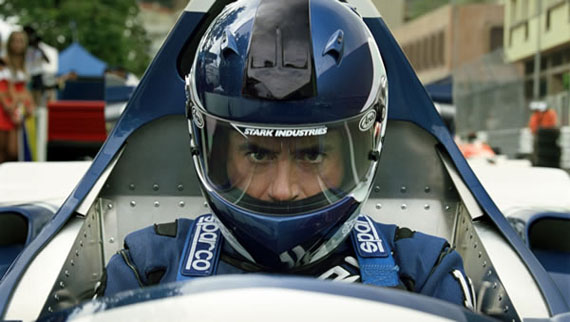
And yet the Stark we find in "Iron Man II" is plainly still a moral idiot, which might generate time-filling conflict and the audience's pity, but it isn't true to the first film. Unhappily hesitating to go to a party and yet drinking to excess before blowing the building up isn't a sign, for example, that Tony's reformed his ways. It's a sign that after all the trouble in the first movie, he still hasn't learned his lesson. He still can't trust Pepper, he's still an adrenalin junkie at the races, he's still courting the excesses of celebrity life, and he's still thinking of himself before others, even though he's slightly kinder than he was before.

For the first Iron Man movie is rendered a waste of emotional involvement if all that Tony can show in the way of self-knowledge in the second movie is a slight measure of gratitude and sorrow. And if Tony won't share or control his tech, control his behaviour, trust his friends or accept responsibility for his actions, if he permits himself the award of a medal when he should be in a cell somewhere, or being sued into absolute poverty in the law-courts, then he's learnt nothing.
And so, when the second movie ends on Stark being given that obviously worthless piece of metal and a pretty ribbon for his part in suppressing a major terrorist crisis which he through his negligence and arrogance caused, I can only conclude that the pressure of creating "Iron Man II" was so intense that Mr Favreau and his team missed the fact that the Senator should've been waving Tony off to a Federal Prison rather than spitefully sticking a tiny needle into Stark's chest.

8.
And so "Iron Man II" simply doesn't function as a conventional and humane morality play, which is a shame, because superhero movies always seem to work best when they're constructed to clearly reflect moral as well as personal conflicts. And yet, so diffuse is the second movie in its multiplicity of roles and ill-defined and separate plots, that it's hard to make sense of what it means on a symbolic level. Or more truthfully, it's hard to accept what the movie is saying given the excellence of its predecessor and the obvious gifts and hard work of the movies creators. But watching the film time and time again, it seems sadly true that it is indeed a film in praise of Caesar and whatever at all Caesar might choose to do, as if the individual capitalist and man of great power should indeed be granted the status of saviour of the Republic regardless of the fact that he's disobeying the Republic's laws.
It's as if any attempts by that spoilsport state to stop Stark partying with his repulsors, to deny Tony his apparent right to threaten to drop in and blow up foreign powers as well as homebased opponents, is somehow a threat to, rather than a denial of, civil liberties.

It's as if what gets said and shown in movies is irrelevant as long as the audience is having fun, fun, fun.
And the fact of that is a genuine shame. For in the first movie, Tony Stark was our representative in the world of the idle and uncaring super-rich. He was lost there and only became himself when he was locked away with his mortality and his guilt, with the memory of Dr Yinsen's sacrifice and Pepper's love for him. But "Iron Man II" has a quite different take on the super-rich, it seems, or at least, the capitalist class that are brilliant and wildly entertaining if socially irresponsible. Stark is a hero because he's Stark and we love him, regardless of what he does, but the government is unfit to trust, the army are all morons except for rare individuals who stand with our heroes even as they steal from them, democratic oversight is not to be trusted, and only the capitalists like Hammer who're too incompetent to produce good work without putting Russian super-villains to use aren't to be trusted.
It's not what you do that counts, apparently, but who you are, and whether we love you or not.
Worse yet, it's a movie that makes self-pitying excuses for the immorality and incompetence of its own hero. Tony's dying, so of course he can mess around with those WOMDs at parties. Tony wasn't loved by his father, so of course he finds it hard to love, and so on. But whatever the narrative evasions, the hero's journey doesn't permit excuse-clauses to modify whether the heroically-transforming programme takes or not, and so, this Iron Man simply isn't a hero, just as the Stark of the first film most certainly was.
9.
Nothing happened in "Iron Man" that wasn't designed to tell us something about Tony's fall and rise as a mensch. But the connection between events and meaning is so confused in "Iron Man II" that it's no surprise that the film closes with such a soggy and smug ending. The narrative's momentum is constantly slowed and often quite derailed by water-cooler moments and bright ideas that aren't connected to anything other than passing fancy and the need to get a movie into the theatres regardless of whether it makes sense or not. Why, for example, is Stark dying of the "palladium" in his system? If it's further punishment for all his sins as an arms manufacturer, or even for his continued arrogance, then how can we make sense of his release from slow death achieved by the odd and painless penance of learning to love Daddy? Stark hasn't sacrificed anything beyond accepting the evidence of his eyes and ears when faced with his father's dewy-eyed testimony on film. In fact, Stark's freed from his suffering while his appropriated technology is still out there in the world; the hero has been rewarded despite doing nothing of social value at all to deserve it. Nor does he seem to have learned anything of moral value from his experience of being poisoned, except that perhaps he might love himself abit more because daddy loved him. But then, Stark's journey in "Iron Man II" is to consistently screw-up and to then be helped out when he hasn't earned his rescue. Indeed, if he hadn't been given his father's work by Nick Fury, Stark wouldn't even have avoided a painful deathful by macguffin. He's survived through chance, through no specific sacrifice, and with no essential moral knowledge gained.
Well, what was the point of it all then?

It's another example of how any meaning that can be taken from the film is either absurd or disturbing, and that couldn't have been the intention. After all, if the Tony of "Iron Man II" is dying, the logic of the hero who's already faced death is to seek an end that helps others, not to go racing in Monte Carlo. And so even when Stark puts Whiplash's rampage to an end, he's only cleaning up a desperately awful mess that he's largely responsible for in the first place; it doesn't mean anything in terms of behaving heroically, especially given that he emerges unharmed and unreformed himself. He's not protecting the people so much as tidying up his own mistakes.
Tony's not even fully aware of the sins he's committing, because the movie-makers themselves don't seem to have been, or perhaps they didn't care, and so he can't convincingly earn absolution, let alone our respect, at the end of "Iron Man II". That medal stands for nothing of value at all.
Lost in a mass of plot-lines and a melee of barely realised and irrelevant characters, and hiding in plain sight beside moments of genuine pleasure and some extremely wearing camp slapstick, lies a reversal of moral purpose. The first Iron Man movie showed how Tony Stark became part of the human race. The second shows how he's somehow now superior to the rest of us, safe above his fellow citizens and their laws, and, look, he even gets a medal and the hand of Pepper Potts too at the end.

But that new heart of his is now powered by what Jarvis declares to be "a new element", an impossibly rare and expensive substance, the knowledge of which has been passed down from one generation of the inconceivably rich Stark family to another without having been made public knowledge in the meantime. The secret science that might save the world from all its energy problems has been locked away for decades until it might save Tony.
It's a story-fact that provides as coherent a meaning as any other from this confused movie, which seems to be about how the super-rich and the super-bright and the super-fortunate can do what they want in their own interests, and even in defiance of their best interests, even down to the hoarding of ideas that might so positively transform the world and weapons which certainly could destroy it.
But Tony already had a new heart, a heart that worked perfectly well. We saw Pepper help him put it into place, and the last thing he needed was a fancier, more expensive model at all.
 10.
10.Well, of course it's good fun. The creators and performers are clearly often brilliant. But it's confused and ill-thought through, and Caesar never was a hero. He brought down the Republic because he didn't want to do what the state demanded of him, because he felt that he was better, that he was more important, than everyone else. He was the most brilliant general with the most fearsome army in all of the Roman Republic and he wanted to do whatever he thought was best.
It's not a good example. You can't dress a democrat in a demagogue's clothes and not confuse the point, just as you can't have a hero who faces his own mortality in one movie and then forgets all the lessons he's learned when facing his imminent death in the next.

nb: added December 1st, 2010: there's an alternative and far more positive reading of the film offered by one Johnny Sorrow in the comments below. You'll need to scroll down a fair way, but it's a well-written piece and given that it completely disagrees with the above, I would recommend you take a look. It'd be worth your while.
Thanks you for visiting. Coming soon; "Darkest Night" and a 2000 ad-based piece. I hope you might consider dropping in at some time and seeing how those two ideas have developed, and that you'll accept my best wishes for your having a splendid day.
.