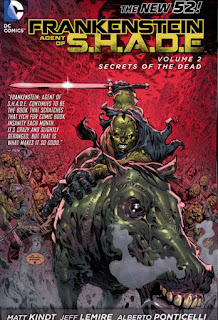
In
Frankenstein: Agent of SHADE Vol. 2: Secrets of the Dead, new series writer Matt Kindt continues the monster mayhem aesthetic found in exiting writer Jeff Lemire's
first volume of the series. There are minor blips in the transition from writer to writer, but these are minor;
Secrets, however, largely involves a crossover with the
Animal Man/Swamp Thing event "Rotworld" that serves the other two series far better than it does
Frankenstein. Kindt's writing of Frankenstein won't disappoint fans, but the push and pull of connecting this last volume of
Frankenstein with other series' events might.
[Review contains spoilers]Jeff Lemire contributes the first two chapters of this collection, which respectively close out Lemire's previous storylines and lead in to the larger "Rotworld" crossover found later in the book. The first chapter then (issue #8) is perhaps the first of the "concluding issues of
Frankenstein" found in this book, as Lemire reveals that it was controversy over the death of the "Son of Frankenstein" that lead to Frankenstein and his Bride's split. The issue ends with the Bride leaving the SHADE organization and raises the possibility that Frankenstein might do the same, a thread that continues through Matt Kindt's stories but never ultimately materializes (else the book might've needed a title change!).
Lemire's second issue, more exactly, picks up threads from Lemire's own
Animal Man series, prior to "Rotworld." Frankenstein and Nina Mazursky (the Creature Commando's human-hybrid sea creature) arrive at Animal Man Buddy Baker's mother-in-law's farm in the aftermath of the events of
Animal Man Vol. 1: The Hunt and fight Animal Man's enemy The Rot. Lemire's last issue doesn't add much to the
Animal Man storyline per se, but he begins to bring to fruition the romance between Frankenstein and Mazursky, and the issue ends in a way that might equally be the conclusion of the
Frankenstein series.
It's mainly because of where Lemire ends that makes the beginning of Kindt's story jarring; Frankenstein is apparently visiting his own book collection in the SHADE library when the librarian embraces and begins kissing him, and also tells him about a conspiracy within SHADE. Why the librarian becomes so amorous is never explained; this is just one of a number of odd "jumps" that Kindt's story makes. To some extent this works with the madcap nature of the
Frankenstein title (the librarian rubs up against Frankenstein precisely because it's absurd for her to do so), but it also demarcates, perhaps a little more than necessary, where Lemire leaves off and Kindt begins.
Kindt also takes Lemire's habit of spelling out SHADE's various strange acronyms and stretches it to an absurd degree; sometimes pages after pages have acronym asides. This is a little too cute; however, Kindt also introduces asides that give glimpses of the lives of Frankenstein's assorted body parts pre-monster, which is quite interesting (and chilling) and offered plenty of story potential had
Frankenstein not ended.
The three-part "Son of Saturn" storyline that starts Kindt's run, to extrapolate a bit, has a bit more of the secret-agent flair that Kindt is known for (
Mind MGMT, etc.) than perhaps Lemire's run did, not that there's anything wrong with that. Frankenstein and the Creature Commandos hunt the SHADE traitor
Mission Impossible-style through an alternate dimension; in a series of weird twists, Frankenstein ends up inside a sentient beast that houses SHADE's retirement facility, except some of those retirees are actually prisoners. The rumored conspiracy is actually a plot to trap Frankenstein before he can kill a rogue SHADE agent, who learned of his death at Frankenstein's hands through one of SHADE's future-seeing mechanisms.
If it sounds complicated, it is, and I might add that it's delightfully so, except that the issue ends with Frankenstein having gathered an army of SHADE retirees to fight "Victor" and the Rot. Victor is none other than Victor Frankenstein, the monster's creator, though how Frankenstein knew that Victor has returned or that he needed to gather an army to fight him is yet another of
Secrets of the Dead's unexplained jumps. Possibly in tying
Frankenstein to "Rotworld," some aspects had to be speeded up or glossed over; this shows also in a couple of issues where Kindt uses considerably heavy narration to move the story forward rather than "in the moment" scenes.
What follows next is the three part "Secrets of the Dead" "Rotworld" tie-in. The first part mainly establishes that the world has turned to Rot while Frankenstein has been away; the second has Frankenstein and the Creature Commando vampire Velcoro hunting pieces of the McGuffin soul-grinder across the Rotworld; and then in the third Frankenstein battles Victor using the soul-grinder. The second issue is the clear winner, as Frankenstein and Velcoro journey across the ruined Rotworld landscape in scenes reminiscent of Cormac McCarthy's
The Road; Kindt builds up the sarcastic Velcoro's personality well toward an especially effective ending.
Unfortunately, the "Rotworld" tie-in hardly needs its three issues, as some of the battles in the first and third parts get overlong. As well, the "Rotworld" story ends with Mazursky and others seemingly transformed into Frankenstein-like creatures, with Mazursky perhaps pregnant with Frankenstein's child ... and then the last panel directs the reader to the
Animal Man and
Swamp Thing "Rotworld" collections to see what happens next.
Not only, ultimately, does the book's major conclusion not feel complete, but also how the characters are un-Frankensteined between issue #15 and the final issue, #16, isn't explained, nor how the SHADE leadership, all of whom were apparently killed in the "Rotworld" story, have all come back to life. Surely those answers are in the
Rotworld collections -- my guess is time gets rolled back somehow -- but for those interested solely in
Frankenstein, it's a disappointing read.
Fortunately, Kindt gets to go out on a high note in which Frankenstein and the Creature Commandos, all live and restored, stop a dirty bomb from exploding over Central City and reveal their existence to a homeland security agent in the process. It is a one-off "regular" story with some deft perspective tricks, and it serves to give Frankenstein and especially the Commandos one last hurrah (Frankenstein appears next in
Justice League Dark, but I don't think the Commandos do), before the series comes to a close.
Whether by virtue of style or outside interference, I can't say Matt Kindt's
Frankenstein, Agent of SHADE: Secrets of the Dead is quite as strong as Jeff Lemire's
War of the Monsters, but it remains that any
Frankenstein is good
Frankenstein, and Kindt's is close enough; series artist Alberto Ponticelli draws every issue including the Zero Month issue included here, giving the book a nice consistency overall. One chapter for Frankenstein closes; I look forward to seeing the character again in his new home.
[Includes original covers, Alberto Ponticelli sketchbook]New reviews on the way!


