Hiển thị các bài đăng có nhãn Secret Six. Hiển thị tất cả bài đăng

Review: Secret Six: The Darkest House trade paperback (DC Comics)

Người đăng: Unknown on Thứ Năm, 16 tháng 2, 2012

That a book where a man's fingers are bitten off and another pours hot sauce in his own eyes can also be one of the most heartbreakingly touching collections I've read in a long time is testament to the prowess and creativity of writer Gail Simone.

Secret Six: The Darkest House offers a superb conclusion to this series; the Six try, for once, to save themselves, and it ends up leading to their annihilation. Simone knows the only way Secret Six can end: tragically, but also with an iota of hope.

[Contains spoilers]

Darkest House contains all the necessary elements for a grand Secret Six adventure -- one teammate double-crosses another, and the entire team is drawn in to a situation where their very souls are at stake. There is such a mixture of the beautiful and the sublime here that it's often hard to tell which is which -- the team goes to Hell, fighting demons, where their most ridiculous member has been made a prince; and yet Bane, who kills without thought, is brought up short by the accusation that he might not be an honorable man, and where the characters spend almost an entire issue standing stock still, debating whether love and free will exist.

Among the comic book internet, Secret Six is much praised, but my guess is that in the larger world Secret Six is the book no one's reading and should be. That a book that's this intelligent and this complicated made it this far in mainstream comics is a small miracle (though it shouldn't be). I'd like to see DC Entertainment give Gail Simone a creator-owned Vertigo series next; if this is what she can do with fewer continuity-ties and limits than are on a book like Birds of Prey or Batgirl, one imagines, then all I want is more.

The trip that the Secret Six take to Hell here is the most moving part of the book -- that the team follows Scandal Savage to Hell, obediently and stupidly, because they love her even though they can't put that name to the emotion; and that Scandal realizes she loves the Six even more than she thought she loved her paramour Knockout. This is not, however, the most brilliant part of Darkest House; that comes in the three chapters that follow. Having returned from Hell with the knowledge that they're all damned, Scandal decides the team should try to be happy in the moment, and sets Bane up on a date. Bane is happy, for a moment, but that happiness is so anathema to him that it spurs him to destroy the team.

It's fitting that Keith Giffen's Doom Patrol appears in this book, as they've been heroes who're equally self-destructive; I noted in my review of Brotherhood that when the Patrol is at their lowest, Giffen serves up an unexpected moment of grace where the Patrol begins to try to live better. Darkest House is a twisted mirror of the same; the Six finally achieve the self-actualization that they've puzzled over throughout the book -- they may be killers, but they are not the evil found in the man who tortures Scandal's other girlfriend Liana -- but this victory warps Bane and leads to their capture. The Six could never win, as it turns out, which should surprise no fan of these hard-luck heroes; finally going on the right-er path only lead to their end.

The Six are, and remain, a study in contrasts. The final chapter, which finds the Six in a Reservoir Dogs-evoking standoff and making a Thelma and Louise-style escape, is punctuated by interludes that show the Six's best selves. Bane feels the emotion that brings about their end; Catman and Deadshot grudgingly not-quite-admit their friendship; and most significantly, Scandal proposes marriage to both Knockout and Liana. What we must see in a relationship between these three is a complete absence of jealousy, something far more enlightened than we'd expect from "bad guys." It's for this reason that Huntress takes no pleasure in the assembled heroes defeating the Six before Bane can complete his scheme; there is something unassailable about the Six, even as they kill and main without hesitation.

Darkest House starts off with the two-part aforementioned Doom Patrol crossover. I won't wax nostalgic here about the final Doom Patrol collection we never got; rather I'll say that in contrast to the Secret Six crossover with Action Comics, where each book came off lesser than it does alone, Simone and Giffen perfectly match their styles. Simone's Doom Patrol sounds exactly like Giffen's such that there's no dissonance to their appearance; Giffen equally writes a nice scene of the Patrol and the Six as friends (or enemies with a truce) at the end. Doom Patrol fans should steel themselves, however -- the included Doom Patrol issue ends on a cliffhanger, which would only be resolved in that Doom Patrol collection we never got -- no, must control myself ...

A crazed stalker tortures the stripper Liana in Secret Six: The Darkest House, calling her a "whore"; she replies that she knows prostitutes that are better people than her attacker. Gail Simone's Secret Six embodies this scene -- the characters within have committed some of the most gruesome acts I've ever seen in a DC book, but they're also some of the bravest, most loyal, and most emotionally real characters I've ever read about.

The Six are not bullies, sparing an innocent family in the end, and as such we're given to see some nobility in them; but then they also torture here in this book for no reason other than that they're paid to do so. I would love -- love -- for DC to release an omnibus edition of Secret Six, if only so I could run around shoving it into people's hands and saying "Here! Read this!" Secret Six, in my opinion, deserves the kind of recognition given to James Robinson's Starman, precisely because it's so complex -- Batgirl aside, I'm eager to see if Simone's next work from DC shines as brightly.

[Includes complete covers. Printed on glossy paper]

New reviews coming up next week. Also you might've heard we announced this here DC Trade Paperback Timeline ebook yesterday -- give it a gander if you haven't already.

UPDATE: After writing my review, seeking out others who'll miss Secret Six as much as I will, I found this post at Too Busy Thinking About Comics, which I think quite beautifully sums up all that's great about Secret Six. You can read the full post at the link:
No other comicbook has ever focused more on those caught not just on the periphery of what society regards as acceptable, but of what it considers to be human too. Without ever turning her cast of disordered and opportunistic criminals into palid and comfortably amusing anti-heroes, Simone and her many artistic compatriots constantly pushed the boundaries of how the super-person book engaged with issues of difference and deviance, of compassion and psychoticism, of community and self-interest. That they succeeded in doing all of that while regularly producing stories which were so touching and indeed hilarious only marks out how untypical and beguiling the comic was. (Anti-social personality disorders have rarely been as funny, or as bleakly tragic either.) Secret Six was the book where folks who wanted to think and feel as well as be surprised and excited turned up every month, and the quality of Ms Simone's scripts remained uniformly high until the book's final issue in the late summer of this year. ...

UPDATE AGAIN:: Gail Simone was nice enough to chime in with this:

More about

Review: Secret Six: The Reptile Brain trade paperback (DC Comics)

Người đăng: Unknown on Thứ Hai, 10 tháng 10, 2011

I'm skeptical of one claim bandied about in the run-up to the DC Comics relaunch, that the relaunch would clear the decks of years of continuity choking off writers creativity. Letting alone that I believe continuity to be essentially inescapable, Gail Simone's Secret Six: The Reptile Brain is a perfect example of how the long history of a shared universe can be strikingly, immensely powerful. Some of what Simone uses (or re-uses) here is her own, something I found distracting in Secret Six: Cats in the Cradle, but works considerably well here; others of what she uses borrows from the edges of the DC Universe's wide tapestry in very effective ways.

[Contains spoilers. Not much more I can say without spoiling elements of this book]

The first few pages of Reptile Brain, despite that they star the "replacement" Secret Six and not our favorite anti-heroes, are one of those perfect comics sequences, self-contained, that appear to be going one direction and then twist in another for a perfect punchline. Such is the case when the Six's "routine" shakedown on a yacht is suddenly interrupted by none other than Simone's Spy Smasher Katarina Armstrong, late of Birds of Prey.

Someone unfamiliar with Simone's previous work might just see the Six surrounded by US officials, but for fans of Birds (and Checkmate, for that matter), the trajectory of Reptile Brain becomes suddenly wonderfully clear -- Armstrong's Six on one side versus Mockingbird Amanda Waller's Six on the other. The chill of understanding that the reader receives when Armstrong makes the scene only comes by being a dedicated reader -- only comes through the virtues of continuity -- and I daresay a comics universe without those instances (if such were even possible) would be poorer indeed.

(Aside: I'm writing this just as the new DC Relaunch/Amanda Waller controversy is breaking. Reptile Brain contains some fantastic Amanda Waller scenes, and I can't help but read this book as something of a farewell to this iteration, at least, of one of the great characters original to the post-Crisis on Infinite Earths, pre-Flashpoint era. I do not think the "thinning down" of Waller for the new DC Universe necessarily represents a greater racism or sexism than what otherwise underlines society insomuch as I think this is another attempt by DC to reflect the greater media depictions of their characters; that does not mean, however, that it's a change rather poorly thought-out and executed.


Further, there is considerable comedy to a scene in Superman/Batman: Public Enemies in which a Kryptonite-addled Lex Luthor grabs up artist Ed McGuinness's significantly rotund Waller in a passionate kiss that just wouldn't be as absurd with the new younger, slimmer Waller nor would be as funny without knowing the decades-long individual and shared histories of these characters. Here, once again, is the power of continuity, not so easily dismissed. End aside.)

To add continuity on top of continuity, Simone then takes both Six teams and drops them unceremoniously in a dinosaur-infested jungle, expertly revealing little by little that they're in fact in Skartaris, the magical alternate DC dimension of Warlord fame. And this is not just Skartaris-as-background, as its often the case when DC characters make a visit. Simone actually drops the Sixers right at the end of Warlord creator Mike Grell's most recent 2009 series, which ran for sixteen issues but so far under the radar that DC never even released a collection of it -- and Simone makes that series' final events key to what happens in Reptile Brain. A turn off to some, maybe, but I love that Simone cares enough about DC Comics continuity to make use of it (in an accessible way), reader familiarity be damned.

What emerges is Secret Six at its best -- two groups of villains, neither quite right or wrong, debating the finer points of colonialism and their own friendship with one another as they battle over whether the United States will annex Skartaris. It is bloody and morally gray, and in the end both teams decide to abandon their mission completely rather than keep fighting -- a peaceful ending that's perfectly against type. That Simone grounds the underlying conflict in political and interpersonal issues helps to balance the swords and sorcery setting that otherwise wouldn't serve Secret Six. From when Simone reintroduces Spy Smasher in the beginning to where she tidies up elements of her All-New Atom run in the end, the "Reptile Brain" storyline is riveting from start to finish.

I picked up Reptile Brain, however, most specifically because it crosses over with Paul Cornell's Superman: The Black Ring, volume one of which I absolutely adored. Unfortunately, as good as a Lex Luthor/Secret Six Simone/Cornell crossover sounds, I found these issues markedly dull. Luthor hires the Six to be his hidden bodyguards in an encounter with Vandal Savage; the Six are almost immediately revealed, and spend most of the rest of two issues standing around while Luthor and Savage bicker about blowing up the building they're occupying. Savage comes off whiny here and the perceived danger to the characters is near nonexistent; even despite that Sixer Scandal Savage confronts her dad and we delve further into Scandal's origins, these issues lack the pep of "Reptile Brain" before them, and they were less than I expected.

Still, four good issues balance out two lesser ones, and Secret Six: The Reptile Brain is ultimately a prime example of the Secret Six series we've grown to love. Unfortunate doesn't even begin to describe that the next book coming down the pike will be Secret Six's last; more on that when it arrives.

[Incluides original covers.]

Reptile Brain crosses over with the second volume of Superman: The Black Ring, and coming up is our review of that book. See you then!
More about

Review: Secret Six: Cats in the Cradle trade paperback (DC Comics)

Người đăng: Unknown on Thứ Hai, 26 tháng 9, 2011

The Secret Six is back to wonderful mayhem with writer Gail Simone's Secret Six: Cats in the Cradle. I continue to believe, unfortunately, that the title is not as strong as at the beginning of the series, but Cats in the Cradle is a marked improvement over the last volume, Danse Macabre. Still, Cats has some moments that are as taut as anything we've seen so far in Secret Six, both shockingly violent and startlingly non-violent, and fans will be riveted nonetheless.

[Contains spoilers]

When the Secret Six is routinely hip-deep in blood, it's hard to keep track of whose killing the most. While it would be hard to characterize Catman Thomas Blake as the team's conscience, however, we can recognize that Blake's misgivings -- if not about killing, than at least about what killing does to him as a person -- have been present from the beginning. In Secret Six: Unhinged, Blake worries to Sixer Deadshot that he's "lost the horizon" -- that Blake no longer knows if the bad things he does are evil, or if his sensibilities have just changed so far that he simply has a different perspective than regular people on his actions that might be perceived as evil.

Simone doesn't give Blake resolution on this question so swiftly. Indeed as recently as Danse Macabre Blake is schooling a bereaved father on the finer points of torturing a criminal, though Blake does pause later to wonder what effect the situation had on young Black Alice, bearing witness. But at the beginning of the second chapter of Cats, Blake tenuous hold on morality seems to disappear in an instant, over a few brief pages that draw the reader closer and closer into Blake's feral green eyes. I worried in Danse that the Six had lost their backstabbing aesthetic, but it's back in force as Blake seriously contemplates killing his teammates in exchange for the life of his kidnapped son. The moment is electrifying -- classic Secret Six.

We learn later that Blake's new madness is not so sudden or unprecedented as it might previously have seemed. In flashback, Simone shows that Blake is the child of an abusive father, who goaded Blake into killing his mother before Blake also later killed his father. (The similarities to Green Arrow's revised origins in Green Arrow: Into the Woods, especially as relates to lions and safaris, are interesting.) Despite that Blake's child came from his being manipulated by the villain Cheshire, who's later betrayed Blake and the Six more than once, Blake's anguish over his own parents is enough to set him on a vengeful path when his son is endangered. Blake does not ultimately attack the Six, but he leaves a trail of carnage as he attacks his son's kidnappers; even Deadshot notes that Blake's torture of one criminal is "&^%$ed up" even by Deadshot's standards.

The kidnapper turns out to be a Mr. MacQuarrie, a self-styled "hero" with no superheroic powers other than to be very, very rich -- kidnapping Blake's son turns out not to be for vengeance on Blake, but on Cheshire for murdering his family when she blew up Qurac. "I am a new kind of hero," MacQuarrie tells Blake. "I right wrongs. My family is dead, yet yours lives. Is that fair? Forget good and evil, I ask you, is it right?" MacQuarrie suggests that Blake tell Cheshire their son died even though he lived, and with some hesitation Blake complies.

Through MacQuarrie, Simone presents the epitome of what Blake has feared to become -- someone without morals, only their instinctual sense of right and wrong; strangely, it seems what Catman fears to become is entirely animalistic. In carrying out MacQuarrie's vengeance against Cheshire -- irrespective of, or perhaps especially because Blake kills MacQuarrie right after -- Blake's transformation in this way is complete. The "rest in peace" that Blake speaks at the end of the "Cats in the Cradle" storyline, seemingly directed at his son, could as much be his own soul or conscience. It will be interesting to see, in the next book, how losing Blake's more level perspective may then affect the Six as a whole.

All of this contains the elements I've grown to love in Secret Six stories -- moral ambiguity, mystery villains, and the team divided against itself. Cats is mostly Thomas Blake's story, but Simone provides a wonderful moment where Scandal Savage leaves the team to find Blake and her self-appointed guardian Bane forbids it -- we have wondered all along when Scandal and Bane's relationship would reach a crisis point, believing it would happen with much bloodshed, and instead they part ways with silence and a kiss on the cheek. Here, Simone reminds us that the Six don't fight for what we think they should, they fight for what they think they should, and could as often as not solve their difficulties without bloodshed when necessary. This works all the more to make the Six characters seem, like Paul Cornell wrote in his introduction to Unhinged, like real people, bound to act in unexpected ways.

I am not entirely sold on Cats, I would mention. The characters are as lively and humorous as ever, but while the story focuses mostly on Blake, the B-plot has Black Alice picking a childish fight with Scandal over petty perceived slights. "This ain't," as Deadshot delicately puts it, "showers after gym class," and Alice's tantrum indeed comes off as a tantrum, something I don't think the Six would tolerate letting alone that I as the reader don't care much about it. Every character here has a personal tragedy, but that Black Alice tried to cure her father's asthma and gave him cancer (something one imagines Zatanna could fix pretty quick) pales in comparison to Jeanette's epic description of her own decapitation in Secret Six: Depths. Simone and Secret Six are funny, but bits like "the Demon Estrogen" were groaners; there just wasn't a lot to Cats outside Catman.

Following "Cats in the Cradle" are two single issues, the first written by John Ostrander of Suicide Squad fame. Ostrander has certainly earned his reputation time and again on Squad, Spectre, and more, but "Predators" here has similar problems to Ostrander's guest-written stories on Danse Macabre. It's nice to read a Secret Six story away from "Cats"'s drama, where the team battles a common enemy, but the plot is far too generic. The characters involved could have been the Secret Six, or the Suicide Squad, or the Titans for Hire or the Teen Titans. Jeannette is super-strong, Scandal flips around, and so on -- the story really fails to illuminate the Six in any sort of specific way. Glad to see Ostrander's name here, but "Predators" seems a slow point after the events of "Cats."

Cats in the Cradle ends with a great, bizarre single issue by Simone that posits the Six as characters in the Old West; the drifter Deadshot comes to town and helps Scandal and her deputy Bane fight a villain resembling Junior and her henchman Slade "Deathstroke" Wilson. Aside from a frame that suggests the story is a mere Punch and Judy puppet show fantasy, and words of ally Thomas Blake in the end, there's overt explanation given for why we're visiting the Six in the past. It doesn't matter -- the Six as gunslingers is a load of fun, and I'd just as soon see them as World War II spies and 1920s mobsters next.

Blake utters, as Junior kills him in the end, "Thought we might be heroes," and Junior replies, "Not in this lifetime." The implications are fascinating -- are there numerous time-separated instances of the Six, like there are the Suicide Squad and Shadowpact? Does Simone mean to suggest iterations of the Six have tried to be heroes time and again, and that maybe our group will finally succeed -- or that every Six is doomed to fail? I am just as eager to see this book's next volume take up the plight of the Old West Six as I am to see it never mentioned again -- a strange aberration interpreted for better or worse depending on how the Six is doing that day.

And one other thought: I have not liked Secret Six as much, these past few volumes, as I did when the book started. The Old West tale, "Unforgivable," is essentially a re-telling of my favorite Secret Six trade, Unhinged. Does the use of Junior, Aaron and Tig, and others suggest a return to that best era of Secret Six post-Cats in the Cradle? I don't know, but this book has done it again -- I'm done with one volume and immediately eager for the next.

[Contains full covers]

More reviews on the way. Thanks for reading!
More about

Review: Secret Six: Danse Macabre trade paperback (DC Comics)

Người đăng: Unknown on Thứ Hai, 19 tháng 9, 2011

I consider the first volume of the ongoing Secret Six series, Unhinged, about as close to perfect as any trade paperback (and well-deserving a hardcover omnibus collection); the follow up, Depths, is nearly as good. As such, this series was bound to take a tumble, and Secret Six: Danse Macbre is that tumble. Blame it on any number of factors -- a Blackest Night crossover that just gets in the way, a new character less interesting than the one she replaces, an art team change that robs the book of some of its dynamism. Either way, Danse Macabre isn't the series's finest volume.

[Contains spoilers]

Danse Macabre pits the Secret Six against the Suicide Squad of the present, and then the two teams against the resurrected Suicide Squad of the past, with beloved Squad writer John Ostrander assisting Six writer Gail Simone. This would seem a recipe not just for a great Six story, but also for some key nostalgic moments among the Squad, especially given that this story crossed over into the Blackest Night "resurrected issue" Suicide Squad #67.

As was true of a number of other Blackest Night crossovers (Blackest Night: Batman immediately comes to mind), however, the enjoyment of a horde of resurrected characters on the screen is lost in the lack of space to do anything with them. The Black Lanterns seem something of an afterthought -- they don't really become a threat until the last chapter -- and their emotional conflicts with the Squad factor almost not at all. By my count, the only Black Lantern identified by their superhero name is Atom Adam Cray, and this only warrants a panel.

The Six themselves have no emotional ties to the Black Lanterns, and further, the living characters are aware throughout the story that the dead characters are Black Lantern derivatives of their hosts and not the hosts themselves. We wouldn't expect the Six nor the Squad to hesitate to kill an attacking former friend, but it was the sense that the identities of the Black Lanterns didn't really matter that made this feel like a missed opportunity. The Black Lanterns, to second-guess, might've been Scandal Savage's former lover Knockout, or Deadshot's brother, or Bane's parents, or the people Catman wishes he hadn't killed; instead, the Six emerge from Danse Macabre relatively unscathed, which after the betrayals in Unhinged and Depths seems like something of a letdown.

As well, Black Alice is a Gail Simone staple, and I liked seeing her here just as I did Yasemin Soze, late of Birds of Prey, and Artemis as tied to Simone's Wonder Woman series. With the lone exception of the fact that Alice finds Ragdoll attractive -- which is hilarious every time it comes up -- I just couldn't get excited about having Alice on the team. She replaces Scandal, which is intended to be a letdown, but I find Scandal's dysfunctional relationship with Bane far more interesting on the screen than Alice's brattiness.

Much as Alice herself might protest, it's obvious she doesn't have the bloodthirstiness of the Six, and as such that makes her like a sidekick, someone who's going to pull the Six away from the brink rather than over it (unlike, for instance, new-er member Jeannette). My annoyance with Black Alice is similar to my annoyance with Misfit in Birds of Prey; I would rather see the heroes undone through their own failings or the machinations of their enemies than due to the predictable inexperience of their junior member.

Danse Macabre marks the departure of artist Nicola Scott from Secret Six, and the arrival of J. Calafiore. I rather liked Calafiore's work on Batman: Gotham Underground, and otherwise I would have said Calafiore's rather angular art would be appropriate for a villains' tale, associating it as I do with the gangs of Gotham. It almost goes without saying, however, that Calafiore's pencils lack Scott's realism, and while the scene of a bereaved father about to torture his daughter's killer was certainly shocking, I felt it lacked some of the impact of Scott's depiction of Bane biting through a henchman's neck in Unhinged, for instance. Under other circumstances, Danse Macabre might be another welcome Six tale -- including a detailed spotlight on Deadshot and the always-welcome inclusion of Amanda Waller -- but all told it lacked the specific punch of the previous volumes.

Again, whereas the two previous Secret Six volumes left the reader concerned whether the Six could continue together after the book's events, Secret Six: Danse Macabre contains no such shocks. The best moment is really the last page, in which we learn Waller is the team's new Mockingbird. It's not clear to me how the team perceives Mockingbird -- I believe they know the former Mockingbird was Lex Luthor, without their best interests at heart, and yet they've followed this Mockingbird on two missions with no real misgivings.

That Waller is Mockingbird suggests she sent the Six on their mission in Depths specifically to free the Amazons and destroy the prison island (or maybe so Waller could take control of it), a reinterpretation of Depths I'm eager to see explored. This shock, however, comes at the end, and to an extent I do believe it's too little, too late.

[Includes original covers]

Ragdoll is as much fun as always here, to be sure, and Scandal's girlfriend Liana faces a wonderfully awkward pre-date grilling from the paternal Bane, but this volume of Secret Six didn't challenge me as much as the books that preceded it did. Hopefully the series gets its stride back with the next volume, Cats in the Cradle. And speaking of which, a review of Secret Six: Cats in the Cradle and more ... coming up from Collected Editions.
More about

"That's One More Crossed Off My Bucket List, Isn't It?":- Paul Cornell & Gail Simone's "Action Comics / Secret Six" Crossover (Part 4)

Người đăng: Unknown on Thứ Sáu, 4 tháng 3, 2011

And now; the conclusion ...

10.

Eventually, eventually, I realised that I couldn't trust myself to read comic books anymore. Oh, I'd consume them, and in greater and greater numbers, but I wasn't to be trusted to always actually read them. Some of it was the over-familiarity of so much of the material, and some of it a growing problem with how to make the most of 21st century storytelling. And some of it was the fact that graphic novels could be found stacked on the shelves of local libraries in previously unimaginable numbers. A surfeit of inexpensive entertainment is a fundamentally corrosive substance. It can eat right through a reader's powers of concentration, and complacency is a remarkably easy state of mind to succumb to.

   
The most effective strategy that I've ever found to keep this slothful-mindedness at bay is to make sure that I never allow myself to finish a comic book without being absolutely sure that I've learned something from the experience. It might be, for example, a trace of  the skills of how to show time slowing without resorting to cliche or ponderousness, as Mike Mignola so often succeeds in doing in "Hellboy", or a shimmer of how Charles M. Schulz presents a sequence of minor variations on the same four-panel gag sequence that relies on the reader's recognising a familiar pattern in order to just slightly subvert their expectations. Just remembering to take pleasure in looking for such skills helps keeps the inattentiveness of skimming at bay.

  
I have friends who can't listen to a piece of music without trying to nail down the notes of a guitar solo or a horn chart in their heads, and it seems to me that they're never idling through their lives in a world where music is so ubiquitous that it's often nothing much more than muzak to most of us. Even if they pick the chords wrong, well, they're still left with something of a new song of their own as a result, because they've not just consumed, they've collaborated,  they've conspired.

   
Part of what makes it so enjoyable to try to sing along with, if you will, writers such as Mr Cornell and Ms Simone is the fact that they have such an apparently clear and unpretentious command of structure, which helps we amateurs feel as if there are some aspects at least of their craft that can be to some degree identified and discussed. And yet, there's also what appears to be an irrepressible intent on the part of both writers to inform these seemingly transparent structures, and the superhero sub-genre too, with a host of stuff that the reader might not immediately expect to find there at all. It's smart and surreptitiously functional stuff - I love that word after 25 years of the necessary pedantry of academia and state schools - and there's a great deal of fun to be had in noting it and writing about it, and perhaps even thinking of how to emulate it.

  
In this, Ms Simone and Mr Cornell's work exemplifies why I do so enjoy writing about comic books. For I've absolutely no interest in creating pseudo-academic pieces which claim to proclaim to the world a fixed, quantifiable truth about how storytelling works, though I've no objection of any kind to those who do seek to do so. Rather, I simply enjoy thinking about both the discipline and the playfulness of effective and unpretentious storytelling, and I'm always invigorated by the belief that, while clearly told and accessible stories are the foundation stone of the superhero sub-genre, a great deal that's fun can be productively added to the brew too. And if I catch the wrong chords and end up whistling the wrong tune, as it were, I hope the reader will both forgive the fact of my mistake and the truth that I'll not regret it quite so shamefacedly as perhaps I ought to. Because the point of this writing about comics can be, I fear, a dreadfully dry affair, and sometimes I think that a great baroque folly of a piece is far more in keeping with the enthusiastic spirit of these comics than a very precise, very correct, very worthy, academic essay.

But then, to paraphrase Mandy Rice-Davies, I would say that, wouldn't I?

 
11.

"What Luthor Has Wrought" is in some ways a quite untypical tale of the Secret Six from Ms Simone. This is, of course, only to be expected, as she has a great deal to achieve in the last part of the crossover with Mr Cornell's "Action Comics" and only one issue and a parsimonious twenty pages to do it in. As such, the reader is faced with the first Secret Six story that I know of where some of the book's primary cast pass through the closing of a tale with barely an emotionally telling incident between them. Jeanette is largely invisible, for example, and both Catman and Deadshot are each limited to a single word-balloon's worth of telling talk. Compared to even the single-issue story told in "The Rabbit And The Grave" (*7), where, despite the relative lack of space, every member of the Six shown on-page bar, again, Jeanette, featured in at least a single sequence of character-informing panels, "Secret Six" # 29 stands as a rare example of Ms Simone focusing on a narrow range of her stars and supporting players.
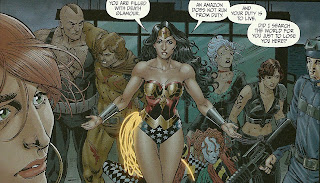
  
Normally, it's a mark of Ms Simone's work on the Secret Six that most every character of even secondary importance is quite deliberately given their own specific arc of development which is referred to during the climax of her longer stories. And so there are, for example, 11 characters who get a closing, if not a resolving, moment in the last chapter of "Depths", 9 at the end of "Six Degrees Of Separation" and 10 in the final twenty pages of "Unhinged". Obviously, Ms Simone is loathe to allow a character to sit as a passenger in the narrative, both for the waste that such inattentiveness might cause, and, we might presume, because she's too especially fond of her cast to allow them drift without due care and attention being paid to their fates. And it's the skill by which Ms Simone packs her conclusions with a considerable number of individual stories all working to serve a greater narrative purpose without causing the climax to drag that both helps mark out her style and the degree of her achievement.

   
Yet it's notable how Ms Simone has adapted her typical practise to take advantage of the challenges and opportunities posed by the Action Comics/Secret Six crossover. Rather than attempting to deliver a diluted form of her normal approach, which would presumably have involved presenting exceptionally shallow little secondary plots and perhaps brief melodramatic excesses to give them any weight and meaning at all, her various super-villains in "What Luthor Has Wrought" are separated into clearly differentiated leads and spear-carriers. That's not to say that anyone beyond Luthor, the family Savage and Ragdoll are flat and uninteresting; the single panel's conversation at 4:5 that sets up the issue's closing revelation also tells us a great deal about Catman's parental demons too. But such moments are by necessity very brief and are intended to reflect the status quo rather than to further it.

  
So far, it could fairly be said, so obviously. But of course a writer faced with a demanding sequence of plot points and a limited amount of pages might decide to focus only upon the most important business before them. But perhaps what's most telling here is how Ms Simone chooses to compensate for her inability to present a typically crowded climax in which a host of characters are by design intensely involved. In the necessary absence of a broad range of simultaneously occurring and intensely-wired events, from grand punch-ups to cruel betrayals, Ms Simone loads the end of "What Luthor Has Wrought" with a simple, focused double climax; a grand punch-up and escape followed by the traumatic details associated with the origin of Scandal's Lamentation Blades, as we've of course discussed before. It's as if a mathematical equation that regulates storytelling has been referred to, determining that in the absence of a large number of arcs great and small, two significant and straight-forward story-closing events which deliver some considerable dramatic force should be put to use instead, one immediately after the other. And


so, Ms Simone has anchored her tale in the horror of the fate of Scandal's mother, one deeply affecting moment rather than the cumulative effect of a sequence of events. Without that closing recollection, which is actually quite unnecessary to the working out of the main plot even as it's so vital to lending some greater emotional weight to it, this whole issue would've felt somewhat light-weight and out-of-place in the Secret Six canon. It would have been something of an indulgence, an anomaly, an issue which existed solely for the undoubted pleasures offered by the chance to collaborate with other professionals. With it, a familiar measure of heavy-hearted character development and emotional intensity is delivered, meaning that "What Luthor Has Wrought" stands not just as a part of an enjoyable crossover, but also as an essential part of the book that the three-parter closes in.

  
Many writers across the years have relied upon the sparks generated by the simple fact of a story running across two quite separate and typically unconnected titles to justify the linking of one comic book with the other. And despite the fact that Luthor has played such a fundamental role in the Six's past, the very idea of grand old dame that is "Action Comics" holding hands with "Secret Six" is indeed something of a surprise and an event in itself. More so, there's a undeniable frission that's created by seeing two capable creators with such distinct styles working together, both for the fact of how effectively they might combine and for the manner in which the marks of their individual styles might remain. (Mr Cornell's mostly disreputable characters in Action Comics, for example, aren't always possessed of the greatest sense of humour, and they tend to unintentionally say

  
things that might make a reader laugh at them rather than with them. By contrast, most of the Six possess a self-conscious and highly individual sense of humour that's put to use for a variety of purposes, creating quite a different tone between the two books under normal conditions. We tend to laugh with the Six, but not the utterly self-obssesed Lex Luthor.) But the care invested in the construction, progression and conclusion of this crossover tells us that it's been designed to function as something more than just a rather interesting idea placed on the schedule as yet another event, although pleasing novelties can be a very fine thing in themselves. Instead, Mr Cornell and Ms Simone have made quite sure that the agenda of each of their individual titles is furthered even as the collaboration between the two titles is kept largely self-contained and, with the exception of a previously-mentioned reservation, internally self-consistent.

This is, within the context of a monthly medium which demands, and which has to demand, that work gets done fast and gets done well, a not-inconsiderable achievement. After all, far less discipline could have been applied and the endeavour still applauded.

*7:- Secret Six # 16

12.

I.

Finally, perhaps we might end with a look at an small aspect of Mr Cornell's work which probably only a blogger with no editor, advertisers, paying customers or, indeed, any kind of mass appeal at all could pay attention to, namely the way that Mr Cornell negotiates the transition between the use of "real-world historical time" and "comic-book continuity-time" in Action Comics # 895 and "Black Widow: Deadly Origin". It's no more than a minor detail of his craft, but it is, if I haven't entirely imagined it, a telling one, evidence of a degree of thoughtfulness and application that the unshowy surface of the work modestly and purposefully obscures.

II.

There is in both "Black Widow: Deadly Origin" and "Action Comics" # 895 a "moment where we go out of historical time and into (comic-book) time" (*8), as Mr Cornell told Marvel.Com when talking about the former book. "Hopefully it's a graceful movement", he stated, and so it is, in both books, but it's always a difficult one to pull off. A comic book scene underpinned in large part by historical events has a quite different meaning to one grounded in continuity, as we touched uponlast Thursday on this very subject.  In essence, and for all of the inevitability of historical revisionism, the basic facts of the events of our common past, and especially the past of living memory, are essentially and broadly fixed; John Lennon died on December 8th, 1980, and that, where the bald facts of the matter are concerned, is pretty much that.

 
The facts of superhero continuity are, however, far more likely to be not just subject to reinterpretation and partial revision, as history is, but to be utterly rewritten and even retconned entirely out of existence. The John Lennon of the DCU may suddenly be revealed to have never died in the first place, or to have never even been born, and such radical and often apparently random changes to a character's status may be many and never-changing and consistently fantastical. (The John Lennon of the MU, of course, actually was, from 1963 onwards, a Skrull!) Lennon the mystic, Lennon the mutant, Lennon the communist spy with a monkey's heart-valve; there is, in truth, no such thing as a "past" in comic-book continuity, although it's necessary that both creators and readers agree to believe that there is for most anything to actually get done.

 
What's more, "real" time has a sense of proportion and progression and solidity that comic book time doesn't. It's not just a question of whether specific events in the superhero worlds can be relied up to remain as they've been shown before, but also a matter of how all these ever-shifting moments relate to one another in sequence. The 50 years-worth of Marvel Comics since Fantastic Four #1, for example, have to be constantly shoveled into a span of continuity that rarely recognises more than a dozen years as having occurred between Reed Richard's first and tragic spaceflight and the apparent death of Johnny Storm. Even if another 5 or 6 years are added to that period, it still leaves that decade-and-a-half of comicbook years hopelessly saturated with events once the reader starts to wonder, playfully or anally, just what's happened and how it all relates to itself. But out here in the everyday world, a year can only ever incorporate the fixed sum of events which actually happened between January 1st and December 31st. As a consequence of these fundamental differences, making sense of our history involves quite different skills to those we use to cope with the joys and pitfalls of comic-book continuity.

   
This issue of time isn't necessarily anything of a weakness where the long-lived, massively complex superhero universes are concerned, though it's often talked of as if it were. A comic-book continuum's identity and value doesn't lie in a specific, fixed and closed canon of  fictional "facts". Instead, the DCU and the MU, amongst many others, are protean creative opportunities that can be constantly recast in inventive and entertaining ways to entice new generations and reflect changing social situations.

  
Yet by locking down comic-book events with reference to specific historical moments, the superhero text does take on a whole mass of other qualities, as we talked about before, a weight of other associations, a verisimilitude, a  sense that what we're looking at carries far more of permanence and of the real than a typical superhero scene does. And so, where it's possible to do so, a judicial use of the business of history to help buttress the "facts" of a superhero's existence can make the whole fantastical brew of the costumed crimefighter narrative all the more convincing and satisfying.

But in placing the "facts" of the real-world and of a comic-book reality together, two different ways of approaching a narrative are suddenly placed one against the other, one more definite if hardly fixed, one so fluid that it can barely be said to hang together at all without the connivance of the reader and their rather unique skills where making sense of continuity is concerned..

*8:- http://marvel.com/news/story/10148/tuesday_ga_paul_cornell

  
III.

Mr Cornell does love to inform his characters with a sense that time has passed for them just as it has for us, and that they too relate the rolling onwards of the years with reference to the events common to our world and theirs. At the same time, he's aware that too close a correspondence between character and the recent past will inevitably date the figure concerned as the years turn onwards; link a superhero with the events of a particular war, for example, and the audience will soon start to wonder why that super-person's not getting any older even as the key occurance they were involved in receedes further and further back in the historical record. For that reason, Mr Cornell tends to tie his character's more recent years to events in comic-book continuity, while those folks he writes about who've had a longer than average life, or who existed solely in the past, start to get linked more and more to a mostly recognisable parallel history to that of ours. And so the Skrull John Lennon is declared to have arrived on Marvel-Earth specifically during the Beatlemania of 1963, because that makes his biography all the more interesting, and ultimately tragic, while such never threatened to inconviently age him or any other character who needs to lastingly stay forever twenty-eight, or whatever.

  
The actual relationship that Mr Cornell's characters typically have with historical events is something of an extension of Stan Lee's decision in and around the early Sixties to have his superheroes just as concerned with their private affairs as they were with their heroic missions, if not more so. Just as you or I might find ourselves worrying on any particular day about the gas not being turned off or the house-keys going missing even as the world's great, and not so great, powers continue to point ICBMs at each other, so Peter Parker would be more concerned with Aunt May's medical bill than Electro's latest  scheme for robbing banks. And so, Mr Cornell's characters may be framed by the context of historical events both real and fictional, but they tend to be pursuing their own private agendas while doing so. Ivan in "Black Widow: Deadly Origins" may be caught in Stalingrad during an 1928 attack by "Imperialists", but his thoughts are of saving a friend's sister caught in a burning building. And when we're shown Vandal Savage on the planet Salvation in "Action Comics" # 895, he's far more concerned with getting Luthor to visit his blessed "pustules", matron, than he is with the matter of escaping off of an alien world and returning to Earth. Mr Cornell seems to be constantly using history as a way of locking down a character's existence in relation to comic book and/or real-world events, but he never forgets that history is usually something individuals pass through while focusing on their private affairs, rather than an overwhelming, individuality-erasing temporal fact which utterly defines everyone who experiences it in a similar fashion.

   
IV.

But there always does remain the problem of how to move a comic-book narrative from a recognisable past, with its relatively fixed and pseudo-historical timeline, into the ever-permanent and yet ever-changing last ten years or so of the superhero universes. In both "Black Widow: Deadly Origin" and "Action Comics" # 895, Mr Cornell creates a buffer between depictions of the past related to history and more contemporary comic-book happenings which occurred in the vague and ill-defined sequence of events referred to as "continuity". And so, as the tale of the Black Widow moves from the historical settings of the Kremlin and the Baikonur Cosmodrome of the early 1960s into the Marvel Universe of "several years ago", the transition is eased by inserting a plausible and yet previously unseen comic-book incident in between the real-world-referenced events of the past and the ever changing and yet oddly fixed matters of comic-book continuity. Once that half-way house of an unknown scene linked to the relatively distant past of the MU is negotiated,  the reader can move into a section of the narrative where history and its rules largely disappears and continuity, with all its strangeness and intricacies, can predominate.

   
Similarly, in "The Black Ring" part 6, events showing the past of Vandal Savage jump from a historically-based scene set in the Prague Spring of 1968 to a previously unseen mission to kill Aquaman set roughly ten or so years ago in comic-book time. There's no specific source for the particulars of any such murderous business in the continuity of the DCU, as far as I know, but once again we're being eased from one way of reading, that involves elements recognisable from our own past, to another, which involves fantastical matters which the likes of you or I will and, of course, never can experience. The key to this comfortable progression from one mode of thought to another is via a scene that is both continuity and not-continuity, that's both linked to the past and yet not fixed to any telling historical moment at all, namely a showdown between Vandal Savage and Aquaman which never happened, or rather, never happened until Action Comics # 895 showed us it had. And then, the transmission belt having been negotiated, Mr Cornell could then start to relate Vandal Savage's activities with reference to specific issues of the "Flash" and "Salvation Run", just as before he was grounding action in the context of particular years and events. One type of engaging with the text was gently replaced by another, and the story rolled on.

    
It might be observed that this technique works even better in Action Comics # 895 than it did in "Deadly Origins". The sudden appearance of Tony Stark and the unavoidable presence of all of the continuity baggage that comes with him was complicated enough in the Black Widow tale to cause a little judder in this reader's concentration. Stark and Natasha's adventuring and the information-heavy sequence that they were presented in made it too obvious that the reader was shifting from events defined in part by "when did this happen?" to those made sense of through the question "how does this fit with all the comic-book continuity that might be relevant here?" (This was especially so because the scene was cleverly referencing "Iron Man II" in several ways in addition to working within the context of events displayed across five decades of comic books.) It was, perhaps, just a little too dense a continuity-informed sequence to jump straight into after all of the historical moments which preceded it. But the scene of Vandal Savage and his daughter as they set out to kill the King Of The Seven Seas in Action Comics # 895 carried less baggage, involved less detail, and presented the shift from one mode of thinking to another in a way that was, accordingly, easier to make. Of course, in some key ways this is an invidious comparison; "Deadly Origin" was a book that was in significant part concerned to deal with the Widow's complex and contradictory back-story, whereas Vandal Savage's past in the Action Comics/Secret Six crossover was a far simpler affair, with all that needed to be shown being that which drove the plot of these three issues to their common conclusion. It was unavoidable that "Deadly Origin" would carry more of the challenges of continuity along with it, because that was much of its purpose. But, all the same, the more gentle of the two context-shifting scenes was the least disconcerting, and perhaps that might be worth the noting.

      
V.

The scene of a distressingly young Scandal Savage accompanying her father on the business of murdering Arthur Curry, standing as it does between history and continuity, serves a host of narrative functions while never seeming to be anything other than an entertaining glimpse into the elder Savage's past;
  1. as stated, it serves as the point at which we jump from "historical" to "comicbook" time, and it successfully eases us from the one to the other.
  2. it carefully and surreptitiously introduces us to the fact that Savage has been dominating and corrupting his daughter since her very earliest years, which of course foreshadows the revelation which will close the crossover in "Secret Six" # 29..
  3. it establishes how Savage is so obsessed with the prophecy that the mere glimpse of a Daily Planet headline declaring "New Luthor Outrage" is enough to drive the thought of an ongoing mission to kill a prominent Justice Leaguer quite out of his mind, which continues to set up how history has for him been one ageless moment of longing, despite all the grand and terrible events that have occurred around him as he's waited for Luthor.
  4. it creates a troubling sense of unfinished business, since the reader knows that Aquaman wasn't killed, and yet they don't know what happened.So much is happening in the background of all of these situations that Vandal Savage moves through, and yet not a single moment of closure is ever seen. This inevitably creates uncertainly and unease.
It's interesting to note that the manner in which Aquaman succeeded in avoiding being killed by the Savages is quite irrelevant to the story at hand, though in years past it would be a reference that would demand explaining away. Sometimes, the point of using continuity, or of rather creating a new event within continuity, is to produce anything but certainty and closure on the part of the reader.

  
13.

If the example above of the historio-continuity narrative bridge - of course I'm joking! - is a minor example of the craftsman's tool-kit, and of course it is, it's also one worthy of recognition and respect. Indeed, even if there's no such technique being used, even if I've imagined it all, it's a trick that I could now use. Humming along and getting the notes all, or even partially, wrong still produces a tune which wouldn't be there otherwise. (It'll probably be a vastly inferior and fearsomely unappealing tune, but never mind; it eludes us now, but that's no matter, tomorrow....) And, by a similar token, any speculation of how Ms Simone establishes the spine and climaxes of her tales does seem like a terribly futile thing, given that her work is so well constructed that there's a sense that a blogger might just as well try to describe why the curve of an apple is so appealing; it just is, so why bother?

   
But part of me thinks - I do hope it's not an entirely vainglorious part - that these specific techniques, these hardwon and downright clever ways of telling stories, obvious and discrete, individual and common-store, are often those which are most likely to pass without notice or comment, and it's often the case that such narrative skills are completely forgotten as the years roll on. Indeed, I wonder if there's ever been a popular form that forgets to remember the detail of its own craft as the superhero sub-genre too often does. (Why, for example, does so much of Will Eisner's work from the Forties look as if it's some future destination of the comic book's evolution rather than an example of craft from sixty years ago? Why is so much that might be taken from Alex Toth's work on perspective and placement and shadow being so inexplicably ignored? Why do we so rarely use even the opportunities granted by Jack Kirby's story-closing tripartite panel structure anymore? ) It's not that I can add to any kind of historical record, and I don't aspire to do so. That's for the people who know, and especially for the folks who can do.Yet, it's hard not to want to respectfully notice some shadow of what's being achieved, even if inaccuracy and over-worthiness seems to be the inevitable outcome. The tiny details of a fantastically entertaining magic trick are always worth the noting, or, at least, the attempt to note, even as the performance of the trick itself is the ultimate point of the exercise.

But these details. They are a pleasure in themselves.

     
Oh, well. Fail harder next time! Thanks for popping in, in the inexplicable event that any tolerant eyes are passing over these words here :) Splendid best wishes are sincerly evoked at this far end of the net in return for your patience, and I wish you an appropriately heartening measure of Sticking Together! too.

.
More about

"What Does Your Crime Require?":- Paul Cornell & Gail Simone's "Action Comics / Secret Six" Crossover (Part 3)

Người đăng: Unknown on Thứ Năm, 24 tháng 2, 2011

7.

There's a great deal that I might add in this part of our chat about the recent crossover between "Action Comics" and "Secret Six" on the matter of how both Ms Simone and Mr Cornell add depth and detail to their recognisably modern-era, fast-moving scripts. And having been a teacher for almost twenty years, I certainly do find difficult not to fill up these pieces with every potentially relevant grain of information I can, as if some imaginary student might suffer an exam catastrophe because I haven't made my notes as comprehensive as possible. But that's a particularly bad habit here, since I'm not approaching a subject I know relatively well, such as that relevant to a specific exam syllabus, but rather using the opportunity of writing a blog to try to gleam some small measure of insight into the business of how thoroughly entertaining comic books are created. What's more, I do have to constantly remind myself that I've discussed a great deal of the information that's relevant to matter at hand elsewhere. For if we're talking of how Mr Cornell and Ms Simone succeed in crafting comics which use a great many of the more contemporary narrative tools while ensuring that their books are far more than


three minute reads, then that's something that's already been repeatedly touched upon in pieces on this blog for much of the past year. And so, for example, we've already talked about how Ms Simone might have politically informed her work, as when we were recently discussing "Welcome To Tranquility", and of how Mr Cornell might have done the same, while engaging last year with his short story "Secret Identity" and his work on Captain Britain and MI:13. To repeat such points would at best be redundant and, at worst, apparently obsequious, duplicating often admiring statements long ago expressed in what would most probably read as an act of utter Uriah Heepism.  So,  if I fail to once again mention, for example, any detail of how Ms Simone so deftly uses continuity to make her books more substantial and entertaining in that which I've written below, it isn't because I've somehow come to the conclusion that her most recent work lacks any such quality, but rather because I've written at length on the subject before, and especially in connection with her use of the characters of Catman and Deadshot.

But the matter of how Mr Cornell uses continuity, or rather, how he uses history, whether from the real or a host of imaginary worlds, isn't something that I've had the chance to talk about previously, and so that's the topic that I'd like to concentrate upon for the remainder of today's piece.

 8.

"Intertextuality" is an ugly if useful word that gets all-too casually and imprecisely banded around in academia, and I doubt I'd ever have come across the term if I hadn't found myself struggling to deliver a few lessons of Media Studies a week for some three years in the late Nineties. For anyone who's never come across this brute of a mark-earner before, it's used in its broadest sense to refer to the way that creators use other people's work to add meaning to their own. For decades, the writers and artists of superhero books have tended to put to use the contents of other comics to achieve this, mirroring other creator's work, adapting other creator's plots, and generally relying on the ever-proliferating mass of continuity, of a common and narrow store of comicbook memories, to encourage the audience to perceive complexity and value in what's tended to be rather familiar fare.


It's quite unavoidable, of course, that such a process should occur in any genre and in any medium, and it's often an incredibly productive business. But when a genre such as that of these marvellously absurd superheroes gets into a longstanding habit of constantly referencing itself and relatively little else, it runs the risk of becoming creatively inbred and functionally deformed, if not ultimately sterile. A thirtieth Galactus story in which he threatens to gobble up the Earth again, which constantly draws off the content of the preceding twenty-nine epics? Yet another grimy, cynical twilight of the superheroes tale, re-using the same familiar mashed-up tenth generation "homages" of Watchman and Dark Knight, produced with the expectation that it'll feel apocalyptically important because those seminal works did? Comic books informed solely by even the best of their tradition don't become more powerful, of course, but far weaker, endlessly rolling out less and less distinct uncreative photo-copies of the surface rather than the soul of the past's great work.


But Mr Cornell is self-evidently part of the ranks of those writers who not only want to broaden the inspirational gene-pool of the genre, but who can't help themselves in doing so. There's something endlessly cheering about his utter unwillingness to consider producing thin, self-referencing fare which exists in sterile isolation from all that verdant stuff that's there for the shaping in the world outside of the Big Two's un-mainstream. And just as we can note his deliberate intent to master the modern-era form of scripting from his work on the first issue of "Wisdom" onwards, we can also follow his enthusiasm for using a mass of material from beyond the world of costumed crime-fighters to add something distinctive and invigorating to the mix. At its most explicit, as in "Fantastic Four; True Story", where the reader is presented with a host of characters often casually stigmatised with the utterly defeating label of "classic literature", Cornell simply refuses to suppress his conviction that the books he's referring to are self-evidantly exceptionally good fun


In "Black Widow: Deadly Origin", for example, we find allusions to, and scenes inspired by the narrative conventions of, 007, Bourne and Mission Impossible. ("I'm going to have my collected James Bond themes on all the time while writing it." he told CBR in 2009.) But at the same time, we're also presented in the same book with cameos of Logan, Bucky Barnes, and The Red Guardian matched with specific moments in the history of the USSR and its empire. And this is one of the aspects of Mr Cornell's writing that's most interesting and important where this genre is concerned, in that Mr Cornell's not in any way snotty or snobbish or dismissive about the characters and the continuity of the fictional universes he's working in. He's not trying to suggest that the superhero as it's often been presented isn't a beguiling and magical thing, but he is unable to consider resisting his belief that so is just about every other type of story too. And regardless of whether these extra layers of story are recognised or not, they mark out Mr Cornell's books as notably different, creating in them individual and distinct textures which add to their character and appeal.

 9.

There's a love of history, and a willingness to enjoy at the very, very least a touch of historical research, in Mr Cornell that first became overwhelmingly obvious to me, or so it seemed, when I was reading his "Black Widow: Deadly Origin". In the first chapter of that book, there's a two-panel appearance by Joseph Vissarionovich Stalin, which in itself is unremarkable, except that's he's portrayed in a way that, to my knowledge, is unique within the pages of any superhero comic book. Instead of the usual taciturn, faintly oriental and frankly sinister stereotype, here we're given, for all the scene's brevity, a figure recognisable from modern popular scholarship. For it is only in recent years that we've become familiarised with the face that Stalin could and so often did present to those around him. A psychopath who could be a warmly intimate and, despite decades of Western preconceptions, an astonishingly gregarious, apparently good-humoured man, Stalin rose to supreme power with a measure of charm as well as through the application of an abnormally ruthless and scheming character . The laughing, wandering Stalin of "Deadly Origin" was so spot on, and so untypical in the context of comic books, that I immediately started to pay even more attention to the unshowy historical background of the tale, as well as reaching for my copy of Montefiore's "Court Of The Red Tsar", which, if I was compelled to, I'd wager is a text that's not unknown to Mr Cornell.


This process of both buttressing and enriching his work with these other real-world narratives can be seen in "Action Comics" # 895 too. Sometimes, it's nothing more playful than the use of an appropriate historical name that might sound to us like that of a bronze-age supervillain - Spearhavoc (*4) - or that chosen for a city - Sacristi - that is itself a French swearword adapted from a religious ritual, a suitably ironic title for a profane conurbation masking a somewhat transcendental and hidden reality.(*5) At other moments it's the use of unspecified but clearly historical events to serve as a backdrop for Vandal Savage's centuries old obsession with prophecy; can that be Rousseau at 895:4:2, and surely that must be the Prague Spring two panels later? And all of this material is used to inspire the reader to ask themselves one absolutely pertinent question; what does it do to even an immortal man to be that obsessed for that long and with no good reason beyond prophecy to be so?  

*4:- There was, for example, the splendidly named Bishop Spearhavoc, who served as Edward The Confessor's goldsmith, as a swift Googling will reveal.
*5:- Or so I'm told. French, let alone the etymology of French swear words, is not comfortable territory for me in any way at all.


Regularly grounding action in references to historical events which, for all that they needn't be identified or understood in order to enjoy the story, lends comic-book events a real-world flavour which is as much a relief as it is a pleasure, I'm sure, to many a reader. I'm far, far from being even vaguely competent in Bohemian/Czechoslovakian history, and so there are a series of possible references in "Action Comics" 895 which escape me and leave me cheerfully grasping at vaguely-informed guesses. (Is that the thirty years war at 895:4:1? Is that a reference to the brief revolts of 1848 a few frames onwards?) But the point is no more that the reader is driven to an obsessional search for information by "The Black Ring" part 6 than it is that Mr Cornell is seeking to spread the gospel of Central European studies. What matters is that the real world and the fictional one are shown intersecting, given the latter a greater sense of depth while expressing a joy at how all these various actual and fictional narratives can be both playfully and serious-mindedly referred one to the other.


Of course, Mr Cornell's desire to use history as content and flavour rather than as an aspect of ostentatious self-regard can lead to a tiny measure of frustration in the reader who'd quite like to know a little more. What did happen in Bohemia in 1358 that inspired Mr Cornell to set a scene there, and is the character with a lupine quality and dark black eyes at the fore of that splash page anything other than an unlucky everyday citizen? (Could the events be connected to the Black Death, since even Savage's language has been affected by that specific horror; where the Black Lantern energy was referred to as "things" in the scene set around 1000 in # 894, by 1358 he's referring to its globes as "pustules"?) Similarly, in "Black Widow; Dark Origin", shouldn't the attack on Stalingrad in 1928 by "imperialists" actually have occurred in 1918 in Volgograd, when the White Russians occupied the city? (*6)


But these kind of trivial questions aren't important, and that's especially true in a comicbook universe where we just don't know what might have occurred in the USSR of Marvel's 1928. What's important is that the text is alive with aspects of depth and enthusiasm, which can, if the reader wants, inspire them to ask a few questions more than they might otherwise have felt moved to consider. The appeal and the value of these books by Mr Cornell is no more founded solely or even substantially in history than many of Ms Simone's comics are made fascinating by her evident love of the geography and culture of nations far beyond America's borders and nothing else. But all that extra care, and curiosity, and, yes, excitement, about how stories might do more while working in an effective and efficient way surely doesn't hurt a comic book's achievement either.

*6:- But then, I could have easily mis-read or misunderstood that page of BW:DO or missed out by not having read previous chapters of "The Black Ring" while waiting for the trade. This isn't a question of getting the references right, as if these comics were nothing but a game of spot-the-connections , but of rather being inspired to read each comic as if it were more than a quick surface-dash from set-up to throw-down.


Oh, dear; to be continued. I must stop saying I'm going to write a particular number of entries on any subject when I invariably over-run. There's one last piece on this topic already written, although not checked, to go up next, and that'll be put up soon.  My apologies for any confusion, and my best wishes too for a splendid time to anyone who's kindly persevered with this page for at least long enough to reach these closing words.

.
More about