Scott Snyder's Swamp Thing Vol. 2: Family Tree contains just four Swamp Thing issues, plus the "Zero Month" issue and the first Swamp Thing annual. As such, the book comes off a little thin; while the reader is treated to the first appearance of the new Alec- Holland-as-Swamp-Thing, the story mainly serves to spotlight one of Swamp Thing's long-time enemies.
Though Swamp Thing and companion title Animal Man began at the same time and are both racing toward the "Rotworld" crossover, Animal Man has succeeded in standing as a title on its own; with this foreshortened volume, Swamp Thing continues to feel like a title biding its time until the crossover, even if in generally enjoyable fashion. [Review contains spoilers]
In previews I had some concern about Swamp Thing's new horn-headed design, but on the page artist Yanick Paquette and others depict it quite well. Snyder's Swamp Thing is the "warrior-king" of the Green, and his horned helm and ridged body armor reflect this well; Swamp Thing has never looked so regal. There's certainly debate to be had as to whether Snyder's "built for war" Swamp Thing improves upon or detracts from Alan Moore's "slow to anger" version, but for the Swamp Thing that Snyder has created, his new appearance coincides nicely.
The first two chapters of Family Tree wrap up the cliffhanger from the first volume, Raise Them Bones; Swamp Thing rescues the kidnapped Abby Arcane and the two escape to regroup. The following two chapters, as well as the zero issue and the annual, all focus in one way or another on Swamp Thing's arch-nemesis, Anton Arcane. In giving Arcane so much space, Snyder takes a route similar to Geoff Johns's use of Sinestro in Green Lantern; more than just a villain, Arcane is a vital character here with a backstory and strong connection to Alec Holland himself.
Arcane is and has always been a delightfully grotesque villain, and Family Tree is a gorgeous read largely due to some great "stunt" artist "casting" of Francesco Francavilla for Arcane's noirish first appearance and Becky Cloonan for a Romeo-and-Juliet-esque tale of young Holland's forgotten first introduction to Abby and Arcane (both artists did notable turns with Snyder on his Batman-title work, too).
While Arcane, again, is visually interesting, Snyder does not give him Sinestro's depth; Snyder's Arcane is notable for having plagued all the various iterations of Swamp Thing through time, but always with a villainous single-mindedness. Snyder establishes well the danger Arcane poses to the Swamp Things, but the audience is left without knowing much about Arcane himself -- questions like who Arcane was before he became a servant of the Rot, how he became such, and so on go unanswered. Throughout this book, Arcane is bad because, well, he's bad.
As well, much of Family Tree's the third chapter takes place in flashback, plus the zero issue and the annual, devoting more than half of the book to something other than the present action. This has the effect of making this second Swamp Thing volume appear as though it's mostly standing still. In two issues, Swamp Thing fights the Rot's avatar Sethe and wins, then he fights Anton Arcane and wins, and then there's two tales of the past. I'm skeptical how much of this is really necessary and how much is filler; while Animal Man has offered complex family drama and explored Buddy Baker's burgeoning new powers, Swamp Thing spent a lot of time on Holland's reluctance about his (inevitable) transformation into Swamp Thing. Once it crossed that threshold, Swamp Thing doesn't seem to have much place to go until Rotworld.
At the same time, by virtue of the flashbacks and even a Green "vision," Snyder is able to make considerable use of the human Alec Holland in this book. An emphasis on "the man behind the monster" has been a hallmark of the New 52 Swamp Thing series, and setting aside the controversies inherit in that, it does help to make Swamp Thing a more relatable character; Snyder reminds the reader a couple times that there's fragile flesh underneath Swamp Thing's crusty surface. Adding a "young love" to Alec and Abby's histories helps bridge the somewhat awkward gap in which she had a relationship with Alec's former Swamp Thing doppelganger and makes their pairing more believable overall.
Snyder also hits a Swamp Thing touchstone by introducing Jason Woodrue (presumably still the future Floronic Man) into young Holland's life, and I wouldn't mind seeing another flashback tale in the same period, drawn again by Cloonan, that follows up on those events -- some Smallville-esque "pre-Swamp Thing" stories, as it were.
Swamp Thing: Family Tree isn't objectionable by any means; in fact, in its scant offerings I probably came to like Alec Holland and Abby Arcane more than I did before. The crossover is the problem; Often the danger with crossovers is that they threaten to overwhelm the story itself, and Rotworld is on a bad track, having similarly sucked some life out of the final Frankenstein volume as well. The upside is that with all this emphasis on Rotworld, perhaps that means there are good things to come, and I look forward to seeing what the Swamp Thing title does when it finally gets there.
[Includes original covers, Yanick Paquette sketchbook]
Saga of the Swamp Thing Vol. 6, the final collection of the series, is by far the most lyrical and ambitious of the bunch. The tone of the book changes, as artist Stephen Bissette promised it would in his introduction to Vol. 5, with new artist Rick Veitch's preference to draw science-fiction rather than horror. Writer Alan Moore rises to the challenge, however, peppering Swamp Thing's journey through space with some of the most bizarre and heartfelt sci-fi I've ever read in a comic book. I'm surprised, ultimately, by what's not included in these adventures, but that's got nothing to do with what's truly a stellar collection. [Spoilers in this here swamp.]
Saga Vol. 6 starts out with the most rudimentary of the stories in the book, which given that Moore creates a seemingly working language for Adam Strange and the Ranninan people, and runs pages upon pages of the first two chapters (issues #57-58) in it, is really saying something. To an extent, the story follows the standard trope of superheroes fighting and then teaming up, though Moore does include an interesting bit about the Rannians only valuing Adam Strange as a stud horse that he unfortunately never follows up upon.
With the third chapter (issue #59), however, guest-writer Bissette kicks of the complexity of the book with a story told from two or three perspectives (even that of a dream), in which Abby Arcane's Frankenstein-like father returns to find her. With no particular knowledge of Swamp Thing or the Patchwork Man before, what was happening in this issue was a mystery to me right up to the end, and it's a lovely story, scary and touching and sad, and bookended bizarrely with the scenes of Anton Arcane in Hell that make it seem like a House of Mystery or Tales from the Crypt-type tale.
The next chapter (issue #60) could be Moore's most complicated of them all. It's told entirely in splash pages and two-page spreads, illustrated by John Totleben. The only narration comes in a twisty metaphoric computer language reminiscent of the aliens' double-speak in Moore's "Pog" story -- and therein, through the frame of a cosmic bed-time story. A sentient mechanical vessel captures Swamp Thing's consciousness, floating through space, and then pursues Swamp Thing throughout itself, trying essentially to mate with him.
It ends, the story itself acknowledges, with the machine splitting Swamp Thing open and raping him, after creating and following Swamp Thing through a time-bent wormhole. The story is terribly difficult for the reader -- to understand, first and foremost; then to witness Swamp Thing's mechanical violation; and further, to understand it all as a lullaby about how Swamp Thing unwittingly saved the robotic alien's race. Moore and Totleben are in top form here, offering a story weird and beautiful in the spirit of 2001: A Space Odyssey, and again demonstrating the versatility of the Swamp Thing character.
And that's not even my favorite chapter of the book!
No, my favorite is the next, "All Flesh is Grass" (issue #61). Here, Swamp Thing jumps to the planet J586, not realizing it's already full of sentient plants, and unwittingly becomes a behemoth made up of J586's citizens. Moore begins the story detailing the people-plants of J586 -- two lovers, a self-involved artist, a faithless priest -- and his detail (like the man walking a shrubbery pet) is exquisite. Once trapped inside Swamp Thing, the lovers realize the distance between them, the artist confronts her isolation, the priest despairs and then regains himself. Moore tells at least four stories simultaneously, plus more, because against the hulking Swamp Thing flies in the Green Lantern Medphyll, himself mourning the recent loss of his mentor.
Medphyll extracts Swamp Thing's bio-electric essence from the swarm of bodies (and in the way the people are grotesquely transformed to become the Swamp-Hulk, Moore's tendencies for horror still remain), eventually offering Swamp Thing the corpse of his mentor to inhabit until Swamp Thing can move on. Medphyll receives a second chance to tell his mentor good-bye, and it's a sad and sweet ending to a rivetingly intricate story.
All of that, and Moore caps it with a punchline in which Adam Strange goes to tell Abby that Swamp Thing's still alive -- and she doesn't believe him! Despite all Abby has experienced, the guy who teleports to an alien planet is too much for her, and she turns him away from her door. Moore has delivered a single-issue sci-fi epic, and then when he presents something more mundane, it's considered just too unbelievable. The truth is stranger than fiction, after all.
Artist Veitch writes issue #61, with appearances by New Gods Metron and Darkseid; Veitch draws here, too, including a take on Jack Kirby's first image of Darkseid. Adding to the wonders of this book, Veitch offers a handful of sequences that culminate with a twenty-five panel page in which Metron believes he sees every aspect of the universe at once -- and Veitch really makes the reader feel it. From Bissette's familial horror to Moore's out there sci-fi and then Veitch's journey into the Source, there is a lot, a lot to experience here.
When Swamp Thing finally returns to Earth, it's almost a let-down. Moore hits the right notes -- in one issue, a throwback to the book's earlier horror days, Swamp Thing violently kills the men who've been hunting him; in the second, Moore takes up again Swamp Thing and Abby's love and lust -- but this is worn ground after what preceded it. Moore tackles well one last existential question, however -- why, if Swamp Thing can cure the Rannian famine, he shouldn't essentially bring peace to Earth -- and seemingly even makes his own cameo before the book closes.
There is never, as I had expected, another appearance of the Parliament of Trees, and though foreshadowed, there is neither Abby conceiving a baby with Constantine (conspicuously absent here) in Swamp Thing's stead nor the birth of baby Tefe. All of these are things I had mistakenly attributed to Moore and expected before the end of the story, which are instead Veitch's or other writers down the road. That's disappointing, perhaps, though no fault of Moore's.
The Saga of the Swamp Thing hardcover series goes out on a high note because the sixth volume is full of high notes -- Alan Moore at his most lofty and imaginative (from issue #60, Moore's penchant for poetry is ramped up continues nonstop to the end). Given the horror of the earliest issues, and the dystopian Watchmen that Moore wrote alongside this, the creativity in these final issues feels like the sun coming up.
It's too bad, knowing what else I know about Swamp Thing, the overall adventure feels unfinished -- the first Rick Veitch collection, Regenesis is long out of print, and I wish DC would reprint it in the vein of these Moore collections. Verily what's really needed is a Swamp Thing Chronicles, reprinting all the various Swamp Thing series in chronological order.
Saga of the Swamp Thing Vol. 6 collects issues #57-64 of the series, with original covers and an introductions by series artist Stephen Bissette. Thanks all reading these books along with me.
The first thing I noticed about the library's copy of Saga of the Swamp Thing Vol. 5 is that it feels slimmer than the Swamp Thing books that came before it (also it's the first one where the significant black ink seems to have smudged the pages). Indeed this book is only 166 pages, whereas previous volumes have been 200 pages or more.
[Spoilers, spoilers]
The six chapters here, however, are distinctly all of a piece, perhaps more so than any other volume in the series (Vol. 3 comes in second), and the fact that there's just six adds to and enhances this. The volume is far from self-contained -- in fact, it reaches back to the Martin Pasko stories that preceded Alan Moore's more so than any other volume so far -- but it lacks the single-issue stories and diversions of the previous books; Saga of the Swamp Thing Vol. 5 tells one story, very taut and methodically, through to its conclusion. After the considerably esoteric conclusion of "American Gothic" that saw Swamp Thing fighting beside angels and demons in the supernatural realms, Saga Vol. 5 returns relatively "down to earth." Abby Arcane skips bail in Louisiana after being charged with "unnatural acts" for her relationship with Swamp Thing, is recaptured in Gotham City, and is held there while Swamp Thing wages war on Gotham for Abby's return.
Moore does here what Moore does best in Swamp Thing -- interspersed with Swamp Thing facing off against Batman and bad guys (including Lex Luthor) plotting Swamp Thing's demise, Moore poetically narrates a gradual "greening" of Gotham City. As more parts of Gotham turn to jungle, the citizens revert to their baser forms with surprising swiftness; by the end, Gotham has become this wonderful and twisted Eden that I suggest only Alan Moore could conceive of.
The book shifts from the war on Gotham in the first three chapters to the aftermath of the death of Swamp Thing in the second three. I can only imagine how DC might handle Swamp Thing's death these days, with die cut covers and tie-ins across the DC Universe; rather instead Moore offers two (somewhat, kind of) quieter single issue stories featuring Abby, and then Swamp Thing's bizarre cosmic return in the last. Doubtful anyone thought Swamp Thing was really dead in his own title, but I imagine this would have been fun to experience in monthly issues, in which the reader paused to reflect on the missing Swamp Thing for two months before he finally re-emerged.
Issue #54 here is "quieter" only in the sense that it's more self-contained than the other chapters here; it is, to be sure, action-packed. The story is one of more traditional horror, and in this way it feels the most familiar in this volume among all the Swamp Thing stories. Moore uses Pasko's Liz Tremayne and Dennis Barclay here, not seen since issue #20 and not perhaps how Pasko might have meant them to be used, but Saga readers have only experienced them filtered through Moore anyway.
With their presence, and with the callback with the desk ornament in issue #53 to the last time Moore killed Swamp Thing, also in issue #20, there is the sense of Moore's Swamp Thing coming to an end, as we know it will in the next volume, but as monthly readers might not have known then.
In the years after these issues, readers have seen so much superhero death that again, these issues seem familiar when in fact they cast the mold that others used. The Swamp Thing memorial issue, #55, evokes both the statue erected for the dead Superman and also the one that Swamp Thing himself created for Hal Jordan after Final Night (it would be crazy if Scott Snyder demonstrated there's still a Swamp Thing statue somewhere in Gotham).
"Blue Heaven," issue #56, in which Swamp Thing awakens on an alien planet, is a work of lyrical genius by Moore and master class in (all-blue) coloring by Tatjana Wood, but I'm also reminded of Hal Jordan's "Emerald Twilight," in which he, too, built himself a false reality only to see it torn down to the ground.
Much as I praised Swamp Thing's uniqueness as the DC Universe's "peaceful warrior" in the last volume, the memorials and speeches in Swamp Thing's honor here do evoke again the difficulties I have with Swamp Thing's character. I think Moore has a tendency here to portray Swamp Thing as "too good," especially as the quintessential "perfect husband" in Abby's memory as opposed to the crazed Dennis. When Swamp Thing lashes out at Gotham, this is positive because it makes Swamp Thing appear more "human"; but ultimately if I had one nitpick, it's that I expect Swamp Thing to return to calm, Earth-friendly, non-judgmental, essentially perfect being before too long.
If Vol. 3 contained good examples of "regular" Swamp Thing stories, then Saga of the Swamp Thing Vol. 5 is a good example of a Swamp Thing "adventure" -- conflict (with Batman!), crisis, and Swamp Thing's rebirth. The persecution Swamp Thing and Abby face for their love certainly still resonates, too.
Saga of the Swamp Thing Vol. 5 collects issues #51-56 of the series, with original covers and an introductions by series artist Stephen Bissette. The end is nigh ...
I'm more than half-way through my reading of Alan Moore's Saga of the Swamp Thing with my completion of the fourth volume. To an extent, it seems strange that the fourth volume should conclude Moore's "American Gothic" storyline -- given as we are these days to the idea of trilogies, Vol. 4 ought seem to be the set-up for the conclusion of Moore's run (Star Wars to his eventual Return of the Jedi), rather than a clean ending before the two final, seemingly lonely volumes.
[Beware spoilers, ye who enter]
Considering these books in this way, however, is an anachronism first of all because Moore's goal wasn't to write a certain number of Swamp Thing collections (whereas many are writing for the trade today, for better or worse) but rather he was simply writing the Swamp Thing ongoing series. Second, whereas one can't tidily split the Saga of the Swamp Thing collections into the first three and second three volumes, instead perhaps these collections can be seen as two-volume duos -- the first two introductory volumes, through the death of Arcane; the second two volumes, "American Gothic," and then the last two volumes. If one considered buying the Swamp Thing books just a few at a time, then, that might be a way to go about it. Similar to Swamp Thing Vol. 2, Vol. 4 is also an uneven collection, but not in a bad way. It's just that the second and third chapters are still distinctly "American Gothic," Swamp Thing-on-the-road stories, while the first chapter is a one-off story mainly disconnected from the rest. The fourth chapter is a Crisis on Infinite Earths tie-in that leads directly to the conclusion of "American Gothic." But these, chapters four through seven (about the Parliament of Trees and Constantine and Swamp Thing's battle with the Brujeria witches) are tonally different than the conclusion, which includes again DC's supernatural staples like the Spectre, the Phantom Stranger, Deadman, and others. It's a fine reading experience, but one that continues to shift issue to issue between all the different genres in which Swamp Thing fits.
Considering the pairings of the various Saga volumes, it's notable that the Phantom Stranger, Etrigan the Demon, and the rest are back in "American Gothic"'s conclusion just the same as they capped off the Arcane story in Vol. 2; in this way, Moore can be seen to cycle Swamp Thing through similar conflicts, but with a character that becomes refined and sharper with each pass (if the supernatural lot appear in Vol. 6, too, then we'll have the makings of a thesis). Again, having the supernatural lot all together, and the formulaic structure of this volume's big conclusion (Swamp Thing #50), show their age when judged by modern standards, but only I think because they've been emulated so many times since.
The big moment that struck me in this book was not, as I might have expected, the Crisis crossover, which was less exciting and more given to exposition than I would have thought (due, perhaps, to Moore having a crossover handed to him). Instead, continuity work that I am, I was surprised to see Zatara, Zatanna's father, in these pages, and then quickly understood when Zatara is killed in the conclusion. I had apparently conflated "American Gothic" with Zatanna's Search, believing that Zatara died somewhere in said search and that Zatanna's membership in the Justice League followed her father's death; I had surely not thought that Zatara had been alive all the way through Crisis.
In Vol. 4's conclusion, Moore sums up well what Swamp Thing offers as a character different than Superman or Batman, for instance. Though Swamp Thing may be his most frightening and violent in the book's second story, "Boogeyman," it's the peace with which Swamp Thing approaches the ultimate evil in the last chapter, talking of how good grows from evil and vice versa, that saves the day. That Swamp Thing is a happy warrior, the DC Universe's very own peacenik, is a hard concept to illustrate, probably why Swamp Thing is so often second fiddle in these stories.
But the largely pacifist Swamp Thing is an interesting character, and certainly unique among his DC Universe fellows. Even at the end of Saga of the Swamp Thing Vol. 4, it feels as though Alan Moore is just getting started, still cutting away at former depictions of Swamp Thing before he can start on his own thing (one reason the second appearance of DC's supernatural lot here might be a detraction). With the introduction of the Parliament of Trees and such, I'm looking forward to the real "out there" Swamp Thing stories to start with the next volume.
Saga of the Swamp Thing Vol. 4 collects issues #43-50 of the series, with original covers and introductions by Neil Gaiman and Charles Shaar Murray. More to come ...
The third volume of Saga of the Swamp Thing is the volume where I, for one, have begun to feel more comfortable with the Swamp Thing character. The book is to some extent the most traditional of the Swamp Thing volumes so far -- eight chapters encompassing four or five story arcs, each with well-defined "villains" for Swamp Thing to defeat; plus there's a certain "movie monster" commonality among the horrors (vampires, werewolves, zombies) that ties the book together and adds to the familiarity of the volume.
At the same time, each of the stories deal not-so-covertly with political or social issues. As well, there's a running storyline throughout in which Swamp Thing gains and explores some new powers. And Swamp Thing's guide to this enlightenment, introduced in Saga of the Swamp Thing #37 collected here, is none other than John Constantine in his first appearance.
This mix of simple and complicated, classic horror and commentary, and one-off stories and overarching threads makes this my favorite of the three Saga of the Swamp Thing books I've read so far. The moment that goes a long way toward my enjoyment of the Swamp Thing character, maybe counter-intuitively, is that writer Alan Moore creates some tension between Swamp Thing and Abby Arcane (mostly centered around Mr. Constantine). Moore backs away from having the couple really fight, which would be ludicrous given they already spend a mostly utopian life hanging out in the swamp, but he does allow for Abby to want them to continue their lives as is while Swamp Thing is tempted by Constantine's siren song.
This is a common story trope, especially in science-fiction, when one half of a couple is tempted away from the other by some dark force that holds knowledge of their origins. From the first volume -- especially when Moore started in the middle of previous writer Martin Pasko's story -- Swamp Thing has seemed very self-assured, Abby's love for him was immediate, and no one seems to wonder about a seven-foot-tall swamp creature lumbering around. When Constantine starts teasing Swamp Thing's origins, Swamp Thing begins to seem more lost and vulnerable, and this is a Swamp Thing easier for me to understand and relate to than the character so far.
The stories within this volume are all very clever (as if you needed me to say so about Alan Moore's Swamp Thing); the presentation of the politics comes off a little dated, but certainly we're still dealing with the environmental dangers in the "Nukeface" and vampire stories, and the racial tensions of "Strange Fruit." My favorite, however, was Moore's werewolf story "The Curse," with the title's double-meaning -- and even its triple-meaning, when the beleaguered housewife's real curse turns out to be the compassion that keeps here from killing her husband. The presentation is again a little dated though the sentiments are not, and in all that single issue (#40) sticks out to be as a good quintessential Swamp Thing story if one had need of such thing some time.
In the last volume, Harbinger and the Monitor appeared in a couple of cut-scenes, in DC's run up to Crisis on Infinite Earths the following year. Harbinger is considerably different from her latter depiction as DC worked out the details of the crossover, and only the Monitor's hand appears. I mention it because there's a couple of pages here -- in issue #41, for instance -- where the skies are red, and now I'm not sure if it's just coincidence or more (exceptionally subtle) foreshadowing of the crossover. I'll choose to believe the latter.
There's no sense in a reader starting with Saga of the Swamp Thing Vol. 3 instead of venturing back to volume one, but if you're looking for some neat and representative Swamp Thing stories, this volume has them pretty well.
Saga of the Swamp Thing Vol. 3 collects issues #35-42 of the series, with original covers and an introduction by series artist Stephen Bissette. Not the end ...
(Read my review of Saga of the Swamp ThingVol. 1 and Vol. 2.)
Continuing my casual journey through DC/Vertigo's collections of Alan Moore's Saga of the Swamp Thing ...
[Spoilers ahoy!]
Saga of the Swamp Thing Volume 2 is a testament to the versatility of the Swamp Thing character (or, at least, the versatility of Alan Moore's imagination as corresponds to Swamp Thing). To say this volume offers humor, horror, and romance side-by-side is to understate it -- the stories stretch from a gruesome trip to hell to presenting Swamp Thing essentially as a cartoon character. Far from off-putting, these variations help to make Swamp Thing seem a more believable character living in a world where most anything can happen.
The genre changes are most obvious through the presence of multiple artists -- Stephen Bissette and others on the more serious stories, and Shawn McManus on the lighter ones. McManus draws a more detailed, animated, and almost distorted Swamp Thing, expressive and more fully revealed than when Bissette and others draw Swamp Thing in the shadows. McManus's art sets apart the initial one-off story (issue #28) as Swamp Thing continues to struggle with the legacy of Alec Holland, but McManus's work is spotlighted most brightly in issue #32, an environmentally-themed tale that sees Swamp Thing teamed up with thinly-veiled renditions of the Pogo comic strip characters. The story is cartoonish, but then turns markedly dark at the end, reminiscent of the Pogo strips themselves or even Steve Gerber's Howard the Duck.
Stepping back, the Pogo story ("Pog") comes just after a wrenching four-part story (including the Saga of the Swamp Thing Annual #2) in which Swamp Thing's arch-enemy Anton Arcane returns, Abby Arcane-Cable is seemingly killed, and Swamp Thing has to venture to Hell to save her. The first three parts are the most horrific, both for the serial killers Arcane looses on the world and also for the revelation Abby's been unknowingly sleeping with her uncle; for the fourth part, Moore pays his proto-Vertigo dues by guest-starring Deadman, the Phantom Stranger, the Spectre, as well as Etrigan the Demon, all in one annual. The Deadman/Phantom Stranger/Spectre appearance seems old hat now -- indeed, the kind of thing every supernatural DC series from Day of Judgment to Shadowpact has to do -- but I'm guessing that when Moore did it, he was creating the mold and not melting into it.
Also collected here is Saga of the Swamp Thing #34, which I'd crudely understood to be the Swamp Thing/Abby "sex issue," though in fact most of that is reserved for the issue's double entendres, in favor of Abby's romantic, psychedelic head trip in the foreground. Moore's lyricism is on display here (here, and throughout these stories), and to some extent Moore is ill-served by having his lines crunched down into panels (no disrespect to letterer John Costanza); rather some aspiring graphic designer out there should lift Moore's narration from these pages and lay it out on a page, all the better to resemble the poetry it really is.
I waited until after I finished this volume to read Neil Gaiman's sizable introduction, and so the inclusion of Len Wein's original Swamp Thing story, in a framing sequence, was a delightful surprise to me (though not now, I guess, to you). This is devoutly an artifact of the era -- I can't recall recent comics running a reprint nor am I quite sure we fans would stand for it. Here, it works, again expanding the breadth of Swamp Thing's world, and kudos to Moore for thinking to include it and then building off of it as well.
Saga of the Swamp Thing Vol. 2 shows how much can be done with Swamp Thing, but the stories are largely built on others' framework -- Arcane returns in a sequel to Pasko's final story, the DC Universe's supernatural characters guest-star, Abby and Swamp Thing finally acknowledge their long-held feelings for one another. I'm eager for the next volume, where I expect Moore will begin to build and go his own way with Swamp Thing now that some of the more obvious stories are out of the way.
Saga of the Swamp Thing Vol. 2 collects issues #28-34 and Annual #2 of the series, with original covers and introductions by Jamie Delano and Neil Gaiman. Continued ...
I've wanted to read Alan Moore's seminal run on Saga of the Swamp Thing for a while, especially in light of Scott Snyder's new DC New 52 Swamp Thing series. Given that Snyder's work itself is influenced by the work of Swamp Thing's creator Len Wein, Moore, and others on Swamp Thing, I'd find it more interesting not to go into Snyder's book blind, but rather with some sense of the works that contributed to this current incarnation. (This series of reviews was written prior to my review of Snyder's Swamp Thing: Raise Them Bones.)
I don't imagine there's much that can be written about Moore's work on Saga of the Swamp Thing that hasn't already been written. At the same time, to keep with my own imperative to write about what I read, I hope the reader will permit me what will be a series of loose and relatively uncoordinated thoughts on DC Comics/Vertigo's Saga of the Swamp Thing collections, which I've been eyeing at my local library. These reflections will run on Fridays for the next few weeks and I encourage anyone who'd like to join me to read along.
Saga of the Swamp Thing Vol. 1 begins with issue #20, which Moore wrote to close out the preceding run by Martin Pasko. This in medias res beginning is not too difficult for the reader to understand, especially with the introduction by Wein and writer Ramsey Campbell. Beginning not quite at the beginning, however, creates some distance between Swamp Thing and the reader, even despite that Moore begins to recreate Swamp Thing completely with issue #21. It is the central contradiction of Swamp Thing which I, as a reader, haven't quite been able to assimilate yet -- that Swamp Thing is, indeed, a hulking green swamp monster, and yet he's gentle toward innocents and most everyone seems to like him. The sudden beginning drops the reader into a scenario where characters Dennis Barclay, Liz Tremayne, and especially Abby Arcane-Cable already fight for Swamp Thing and confide in him; they have overcome Swamp Things's contradictions, and so there's little time spent helping the reader to do the same via the characters. Who could look into Swamp Thing's kindly visage and not want to hug him -- and yet, after the first volume, I don't feel I know Swamp Thing quite yet.
This may also be because in the first eight issues, which encompass two story arcs, Swamp Thing is not very often the book's main actor. Swamp Thing (I have an urge to call him "Swampy," but I'm not sure if that's kosher) arrives both times to thump the bad guy in the end, but largely the stories are about the horror that Jason Woodrue, the Floronic Man, and later the demonic Monkey King, inflict on the larger population. In this way, Moore's first volume of Swamp Thing stories remind me of aspects of Neil Gaiman's Sandman stories (though Moore's Swamp Thing, I know, predates Sandman by a few years) or the later House of Mystery tales, in that Swamp Thing is more of the host of these "weird mystery" episodes than the protagonist himself.
Much is made, at least by Swamp Thing himself, of the fact that Moore reveals Swamp Thing never to have been the transformed scientist Alec Holland, but rather a mutated plant creature that just believed itself to be Holland. Though Swamp Thing seems to come around by the end, Moore initially presents this as a loss, that Swamp Thing has lost the humanity he held dear (and, in one sequence, carries around in the form of a skeleton). I had less trouble with this myself, and it seems to me Moore gives Swamp Thing a gift. No more is Swamp Thing a bastardized version of Alec Holland, less of a man than what he was; rather Swamp Thing is Swamp Thing, self-actualized rather than lesser than, and as someone who never knew Alec Holland, this is for me a more interesting character to read about.
Reading this book with an eye toward the New 52, I took special note of issue #23's discussion of the "green" and the "red." The "red" seems to represent humanity; Woodrue leaves the "red world" behind to speak for the plant world, the "green," and yet much of the destruction Woodrue causes is specifically flush with red backgrounds by colorist Tatjana Wood. Swamp Thing and Woodrue's battle, therefore, might be translated as a war between Swamp Thing on the green side and Woodrue on the red side. I know very little about what's coming up in Snyder and Jeff Lemire's Swamp Thing/Animal Man crossover "Rotworld" except that I believe it involves red and green (altered, perhaps, from Moore's original meanings), so this is something I'll be watching for as Moore's Swamp Thing continues.
Saga of the Swamp Thing Vol. 1 indeed has some genuinely scary moments, and the way in which it evokes (or successfully foreruns) certain Vertigo series to follow immediately endears it to me. Moore's horror here is, quite obviously, of a different type that the gory gross-outs found in the Catwoman and Suicide Squad titles in our midst, and its Moore's kind of horror I can get behind.
Saga of the Swamp Thing Vol. 1 collects issues #20-27 of the series, with original covers (logos and prices and everything!) and introductions by Len Wein and Ramsey Campbell. More to come ...
It's definitely good to have a new Swamp Thing title on the newsstands. Irrespective of whether one would prefer the Swamp Thing title under the auspices of DC Comics or Vertigo, it remains that Swamp Thing is back for a new audience in the New 52, with writer Scott Snyder and artist Yanick Paquette. But Snyder's Swamp Thing: Raise Them Bones is a devoutly New 52 series, focusing to a surprising extent on the man within the monster. This will certainly be a point of controversy -- depending on what version of Swamp Thing a reader subscribes to, Snyder's incarnation may amount to heresy.
[Review contains spoilers]
When Alan Moore took over the Saga of the Swamp Thing title in the 1980s, beginning the best-known run for the character, one of his first changes was to reveal that scientist Alec Holland was not the hulking Swamp Thing. Rather, Swamp Thing was a plant elemental created at the moment of Holland's fiery death, as other swamp things had been created before him, who mistakenly believed for a time that he was Holland. This freed the Swamp Thing character for more self-actualized stories; gone was the pathos of a man trapped in a monster's body, but at the same time Moore could now tell stories about Swamp Thing proper, not Alec-Holland-trapped-in-Swamp-Thing's-body. Snyder's Swamp Thing is both entirely faithful to Moore's version, and radically different. Snyder's focus character is one Alec Holland, mysteriously resurrected from the dead and having never been Swamp Thing, though sharing all of Swamp Thing's memories. In this way, Moore's Swamp Thing existed, many of his adventures happened, and it's all preserved within Holland. And yet, Snyder retroactively reveals that Holland had been meant by the ruling Parliament of Trees to be Swamp Thing all along, and only with Holland's untimely death had Moore's "substitute" Swamp Thing been created as Holland's replacement. Moore's Swamp Thing existed, but he's been relegated to an experiment or placeholder; his adventures took place, but they don't necessarily "count."
If this dismays some Swamp Thing fans, the fault is not necessarily Snyder's; the idea of Alec Holland as the true Swamp Thing bore mention in Geoff Johns's Brightest Day finale, too. Undoubtedly some will see this as another strike by DC against Moore; with these changes, DC's Swamp Thing acknowledges Moore's work but simultaneously unshackles itself from it.
For better or worse, all of this adheres well to the tenets of the New 52 -- younger characters, more realistic and believable. Snyder makes the interesting creative choice -- in a book called Swamp Thing with an image of the "classic" Swamp Thing on the cover -- never to have the monster appear in the book until the end, and then mostly off-panel. The New 52 Swamp Thing's first volume is entirely Alec Holland's. The audience is therefore reminded for however long the Swamp Thing series lasts that there is a living, breathing man inside the monster, because that man gets seven issues of his own in the spotlight before he becomes the swampy beast. It's the equivalent of Grant Morrison writing about the T-shirted Superman before he gets his costume; Raise Them Bones is Swamp Thing's pre-origin.
The book itself is entertaining enough, though it pales in unfair comparison both to Moore's seminal Swamp Thing work and to Snyder's Batman: The Black Mirror -- Raise Them Bones is adequately scary, but it's not James Gordon Jr. scary. Snyder's Holland wants nothing to do with Swamp Thing or the Parliament of Trees until he's stalked by agents of the dark Rot, broken-necked zombies with a penchant for sharp objects. The action scenes with these demons are good, as are Holland's interactions with old friends and enemies, but Snyder gives over too many pages to repetitive exposition from the Parliament, especially later in the book. For seven issues, there isn't especially much that happens from the beginning to the end of Raise Them Bones.
Fans of Moore's Swamp Thing won't recognize the motorcycle-riding, shotgun-toting Abigail Arcane in Snyder's story, either (there's an apocalyptic Walking Dead vibe to the book that's too heavy in comparison to Moore's lighter, episodic Swamp Thing horror). Snyder does, however, finally offer a plausible explanation for Moore's sudden, inexplicable romance between Abby and Swamp Thing -- that, like Romeo and Juliet, they are representatives of two warring sides, the Green and the Rot, who can only find peace with one another. Abby exits the book at the end, just as Holland becomes Swamp Thing, and one hopes Snyder does not permanently keep her out of the book, nor make her (like Mary, Queen of Blood in I, Vampire) Swamp Thing's permanent nemesis and opposite number.
The amalgamation of old and new Swamp Thing legend here can't help but remind the audience of DC's recent steps with the Legion of Super-Heroes, cutting off their history after Great Darkness Saga and Crisis on Infinite Earths and grafting it to the present, leaving the "Five Years Later" and other eras in limbo. The same thing happens here -- Snyder's Abby makes no mention of she and Swamp Thing's daughter Tefe, for instance, suggesting that Swamp Thing's history has been snipped roundabouts the end of Moore's run and brought forward to the New 52 (this is beneficial, and perhaps not accidental, in that Moore's Swamp Thing trades are the ones most available to interested readers). But Snyder's Parliament also suggests that the "original" Swamp Thing has died, a story untold in previous comics, so one might hope Snyder will tell a flashback tale at some point and indeed spotlight the classic monster for an issue.
Artist Yanick Paquette brings forth both the Green and the Rot well, often using creative panel bordering to highlight each. His twisted-headed zombies and various undead farm animals are appropriately gory, and will undoubtedly become more so as the Swamp Thing title nears the upcoming "Rotworld" crossover with Jeff Lemire's Animal Man. As a boon to collection and digital readers, Paquette's pages often seem like two-page spreads, but they're instead single, thematically similar pages, making single-page reading easier. Guest artist Marco Rudy emulates Paquette's style well at first, but when he inks himself in issue #6 the art becomes too dark and scattered; though it features a climactic fight, this is the poorest of the issues.
Alan Moore's Swamp Thing is a literary highlight in DC Comics's library, a run that was frightening and cosmic, socially aware and romantic, funny and faithful to the overarching DC mythology around it. In contrast, Scott Snyder's Swamp Thing: Raise Them Bones is Swamp Thing-light, a story where Alec Holland runs around for a while before the book's inevitable conclusion. Whereas Jeff Lemire's Animal Man felt as though it stood shoulder-to-shoulder with Grant Morrison's ground-breaking run, Snyder's Swamp Thing still has a ways to go. That the DC Universe has a Swamp Thing again is auspicious, however, and hopefully things only get better from here.
[Includes original covers, sketchbook and cover designs by Yanick Paquette]
Later this week, the Collected Editions review of Justice League Vol. 2: The Villain's Journey. Don't miss it!
[With Swamp Thing rejoining the DC Universe, a timely "Uncollected Editions" feature by Paul Hicks]
When Mark Millar and Grant Morrison took over Swamp Thing in 1994, they must have been faced with several dilemmas. Alan Moore had broken all types of new ground in making the book a cutting edge mature readers title and that had been successfully been continued under the pen of Rick Veitch. Somewhere between issue #87 and #88 the book stumbled dreadfully. Veitch left, editorially prevented from completing his long-planned finale to a time travel arc and his stoey where Swamp Thing meets Jesus Christ. In a show of solidarity, the series's already-lined-up and promising new young writer, named Neil Gaiman, decided to walk as well. After several months of nothing, issue #88 finally appeared with writer Doug Wheeler at the helm to hastily wrap up the time travel arc in a less controversial, more workmanlike manner.
The book continued for another seven years with Wheeler, followed by horror novelist Nancy A. Collins. The stories became very safe, status-quo-maintaining adventures split between the Louisiana bayous and the plant spiritual dimension known as the Green. Between Veitch's last issue and issue #140, there's nothing truly memorable or compelling. Swamp Thing was a title now mired in mediocrity and desperately needing to be dragged out of its rut. Millar and Morrison had the antidote, but it was a brutal process that started with the decimation of the supporting cast.
The four-part "Bad Gumbo" story in Swamp Thing #140-144 begins with an incoherent Swamp Thing howls through the Louisiana bayou, murdering the local populace. For a long-time reader, this is the equivalent of watching Superman tear apart everyone at the Daily Planet (except for Lois and Jimmy or in this case his wife Abby and the hippie Chester). Meanwhile, botanist Dr Alec Holland awakes in the Peruvian forest from a drug-induced coma. The plant who dreamed that he was a man is now a man who dreamed he was a plant. This is Millar and Morrison sweeping the pieces off the board and making sure we can’t play the game the same familiar way anymore.
Abby no longer lives in the bayou, shacked up instead with a regular man. She gets an ominous phone call from the mysteriously absent Tefé, the half-human, half-elemental daughter she had with Swamp Thing. Tefé warns that Swamp Thing is coming to kill Abby and she should run for her life. Abby runs, but she’s already being tracked through the flora in her intestines.
Wearing his artist hat, Phil Hester works with inker Kim DeMulder to superbly return the darkness to this title. There is wildness to the art that meshes brilliantly with the plot as the familiar world of Swamp Thing falls apart. Real locations give way to nightmare-scapes. Simple things like a black bird or ivy on the side of a house become ominous and threatening. Peruvian forests give way to jungles of machinery eating the forests. Alec is guided to board the horrific Soul Train to journey from Peru to Louisiana. It’s fantastic to look at and it works so well to convey the dislocation as Alec begins his physical and spiritual journey to find what he lost, or may have never had.
Millar and Morrison introduce a number of new characters to nudge Alec to learn what he needs, including Don Roberto, El Seńor Blake and the mysterious Traveller. I’ve heard the writers wanted to use established characters like the Phantom Stranger and John Constantine, but they were unavailable; this is better, I think, because the reader can't as easily predict the motives of Alec's new mentors as we could with familiar faces. The writers (maybe one in particular) deliver many well-informed explanations about the effect of plant-based drugs on human physiology, but it’s all a smokescreen. Alec isn’t a victim of hallucinogenics, rather Swamp Thing is under attack by his elemental forefathers, the Parliament of Trees. He’s a disappointment, failing to reach his true potential and held back by his connection to humanity. Their solution is to sever the human part from the plant, and the rampaging remains are trying to destroy every human connection Alec has.
Alec must race to save Abby and recover his power. The climax is a very physical confrontation with guns and explosions, not the usual fodder for this title. Alec does attain a victory, but it is bittersweet; Abby can no longer live in the world of monsters. While she isn’t killed off like the bayou-dwellers, her relationship with Alec has been destroyed. I thought this a travesty at the time, but looking at where the story went to from there, the writers offered wide-open possibilities. Abby was Alec’s center, his last true connection to humanity; she grounded him, but isn't that another way to say she held him back?
You may have noticed I’ve always placed Millar’s name ahead of Morrison’s. That’s deliberate. This isn’t Grant Morrison’s book with a novice writer hanging on his coattails, but rather this is the start of Millar’s run and beyond these four issues he was on his own. Millar's twenty-eight issue solo run on Swamp Thing after this arc surpassed these beginnings. It was marvelously inventive, deliciously dark and ultimately became a thoughtful exploration of the plant elemental with the safeties off. It carries the book to a (sadly all too rare) fully satisfying conclusion.
To get there, the authors needed a dose of "Bad Gumbo" to clear their collective heads and make way for something new and stranger. And isn't that just what Alan Moore did, too?
[DC may be rebooting, but we've still got trades to read! Reviews of Birds of Prey and more coming next week -- see you then!]
In which the blogger concludes his discussion of 10 books he can find nothing bad about at all to speak of. The imaginary rules which guided these choices, and the first 7 comics on this list, can be found in the previous two blog entries below;
8. "Detective Comics", # 478; "Sign Of The Joker", writer, Steve Engelhart, artists, Marshall Rogers and Terry Austin
I was fifteen years old when I first read "Sign Of The Joker", and there were two things about it that really did puzzle me. Firstly, whyever was Silver St. Cloud running away from a love affair from The Batman, and, secondly, why didn't I feel that she'd in any way made the wrong decision?
Now, of course, I know that she was better off out of it. The constant sense of threat, the endless conflict, the inevitability of psychological if not physical harm; watching Bruce Wayne dressed in his bat costume balanced on a girder suspended above Gotham River dodging both acid spray from the Joker's lapel and lightning bolts from the heavens merely confirmed for Ms St. Cloud that a sane existence isn't compatible with a Batman for a groom.
Silver St. Cloud knew that she needed a saner existence than that, and she quite rightly escaped from what would have no doubt been a short and tragic career as Mrs Batman, the dearly beloved hostage and victim. Only a superhero fan used to staring at a comic-book world through the point-of-view of the folks wearing the costumes could ever see such a choice as anything other than sensible.
But then, to superhero fans, it was hard to make sense out of Silver St Cloud in so many ways. She simply didn't behave as the girl-friend of a superhero should. She was loyal, but she wasn't in any way deferent. She was demonstratively brave, but her courage seemed to exist as a quality of her own rather than as a means to propel her into conflicts which only a boyfriend in a pointy-eared mask could solve. (She could prevent a security guard from calling the police to arrest Batman and fiercely insult Boss Thorne without any sign that she needed a superhero to chaperon her.) She was admirably independent enough to hand
back a lifetime's pass to the Bat-Cave, and yet she didn't weep when she did so. She was upset, but she was dignified and she didn't weep. But that's what most women did in superhero books in such circumstances. Whether it was a tiny sniffy jewel of a tear, or great tidal waves of sobbing, most women wept.
Silver St. Cloud had none of those markers of absolute dependence, of a lack of initiative and the absence of secure attachment, which allowed us to readily believe that, for example, Janet would fall for Henry, or Carol for Ray. Ms St Cloud was a woman and not an adolescent girl. She was intelligent,
independent, competent, beautiful and exceptionally rich. Her life wasn't ever going to be empty of meaning and achievement even if she didn't chose to marry the millionaire and clearly-deeply disturbed Bruce Wayne. She was tough and she was smart. She'd survive. She was nobody's sidekick and deserved to be nobody's much-missed victim of a vengeance-justifying super-villain attack either.
There might be a temptation to look down on Silver St. Cloud, to consider her weak for not standing by her man. To such a judgement might be added a measure of the contempt that's often granted to those who've been blessed by the good fortune of unearned great wealth and considerable beauty. But for all that I fall far more on the side of the cause of egalitarianism than I do to the creed of the New Right, I can't see how Ms St. Cloud can be blamed for being born rich and the owner of those fine genes which promote good teeth and high cheekbones, especially given that she shows evidence of so many personal qualities worthy of respect.
No, even though I couldn't work out how anybody wouldn't love, marry, cherish and be murdered for a super-hero, I also knew that she was right. Silver St. Cloud was better off out of it.
9. "Swamp Thing", book 57; "Exiles", writer, Alan Moore, artists, Rick Veitch & Alfredo Alcala
There's nothing more frightening in any comic book than a Thanagarian diplomatic mission seeking a "free exchange of information". The fascist, imperialist Hawkpeople of "Exiles" remain a far, far more terrifying threat than any Dracula, Dr Doom or even Darkseid could ever be, because they're so recognisably of our own world. They're the amoral and militaristic practitioners of realpolitik. They're the Greeks bearing gifts. They're the folks
without mercy, but with the grand strategic plans, and they have the same contempt for the ordinary women and man as Keel Roo and SciraEk have in "Exiles" for Adam Strange. The appalling attack of these Hawk creatures upon the Swamp Thing as he tries to heal the ruined and radioactive eco-system of Rann is for me one of the few superhero fight scenes which can still inspire genuine anxiety. The stakes are so high, the weapons being used so disgustingly invasive, the revulsion inspired by the Thanagarians so intense; it's as if Alan Moore had abstracted everything that's depraved and repellent about the culture of Nazism and then fused it with this imaginary off-world society in order to bring home with the shock of the new how these people, or any people like them, from any political system of any kind, must never be trusted or tolerated.
Mr Moore's wasn't presenting an entirely new version of the peoples of Hawkworld in "Exiles". The Thanagarians had been depicted as an authoritarian race before, more notably in Tony Isabella's thoroughly enjoyable "Shadow War Of Hawkman" series, which really does deserve to be reappraised and reprinted. But Moore turned a formidably hostile alien race into a
recognisably fascist culture. Instead of a people of mostly-identical Hawkmen prone to be corrupted and then redeemed by various individual leaders, Mr Moore and the exquisite art team of Rick Veitch and Alfred Alcala provided us the informing details of Thanagar's military/diplomatic hierarchy, with its language of deception and domination, and with the stomach-turning stench of the assumption of racial superiority which marks every panel of the Hawkwomen and men in this book. Here is the rank and protocol and phraseology of the fascist state, and the straight-faced and yet clearly sneering contempt by which these Thanagarians judge everyone and everything beyond their own narrow mission is enough to make this reader's fists begin to ball. Alan Moore's loathing for the authoritarian mind-set saturates this book, and it will give nothing away to a reader who's never read "Exiles" to note that things do not end well for these Hawkpeople.
"We Terrans may not be much on the eight basic principles of aerial inertia tactics ... but we are complete bastards." explains Adam Strange to the drowned corpse of Keel Ro.
Well, she deserved it.
1o. "Superman Adventures, # 25; "(Almost) The World's Finest Team", writer, Mark Millar, artists, Mike Manley & Terry Austin
Mark Millar's "Superman Adventures" aren't simply a joy to read, though they certainly are that. They're also the irrefutable proof that he's a highly skilled professional craftsman with an impressive command of the more traditional forms of comicbook storytelling. Too often he's judged solely with reference to a partial understanding of his post-millennium style, to his widescreen, summer-blockbuster approach to harnessing much of the appeal of the movies while maintaining the distinct strengths of superhero comic books. And because much of that more recent work, from "The Authority" through the "Ultimates" and on to the Millarworldsuperbooks of today, is so very idiosyncratic and single-minded in its approach, there's a tendency at times for folks to miss the fact that Millar's 21st century work is built upon an absolute command of the basic language of the Silver-Age superhero tale. He can pull off the grand extremes of a "Nemesis" or a "Kick-Ass" because he knows, and has clearly and consistently shown, how to write the likes of the Flash, the Justice League and, in particular, Superman in an intensely respectful and concise form.
In "(Almost) The World's Finest Team", Millar has The Mad Hatter kidnap Bruce Wayne, a conceit which allows him to convincingly pair a feisty and impressively competent Batgirl with his own take of a thoroughly decent and dignified Superman. There's nothing arch about how Mr Millar approaches these characters; there's no irony on show, or knowing nudges in the text to show that he's a more sophisticated and modern-minded writer than the subject matter might otherwise allow. In fact, his work on "Superman Adventures" was as likely to escape critical acclaim because it didn't seek to draw attention to itself as his later work is often attacked for being the product of a man with no respect for tradition and too much concern for himself. The question isn't, of course. which of these writers is the "real" Mark Millar, the modest scribe or the Hollywood hustler? The fact is that different properties require different approaches, just as writers at different stages of their lives have distinct and different things to say for themselves in their work. Here, Millar was intent on establishing that he was a reliable pair of hands with a trustworthy command of scriptwriting, as well as presenting a take on the character of Superman which reflected Millar's fundamental affection for the man of steel and the moral values most commonly associated with him. It's a version of Superman which deserves to be ranked in the front row of work on the character, but sadly, because of the title's low profile, and because of the fact that "Superman Adventures" was supposedly a "kid's" book about a non-continuity version of Kal-El, it's a comic that's rarely granted the respect it's owed.
Present in this all-ages, will-not-frighten-the-censors, comic book are a great deal of the techniques which would later come to be associated with Millar's writing style. The splash page is a typically intense affair, the story is arranged around a series of spectacular superhero-fan-pleasing scenes, and Millar works hard to make sure each character on display has an absolutely distinctive personality on the page. Readers new to "(Almost) The World's Finest Team" will note, for example, water-cooler moments the likes of which would be quite familiar components of Mr Millar's later work; the scene in which Robin launches the Bat-Plane with a cry of "Let's party!" is in many ways the equivalent of Tony Stark blasting off in his ultimate universe armour, a great celebration of the opportunities for fun that the superhero can bring. (The exuberance of the art by Mike Manley and Terry Austin perfectly matches the sheer good cheer of the script.) Yet, matched with these superheroic moments here is a conscious and constant fidelity to the moral principles historically associated with the World's Finest team. A stern but decent Batman's closing speech in praise of Superman's effectiveness is one example of that, as is Superman's advice to Batgirl that "you don't have to break someone's ribs to solve a case".
Unpretentious, disciplined, life-affirming and fun. I'd recommend it.
Thank you for reading. I really do wish a splendid day to you all. "Stick together!", as Superman would say.
Why 1985? I blame the "Amazing Heroes 1985 Previews Issue". It promised so much for the mainstream of superhero comic books, it contained page upon page of commitments to radical change which were so exciting and so sweeping in scale that it seemed, compared to what had gone before in at least the previous decade, that the comic-book Millennium was just about to arrive.
There was talk of the soon-to-be-published "Crisis On Infinite Earths", of which Marv Wolfman was quoted as declaring "I know it's going to change things, and change them permanently." Change? Fundamental change had been anathema to the mainstream form for what seemed like time out of mind, and permanent change was surely an oxymoron. Consequently, the very concept of change was intoxicating in itself. And change seemed so necessary in the superhero worlds of the Big Two, which had been spiralling further and further into their long and painful creative and commercial declines since at least the mid-Seventies. Even the reinvigorated team-books which had helped to carry the superhero through the doldrums of the early Eighties, from X-Men to Teen Titans, from Legion Of Super-Heroes to the Fantastic Four, were hemorrhaging vitality with every passing month by the closing of 1984. "Change" was desperately needed.
And now it seemed as if, impossibly, the revolution was already here, or, at least, already beginning to roll off of the printing presses. Even Frank Miller was returning to the superhero, as promised in the Previews '85 piece about a "Batman Special Project", a three issue "limited series" which seemed to promise to free Bruce Wayne's alter ego from the character's slow degeneration downwards into a taciturn loner with a terrible attitude to any social activity he couldn't control. "Batman is not a psychotic", Miller declared, "He's not out for revenge against criminals", which all seemed very promising indeed. In fact, Miller's approach seemed quite thrillingly heretical, drawing on popular entertainment outside of comics as much as the stultifying continuity of the past 45 years, with his promise that Alfred would be portrayed in the light of John Gielgud's butler from "Arthur", while Catwomen would be "... 50 years old, and if you like Joan Collins, you'll like her."
John Gielgud, Joan Collins; the future was not just going to be radical and intelligent, it would incorporate a Batman characterised by humour as much as darkness! It almost seemed as Mr Miller's "Batman Special Project" was going to alter everything on its own, just as his "Daredevil" had promised to at the turn of the decade.
And then, then, as the excited reader reached page 134 after devouring the close-typed text of every previous page before it, and just before reaching the end of the "Special Issue", there was two-thirds of a page and three fantastically enticing columns concerning "The Watchmen" a new comic book by Alan Moore and Dave Gibbons, of which the writer said;
"Dave and I are really excited about The Watchmen; it'll be a great book ... People who've been reading standard superhero comics for 20 years will have one or two surprises with "The Watchmen."
And if they were excited, then I was excited. Because the mainstream had, with the exception of Miller's "Daredevil" and Moore's "Swamp Thing", been bereft of excitement, of the shock of the new, for so many years, and this sense that even the long-moribund mainstream companies were knowingly evolving, becoming perhaps daring at best and competent at least, charged the times in a way that I'd not known before and which I've certainly not experienced since.
After all, if "Daredevil" and "Saga of The Swamp Thing" could have been transformed into the very finest comics on the newstands and in the comic shops, then what wasn't possible? Because those books had been absolutely dead in the water, dull and time-serving despite the very best efforts of some exceedingly laudable writer-and-artist teams, and yet the right creators even in the worst of times had made something quite utterly unforeseen, something unimaginably fine of both of them.
Well, why couldn't everything be transformed that way? Why couldn't every month bring not one or two outstanding comic books from the Big Two, but 50 or 60?
Why ever not?
2.
The Big Two were undoubtedly economic as well as creative dinosaurs in late 1984, with Jim Shooter's Marvel trying to outmuscle and indeed bury the new independent sector by crushing it under a wave of expensive reprints and supposedly high-prestige projects. And for all that most of them were soon to fail, and usually fail messily too, the independent companies faced with Shooter's economic warfare had substantially raised the stakes where the superhero, and superhero-like characters, were concerned. If there were barely a handful of Marvel and DC books capable of accelerating the pulse-rate in December 1984, there was a host of what only a coldblooded capitalist cynic would define as "product"from the smaller publishers. The 1985 Preview, after all, listed the following prospects for the "alternative" superhero and its brethren from beyond the command economies of Marvel and DC for the coming year;
"Alan Moore's Comic" (Fantagraphics)
"American Flagg" (Howard Chaykin)
"Aztec Ace" (Doug Moench, Dan Day)
"The Badger" (Mike Baron, Bill Reinhold)
"Cross fire" (Mark Evanier, Dan Spiegle)
"Dalgoda" (Jan Strnad, Dennis Fujitake)
"Flaming Carrot" (Bob Burden)
"Grimjack" (John Ostrander, Tim Truman)
"Groo The Wanderer" (Sergio Aragones, Mark Evanier)
In fact, a more rational, and perhaps less youthful and naive, mind might have asked itself just how many bright and enjoyable comic books can anybody possibly need month-in and month-out? But my mind had its eye upon an ever greater bounty, the prospect of pretty much every book being produced by the previously dead-in-the-water Big Two being every bit as good as those of their "Third Way" independent competitors. (*1) Sixty books, ninety books, god-knows-how-many-books, every month, all excellent, all splendid, a comic-book utopia. Because if the Swamp Thing was savable, and capable of being transformed by Mr Moore, Mr Bissette and Mr Totleben into the month-upon-month mind-expanding wonder it was, then what couldn't be made into a thing of wonder? After all, Alan Moore was, we knew, safe in his Northampton arm-chair and enthusiastically producing story bibles for DC comics that he himself was never going to write;
"Alan Gold phoned me up and asked me if I wanted to write The Omega Men, but I couldn't because I've got a lot of other stuff and The Omega Men is not something I could see myself do easily without making some really really major changes ... But what I did was, I offered to write a synopsis of a possible way that the Omega Men could be sorted out and made into a more viable sort of concept. I wrote about 27-30 pages." (Amazing Heroes # 58, October 1984)
And where "Swamp Thing" had gone, and where "Omega Men" was undoubtedly going, then anything and everything would surely follow? This was the comic-book coming of age, and, very very dangerously for the easily self-deluded reader, there was evidence that the process was thrillingly underway.
*1 - If you're at all curious about this phrase "Third Way", please do check out the July archive for the piece entitled "Nexus, Zot! The Rocketeer, American Flagg & Mr Monster.
3.
You didn't have to be a coldhearted capitalist cynic to see the overwhelming mass of Marvel and DC books in 1984 as little if anything more than "product". Of quite everything being published, only "Swamp Thing" stood as a comic book that could have been passed among non-comic book reading friends as a proselytising text. Nothing else from Marvel or DC came anywhere close to the sheer incandescent, genre-shredding brilliance of that book, though there were a few highly entertaining and well-crafted books holding their ground in the ranks, of which Walter Simonson's "Thor" stood a winged-helmet's worth above any of the other competition. And of all those comics being churned out through the 52 delivery days of 1984, there weren't more than 10 or so that I'd pick up through anything more than a sense of nostalgia and a need for a comic-rush;
* Atari Force (Gerry Conway, Jose Garcia-Lopez)
* Star Trek (Mike W. Barr, Tom Sutton)
* Crisis On Infinite Earths (Marv Wolfman, George Perez)
* Avengers (Roger Stern, John Buscema, Tom Palmer)
* Power Pack (Louise Simonson, June Brigman)
* Daredevil (Dennis O'Neil, David Mazzucchelli)
Now, that's not a long list, and supplementing it with books where artists like Jim Aparo and Alan Davis carried stories which I cared little for still didn't make for any meaningful journey to the local newsagents for the monthly deliveries of thin, poorly-printed and overly-familiar comics. It was a cold time for those of us who refused to believe that the Big Two simply couldn't produce good books. After all, there were so many fine comics being produced beyond NYC's corporate offices, and if the fanboys, the amateurs and the new-to-the-business enthusiasts and pop-thinkers could do so well, then what couldn't the companies with the know-how and financial muscle achieved if they wanted to?
4.
But take a step ahead in time to 1987 and nothing seems to have quite gone as expected. "Crisis On Infinite Earths" and "The Dark Knight Returns" have both arrived and disappeared and the last quarter of "Watchmen" will be published in this year, but a glance at the comic books being produced doesn't provide any valid evidence for the presence of the new Millennium. For not only have so many of the Third Wave independent books gone under, but Marvel and DC are still locked into producing pretty much the same quality of books that they always have. In fact, Marvel had celebrated the year of the "Dark Knight Returns" with their suicidally poor "New Universe" line, a package of fourth-hand concepts and soulless production-line comics which wouldn't even convince as a satirical invention for a comedy piece on the Imperial Years of Jim Shooter's fading reign at The House Of Ideas. (Kicker, Inc? How was that possible?) And if there was a slight rise in the quality in DC's books, in the measure of enthusiasm and seriousness of tone which made their post-Crisis comics carry some sense of the new, it couldn't be said that every "Omega Men" had been made a king or Queen of comics. (In fact, the "Omega Men" title was cancelled in 1986, Alan Moore's notes or not. How was this possible?) Overall, the casual as well as the committed reader would be hard pressed to make an objective case for the world having changed in a very substantial way for the better at all. "Swamp Thing" and "Thor" continued to head the Big Two's products, indicating that little had really changed. There were revamps of familiar products, such as Andy Helfer's "The Shadow", Howard Chaykin's "Blackhawk", Mike Grell's "Green Arrow", John Byrne's "Superman, George Perez's "Wonder Woman" and John Ostrander and Kim Yale's "Suicide Squad", all of which delivered entertaining stories month in and month out for a period of time. And "Kraven's Last Hunt" in Spider-Man, by Matteis and Zeck, seemed to promise that Marvel were considering raising their sights where the content of a few of their books were concerned.
But the trumpet hadn't sounded so much as parped while the trumpeter was clearing their throat, and the dead hadn't risen so much as shuffled around a touch before settling down for a few more years sleep. And it seemed undeniable that 1985 and its promise had been frittered away at the very same time as it had appeared, invested into a few headline-gathering books while the underlying reality of the mainstream comics stayed locked on pretty much the same course as they'd been since Gerry Conway had spent his short time as Marvel's editor clearing out the mavericks who either couldn't get their work in on time, or who were writing the books he wanted to, or both. For all that DC had relaunched its key books with some determination and energy, they were mostly merely producing a slightly less complacent and a slightly more energetic version of what had gone before. Certainly, at no time did the reader experience the world-turned-upside-down exhilaration of reading Alan Moore's "The Anatomy Lesson", which he'd effectively relaunched the Swamp Thing with. If things were better, they were better versions of what had gone before. This was not the revolution at all.
Soon enough, in just five years, and instead of comic shops bursting with thrilling and bright mainstream comics, and rather than a luminous independent range of superhero books, there'd be the Image revolution and the rise of spectacularism over content and enthusiasm over craft. And then, memory assured me, the mainstream responded at it usually had, aiming low and swerving only to avoid being utterly flattened by each new threatening trend, while the Third Way dissolved into a couple of surviving books and a great deal of thwarted hope.
Ah, well. The memories aren't particular good ones.
5.
But memory simply isn't to be trusted. Take those Image years, for example. My memory is of long years of books from all companies, independent or not, containing little but impossible muscles and poorly-designed spandex, a plague of shallow storytelling and the horrible sight of the Big Two falling into line behind the flash and fireworks of McFarlane and Lee and company. And yet, taking but 1993, the year after Youngblood's astonishingly high-selling debut, I was shocked to realise that it's the year which saw the publication of the greatest number of quite excellent superhero titles I that know of since my childhood;
* "Batman Adventures: Mad Love" (Bruce Timm & Paul Dini, my favourite comic of all time!)
* "The Golden Age" (James Robinson, Paul Smith)
* "Marvels" (Kurt Busiek, Alex Ross)
* "Sandman" and "Death: The High Cost Of Living" (Neil Gaiman)
* "Doom Patrol" (Grant Morrison & Richard Case)
* "Flash" (Mark Waid & Greg LaRocque: "The Return Of Barry Allen!)
* "Green Lantern: Mosaic" (Gerard Jones & Cully Hammer)
* "Sandman: Mystery Theatre" (Matt Wagner & Guy Davies)
* "Jonah Hex: Two-Gun Mojo" (Tim Truman, Joe R Lansdale)
* "Spider-Man" 2099 (Peter David & Ric Leonardi)
* "Hulk" (Peter David, Dale Keown & various)
* "The Spectre" (John Ostrander, Tom Mandrake)
That's a fine, fine selection of books, and these are of course only those which caught my eye from Marvel and DC. And it's not what I expected to find at all. Memory lied. In fact, it would seem from the examples above that the mainstream companies were in the rudest of health, or at least in some small part of it, even given that many of those titles must have been commissioned before the truth of how successful Image was had been processed by management. And the excellence didn't peter out in 1993 either, even if it never stretched beyond a handful of books; the year afterwards, for example, brought the likes of Mike Mignola's "Hellboy" from Image and "Starman" by James Robinson and Tony Harris. The history I'd taken as gospel was obviously quite incorrect, for if none of the above shone quite so intensely as Alan Moore's "Swamp Thing" had, still all of them would have sparkled in its orbit on the newstands of 1985 as they did in their own company in the comic shops of 1993. These were smart and moving books which if they'd been published in the mid-Eighties would have been remembered today as the markers of a period of remarkable conceptual fecundity and craftmanship.
So, in a sense, the millennium did occur, just as of course it hadn't.
Or; the selective sampling of comic books picked on the basis of personal taste and recalled by an all-too-fallible memory is no foundation for an understanding of the history of a period at all. For, to take but one other example, 1978 can be read as the absolute nadir of the superhero's existence, but there was the first run of Levitz on the LSH, and the counter-intuitively smart and thoroughly entertaining Mantlo/Golden "Micronauts", there's the Gerber "Mr Miracle" and the Fleischer "Jonah Hex", Kubert and Rodgers absolutely on top of their game, Claremont and Byrne's X-Men was at its height, and say what you like, I loved Ernie Colon's art on "Battlestar Galactica".
But change the reader, of course, and the same books are watertight evidence to the quite opposite conclusion.
6.
History is one damn comic book after another.
7.
The ridiculous flaw in my thinking, for whatever little its unravelling is worth, was that I was distracted, indeed mesmerised, by genius. The comic book "millennium" of 1985 was never going to exist, the line-wide books of incredible achievement were never going to happen, because the assumption that I made was that everybody could be, if not Alan Moore, then at least creators who could operate at a significant fraction of Alan Moore's abilities. And just as the subsequent writers of "Omega Man" had Moore's notes and yet couldn't produce a comic that's lodged in the historical memory, so too the industry as a whole couldn't grasp what he was doing, or how he achieved what he did.
The "Swamp Thing" hadn't succeeded because of some long-ignored potential buried where the journeyfolks and the breadheads, man, couldn't see it. Every book has hidden potential, but that doesn't mean that the potential is that considerable or particularly commercial. The "Omega Men" no more carried the promise of greatness within it than did "Swamp Thing", or any other fondly conceived if relatively commonplace idea launched with a measure of sweat and a prayer for success into the marketplace.
The secret ingredient wasn't anything to do with the properties of DC Comics at all. It was Alan Moore and his closest collaborators that created the illusion of promise in 1985, as he threw around stories as if they were nothing of consequence at all, as if his first-thought-best-thought premises were of no real importance when they were in fact more substantial examples of the comicbook writers craft than just about anything his contemporaries could ever conceive of for themselves. In those four years at DC, he effortlessly grafted onto the Green Lantern mythos a conceptual framework that informs so mucn of what the estimable Geoff Johns is doing today, a quarter-century later. His Chimera of the DCU Elemental has been explored every which way and still no-one else has been able to make it work again. His Superman is a fond, touching and surely definitive take on the character. From Adam Strange to Thanagar, the Joker to the only substantial modern-era Vigilante tale ever spun, the DCU is in many ways Alan Moore's child even now.
In fact, if he hadn't proven so unable to get a grasp on Batman's character, he'd be quite beyond any slither of criticism at all.
7.
Take away the false and impossible self-invented promise of 1985 and today's business by the Big Two suddenly doesn't look half-as-bad as it did to me just a few hours ago. In fact, if I'd've been picked up in 1984, or 1994, or 2004, and shown the spread of mainstream superhero comic books today, I would have been as impressed by the base-level competence as I would have been disappointed by the absence of genius. But there's never been a host of such fine writers as we have today, writers whose work far outstrips that of just about every wordsmith mentioned in the Amazing Heroes 1985 Previews Issue. There's Gail Simone and Brian Michael Bendis, Mark Millar and Paul Cornell and Jeff Parker, Matt Franction and Grant Morrison, Jonathan Hickman and Rick Remender, Geoff Jones and Ed Brubaker, Warren Ellis and Peter Milligan, Adam Beechum and Brian Azarello and Allan Heinburg, JMS and Peter David, Jimmy Grey and Jimmy Palmiotti, Dan Slott and Bill Willingham, and all those who've I've regretfully forgotten to mention. And, and!, there's quite frankly too many highly-competent, if not always entirely-distinct, artists to list here from today's ranks, and again, there's far far more of them than at any other time since at least the middle of the Seventies.
These are, in truth, unexpectedly good days.
In fact, if transported forward in time 25 years from 1985 to today, I might not have thought that the mainstream comic book millennium had arrived, but I'd have believed that it was far far closer than perhaps my new contemporaries would believe. I'd know how much progress had been achieved, for all the disappointments and compromises. And short of being dumb enough to imagine that there could ever be three or four dozen Alan Moores slaving away at three or four dozen Omega Men books, while another score or so Frank Millars pick up the slack on the night shift when the Moore clones need their sleep, I'd have been rather pleased to be here, in 2010, for all of its weaknesses as well as its strengths.
8.
Of course today's mainstream superhero books are far from perfect. The text is often too sparse, continuity's regularly and regretfully the sole driver of story, diversity can still be a matter of tokenism, books too often carry worrying moral meanings, many comics are far too expensive, some artists seem committed to money-generating and time-saving splash pages and cheesecake, and, god damn it, I miss a host of writers and artists from Steve Gerber to John Ostrander, from Mike Golden to John Buscema, from Stan and Jack and Steve and pretty much everyone before them and after, and somebody's got to get the blame for why I can't have exactly what I want all the time and every time I howl for it.
But then, that's pretty much how I felt in 1985 too, give or take a problem or two from the list directly above, and, despite what I believed when I started to write this, things are so much better now than they were then. There's been progress, there's been quality, and if the world of mundane mainstream superhero comics wasn't consumed in a healing Last Judgement and a more perfect era set into train afterwards, well, it was never going to, was it? And I can't judge the success or otherwise of a genre by whether or not it's lived up to my naive preconceptions of 25 years ago, although I fear, without realising it, that I may well have been doing so for longer than I'd ever care to admit.
9.
What if the End Of History came and went and nobody noticed, and everybody just carried on, and did a pretty fair job too?
What then?
Next off: "Ultimatum". And then perhaps a look at the end of the week at some of the new week's books, and there's a piece on the Broons strips from World War II that's perculating. Why not? If I know nothing, it means that there's lots to get round to and pay attention to. My thanks to everyone that's left a comment. Should anyone care to join in here or in the older threads, please do. Every word's appreciated, as is every reader who pops in and doesn't feel that the comment boxes are for them. Why should they be? My splendid best wishes to anyone who's read down this far, and to everyone who hasn't too, from the Splendid Wife's Central Command Bunker here in the windswept East of England!
Scott Snyder's Swamp Thing Vol. 2: Family Tree contains just four Swamp Thing issues, plus the "Zero Month" issue and the first Swamp Thing annual. As such, the book comes off a little thin; while the reader is treated to the first appearance of the new Alec- Holland-as-Swamp-Thing, the story mainly serves to spotlight one of Swamp Thing's long-time enemies.
Though Swamp Thing and companion title Animal Man began at the same time and are both racing toward the "Rotworld" crossover, Animal Man has succeeded in standing as a title on its own; with this foreshortened volume, Swamp Thing continues to feel like a title biding its time until the crossover, even if in generally enjoyable fashion. [Review contains spoilers]
In previews I had some concern about Swamp Thing's new horn-headed design, but on the page artist Yanick Paquette and others depict it quite well. Snyder's Swamp Thing is the "warrior-king" of the Green, and his horned helm and ridged body armor reflect this well; Swamp Thing has never looked so regal. There's certainly debate to be had as to whether Snyder's "built for war" Swamp Thing improves upon or detracts from Alan Moore's "slow to anger" version, but for the Swamp Thing that Snyder has created, his new appearance coincides nicely.
The first two chapters of Family Tree wrap up the cliffhanger from the first volume, Raise Them Bones; Swamp Thing rescues the kidnapped Abby Arcane and the two escape to regroup. The following two chapters, as well as the zero issue and the annual, all focus in one way or another on Swamp Thing's arch-nemesis, Anton Arcane. In giving Arcane so much space, Snyder takes a route similar to Geoff Johns's use of Sinestro in Green Lantern; more than just a villain, Arcane is a vital character here with a backstory and strong connection to Alec Holland himself.
Arcane is and has always been a delightfully grotesque villain, and Family Tree is a gorgeous read largely due to some great "stunt" artist "casting" of Francesco Francavilla for Arcane's noirish first appearance and Becky Cloonan for a Romeo-and-Juliet-esque tale of young Holland's forgotten first introduction to Abby and Arcane (both artists did notable turns with Snyder on his Batman-title work, too).
While Arcane, again, is visually interesting, Snyder does not give him Sinestro's depth; Snyder's Arcane is notable for having plagued all the various iterations of Swamp Thing through time, but always with a villainous single-mindedness. Snyder establishes well the danger Arcane poses to the Swamp Things, but the audience is left without knowing much about Arcane himself -- questions like who Arcane was before he became a servant of the Rot, how he became such, and so on go unanswered. Throughout this book, Arcane is bad because, well, he's bad.
As well, much of Family Tree's the third chapter takes place in flashback, plus the zero issue and the annual, devoting more than half of the book to something other than the present action. This has the effect of making this second Swamp Thing volume appear as though it's mostly standing still. In two issues, Swamp Thing fights the Rot's avatar Sethe and wins, then he fights Anton Arcane and wins, and then there's two tales of the past. I'm skeptical how much of this is really necessary and how much is filler; while Animal Man has offered complex family drama and explored Buddy Baker's burgeoning new powers, Swamp Thing spent a lot of time on Holland's reluctance about his (inevitable) transformation into Swamp Thing. Once it crossed that threshold, Swamp Thing doesn't seem to have much place to go until Rotworld.
At the same time, by virtue of the flashbacks and even a Green "vision," Snyder is able to make considerable use of the human Alec Holland in this book. An emphasis on "the man behind the monster" has been a hallmark of the New 52 Swamp Thing series, and setting aside the controversies inherit in that, it does help to make Swamp Thing a more relatable character; Snyder reminds the reader a couple times that there's fragile flesh underneath Swamp Thing's crusty surface. Adding a "young love" to Alec and Abby's histories helps bridge the somewhat awkward gap in which she had a relationship with Alec's former Swamp Thing doppelganger and makes their pairing more believable overall.
Snyder also hits a Swamp Thing touchstone by introducing Jason Woodrue (presumably still the future Floronic Man) into young Holland's life, and I wouldn't mind seeing another flashback tale in the same period, drawn again by Cloonan, that follows up on those events -- some Smallville-esque "pre-Swamp Thing" stories, as it were.
Swamp Thing: Family Tree isn't objectionable by any means; in fact, in its scant offerings I probably came to like Alec Holland and Abby Arcane more than I did before. The crossover is the problem; Often the danger with crossovers is that they threaten to overwhelm the story itself, and Rotworld is on a bad track, having similarly sucked some life out of the final Frankenstein volume as well. The upside is that with all this emphasis on Rotworld, perhaps that means there are good things to come, and I look forward to seeing what the Swamp Thing title does when it finally gets there.
[Includes original covers, Yanick Paquette sketchbook]
Saga of the Swamp Thing Vol. 6, the final collection of the series, is by far the most lyrical and ambitious of the bunch. The tone of the book changes, as artist Stephen Bissette promised it would in his introduction to Vol. 5, with new artist Rick Veitch's preference to draw science-fiction rather than horror. Writer Alan Moore rises to the challenge, however, peppering Swamp Thing's journey through space with some of the most bizarre and heartfelt sci-fi I've ever read in a comic book. I'm surprised, ultimately, by what's not included in these adventures, but that's got nothing to do with what's truly a stellar collection. [Spoilers in this here swamp.]
Saga Vol. 6 starts out with the most rudimentary of the stories in the book, which given that Moore creates a seemingly working language for Adam Strange and the Ranninan people, and runs pages upon pages of the first two chapters (issues #57-58) in it, is really saying something. To an extent, the story follows the standard trope of superheroes fighting and then teaming up, though Moore does include an interesting bit about the Rannians only valuing Adam Strange as a stud horse that he unfortunately never follows up upon.
With the third chapter (issue #59), however, guest-writer Bissette kicks of the complexity of the book with a story told from two or three perspectives (even that of a dream), in which Abby Arcane's Frankenstein-like father returns to find her. With no particular knowledge of Swamp Thing or the Patchwork Man before, what was happening in this issue was a mystery to me right up to the end, and it's a lovely story, scary and touching and sad, and bookended bizarrely with the scenes of Anton Arcane in Hell that make it seem like a House of Mystery or Tales from the Crypt-type tale.
The next chapter (issue #60) could be Moore's most complicated of them all. It's told entirely in splash pages and two-page spreads, illustrated by John Totleben. The only narration comes in a twisty metaphoric computer language reminiscent of the aliens' double-speak in Moore's "Pog" story -- and therein, through the frame of a cosmic bed-time story. A sentient mechanical vessel captures Swamp Thing's consciousness, floating through space, and then pursues Swamp Thing throughout itself, trying essentially to mate with him.
It ends, the story itself acknowledges, with the machine splitting Swamp Thing open and raping him, after creating and following Swamp Thing through a time-bent wormhole. The story is terribly difficult for the reader -- to understand, first and foremost; then to witness Swamp Thing's mechanical violation; and further, to understand it all as a lullaby about how Swamp Thing unwittingly saved the robotic alien's race. Moore and Totleben are in top form here, offering a story weird and beautiful in the spirit of 2001: A Space Odyssey, and again demonstrating the versatility of the Swamp Thing character.
And that's not even my favorite chapter of the book!
No, my favorite is the next, "All Flesh is Grass" (issue #61). Here, Swamp Thing jumps to the planet J586, not realizing it's already full of sentient plants, and unwittingly becomes a behemoth made up of J586's citizens. Moore begins the story detailing the people-plants of J586 -- two lovers, a self-involved artist, a faithless priest -- and his detail (like the man walking a shrubbery pet) is exquisite. Once trapped inside Swamp Thing, the lovers realize the distance between them, the artist confronts her isolation, the priest despairs and then regains himself. Moore tells at least four stories simultaneously, plus more, because against the hulking Swamp Thing flies in the Green Lantern Medphyll, himself mourning the recent loss of his mentor.
Medphyll extracts Swamp Thing's bio-electric essence from the swarm of bodies (and in the way the people are grotesquely transformed to become the Swamp-Hulk, Moore's tendencies for horror still remain), eventually offering Swamp Thing the corpse of his mentor to inhabit until Swamp Thing can move on. Medphyll receives a second chance to tell his mentor good-bye, and it's a sad and sweet ending to a rivetingly intricate story.
All of that, and Moore caps it with a punchline in which Adam Strange goes to tell Abby that Swamp Thing's still alive -- and she doesn't believe him! Despite all Abby has experienced, the guy who teleports to an alien planet is too much for her, and she turns him away from her door. Moore has delivered a single-issue sci-fi epic, and then when he presents something more mundane, it's considered just too unbelievable. The truth is stranger than fiction, after all.
Artist Veitch writes issue #61, with appearances by New Gods Metron and Darkseid; Veitch draws here, too, including a take on Jack Kirby's first image of Darkseid. Adding to the wonders of this book, Veitch offers a handful of sequences that culminate with a twenty-five panel page in which Metron believes he sees every aspect of the universe at once -- and Veitch really makes the reader feel it. From Bissette's familial horror to Moore's out there sci-fi and then Veitch's journey into the Source, there is a lot, a lot to experience here.
When Swamp Thing finally returns to Earth, it's almost a let-down. Moore hits the right notes -- in one issue, a throwback to the book's earlier horror days, Swamp Thing violently kills the men who've been hunting him; in the second, Moore takes up again Swamp Thing and Abby's love and lust -- but this is worn ground after what preceded it. Moore tackles well one last existential question, however -- why, if Swamp Thing can cure the Rannian famine, he shouldn't essentially bring peace to Earth -- and seemingly even makes his own cameo before the book closes.
There is never, as I had expected, another appearance of the Parliament of Trees, and though foreshadowed, there is neither Abby conceiving a baby with Constantine (conspicuously absent here) in Swamp Thing's stead nor the birth of baby Tefe. All of these are things I had mistakenly attributed to Moore and expected before the end of the story, which are instead Veitch's or other writers down the road. That's disappointing, perhaps, though no fault of Moore's.
The Saga of the Swamp Thing hardcover series goes out on a high note because the sixth volume is full of high notes -- Alan Moore at his most lofty and imaginative (from issue #60, Moore's penchant for poetry is ramped up continues nonstop to the end). Given the horror of the earliest issues, and the dystopian Watchmen that Moore wrote alongside this, the creativity in these final issues feels like the sun coming up.
It's too bad, knowing what else I know about Swamp Thing, the overall adventure feels unfinished -- the first Rick Veitch collection, Regenesis is long out of print, and I wish DC would reprint it in the vein of these Moore collections. Verily what's really needed is a Swamp Thing Chronicles, reprinting all the various Swamp Thing series in chronological order.
Saga of the Swamp Thing Vol. 6 collects issues #57-64 of the series, with original covers and an introductions by series artist Stephen Bissette. Thanks all reading these books along with me.
The first thing I noticed about the library's copy of Saga of the Swamp Thing Vol. 5 is that it feels slimmer than the Swamp Thing books that came before it (also it's the first one where the significant black ink seems to have smudged the pages). Indeed this book is only 166 pages, whereas previous volumes have been 200 pages or more.
[Spoilers, spoilers]
The six chapters here, however, are distinctly all of a piece, perhaps more so than any other volume in the series (Vol. 3 comes in second), and the fact that there's just six adds to and enhances this. The volume is far from self-contained -- in fact, it reaches back to the Martin Pasko stories that preceded Alan Moore's more so than any other volume so far -- but it lacks the single-issue stories and diversions of the previous books; Saga of the Swamp Thing Vol. 5 tells one story, very taut and methodically, through to its conclusion. After the considerably esoteric conclusion of "American Gothic" that saw Swamp Thing fighting beside angels and demons in the supernatural realms, Saga Vol. 5 returns relatively "down to earth." Abby Arcane skips bail in Louisiana after being charged with "unnatural acts" for her relationship with Swamp Thing, is recaptured in Gotham City, and is held there while Swamp Thing wages war on Gotham for Abby's return.
Moore does here what Moore does best in Swamp Thing -- interspersed with Swamp Thing facing off against Batman and bad guys (including Lex Luthor) plotting Swamp Thing's demise, Moore poetically narrates a gradual "greening" of Gotham City. As more parts of Gotham turn to jungle, the citizens revert to their baser forms with surprising swiftness; by the end, Gotham has become this wonderful and twisted Eden that I suggest only Alan Moore could conceive of.
The book shifts from the war on Gotham in the first three chapters to the aftermath of the death of Swamp Thing in the second three. I can only imagine how DC might handle Swamp Thing's death these days, with die cut covers and tie-ins across the DC Universe; rather instead Moore offers two (somewhat, kind of) quieter single issue stories featuring Abby, and then Swamp Thing's bizarre cosmic return in the last. Doubtful anyone thought Swamp Thing was really dead in his own title, but I imagine this would have been fun to experience in monthly issues, in which the reader paused to reflect on the missing Swamp Thing for two months before he finally re-emerged.
Issue #54 here is "quieter" only in the sense that it's more self-contained than the other chapters here; it is, to be sure, action-packed. The story is one of more traditional horror, and in this way it feels the most familiar in this volume among all the Swamp Thing stories. Moore uses Pasko's Liz Tremayne and Dennis Barclay here, not seen since issue #20 and not perhaps how Pasko might have meant them to be used, but Saga readers have only experienced them filtered through Moore anyway.
With their presence, and with the callback with the desk ornament in issue #53 to the last time Moore killed Swamp Thing, also in issue #20, there is the sense of Moore's Swamp Thing coming to an end, as we know it will in the next volume, but as monthly readers might not have known then.
In the years after these issues, readers have seen so much superhero death that again, these issues seem familiar when in fact they cast the mold that others used. The Swamp Thing memorial issue, #55, evokes both the statue erected for the dead Superman and also the one that Swamp Thing himself created for Hal Jordan after Final Night (it would be crazy if Scott Snyder demonstrated there's still a Swamp Thing statue somewhere in Gotham).
"Blue Heaven," issue #56, in which Swamp Thing awakens on an alien planet, is a work of lyrical genius by Moore and master class in (all-blue) coloring by Tatjana Wood, but I'm also reminded of Hal Jordan's "Emerald Twilight," in which he, too, built himself a false reality only to see it torn down to the ground.
Much as I praised Swamp Thing's uniqueness as the DC Universe's "peaceful warrior" in the last volume, the memorials and speeches in Swamp Thing's honor here do evoke again the difficulties I have with Swamp Thing's character. I think Moore has a tendency here to portray Swamp Thing as "too good," especially as the quintessential "perfect husband" in Abby's memory as opposed to the crazed Dennis. When Swamp Thing lashes out at Gotham, this is positive because it makes Swamp Thing appear more "human"; but ultimately if I had one nitpick, it's that I expect Swamp Thing to return to calm, Earth-friendly, non-judgmental, essentially perfect being before too long.
If Vol. 3 contained good examples of "regular" Swamp Thing stories, then Saga of the Swamp Thing Vol. 5 is a good example of a Swamp Thing "adventure" -- conflict (with Batman!), crisis, and Swamp Thing's rebirth. The persecution Swamp Thing and Abby face for their love certainly still resonates, too.
Saga of the Swamp Thing Vol. 5 collects issues #51-56 of the series, with original covers and an introductions by series artist Stephen Bissette. The end is nigh ...
I'm more than half-way through my reading of Alan Moore's Saga of the Swamp Thing with my completion of the fourth volume. To an extent, it seems strange that the fourth volume should conclude Moore's "American Gothic" storyline -- given as we are these days to the idea of trilogies, Vol. 4 ought seem to be the set-up for the conclusion of Moore's run (Star Wars to his eventual Return of the Jedi), rather than a clean ending before the two final, seemingly lonely volumes.
[Beware spoilers, ye who enter]
Considering these books in this way, however, is an anachronism first of all because Moore's goal wasn't to write a certain number of Swamp Thing collections (whereas many are writing for the trade today, for better or worse) but rather he was simply writing the Swamp Thing ongoing series. Second, whereas one can't tidily split the Saga of the Swamp Thing collections into the first three and second three volumes, instead perhaps these collections can be seen as two-volume duos -- the first two introductory volumes, through the death of Arcane; the second two volumes, "American Gothic," and then the last two volumes. If one considered buying the Swamp Thing books just a few at a time, then, that might be a way to go about it. Similar to Swamp Thing Vol. 2, Vol. 4 is also an uneven collection, but not in a bad way. It's just that the second and third chapters are still distinctly "American Gothic," Swamp Thing-on-the-road stories, while the first chapter is a one-off story mainly disconnected from the rest. The fourth chapter is a Crisis on Infinite Earths tie-in that leads directly to the conclusion of "American Gothic." But these, chapters four through seven (about the Parliament of Trees and Constantine and Swamp Thing's battle with the Brujeria witches) are tonally different than the conclusion, which includes again DC's supernatural staples like the Spectre, the Phantom Stranger, Deadman, and others. It's a fine reading experience, but one that continues to shift issue to issue between all the different genres in which Swamp Thing fits.
Considering the pairings of the various Saga volumes, it's notable that the Phantom Stranger, Etrigan the Demon, and the rest are back in "American Gothic"'s conclusion just the same as they capped off the Arcane story in Vol. 2; in this way, Moore can be seen to cycle Swamp Thing through similar conflicts, but with a character that becomes refined and sharper with each pass (if the supernatural lot appear in Vol. 6, too, then we'll have the makings of a thesis). Again, having the supernatural lot all together, and the formulaic structure of this volume's big conclusion (Swamp Thing #50), show their age when judged by modern standards, but only I think because they've been emulated so many times since.
The big moment that struck me in this book was not, as I might have expected, the Crisis crossover, which was less exciting and more given to exposition than I would have thought (due, perhaps, to Moore having a crossover handed to him). Instead, continuity work that I am, I was surprised to see Zatara, Zatanna's father, in these pages, and then quickly understood when Zatara is killed in the conclusion. I had apparently conflated "American Gothic" with Zatanna's Search, believing that Zatara died somewhere in said search and that Zatanna's membership in the Justice League followed her father's death; I had surely not thought that Zatara had been alive all the way through Crisis.
In Vol. 4's conclusion, Moore sums up well what Swamp Thing offers as a character different than Superman or Batman, for instance. Though Swamp Thing may be his most frightening and violent in the book's second story, "Boogeyman," it's the peace with which Swamp Thing approaches the ultimate evil in the last chapter, talking of how good grows from evil and vice versa, that saves the day. That Swamp Thing is a happy warrior, the DC Universe's very own peacenik, is a hard concept to illustrate, probably why Swamp Thing is so often second fiddle in these stories.
But the largely pacifist Swamp Thing is an interesting character, and certainly unique among his DC Universe fellows. Even at the end of Saga of the Swamp Thing Vol. 4, it feels as though Alan Moore is just getting started, still cutting away at former depictions of Swamp Thing before he can start on his own thing (one reason the second appearance of DC's supernatural lot here might be a detraction). With the introduction of the Parliament of Trees and such, I'm looking forward to the real "out there" Swamp Thing stories to start with the next volume.
Saga of the Swamp Thing Vol. 4 collects issues #43-50 of the series, with original covers and introductions by Neil Gaiman and Charles Shaar Murray. More to come ...
The third volume of Saga of the Swamp Thing is the volume where I, for one, have begun to feel more comfortable with the Swamp Thing character. The book is to some extent the most traditional of the Swamp Thing volumes so far -- eight chapters encompassing four or five story arcs, each with well-defined "villains" for Swamp Thing to defeat; plus there's a certain "movie monster" commonality among the horrors (vampires, werewolves, zombies) that ties the book together and adds to the familiarity of the volume.
At the same time, each of the stories deal not-so-covertly with political or social issues. As well, there's a running storyline throughout in which Swamp Thing gains and explores some new powers. And Swamp Thing's guide to this enlightenment, introduced in Saga of the Swamp Thing #37 collected here, is none other than John Constantine in his first appearance.
This mix of simple and complicated, classic horror and commentary, and one-off stories and overarching threads makes this my favorite of the three Saga of the Swamp Thing books I've read so far. The moment that goes a long way toward my enjoyment of the Swamp Thing character, maybe counter-intuitively, is that writer Alan Moore creates some tension between Swamp Thing and Abby Arcane (mostly centered around Mr. Constantine). Moore backs away from having the couple really fight, which would be ludicrous given they already spend a mostly utopian life hanging out in the swamp, but he does allow for Abby to want them to continue their lives as is while Swamp Thing is tempted by Constantine's siren song.
This is a common story trope, especially in science-fiction, when one half of a couple is tempted away from the other by some dark force that holds knowledge of their origins. From the first volume -- especially when Moore started in the middle of previous writer Martin Pasko's story -- Swamp Thing has seemed very self-assured, Abby's love for him was immediate, and no one seems to wonder about a seven-foot-tall swamp creature lumbering around. When Constantine starts teasing Swamp Thing's origins, Swamp Thing begins to seem more lost and vulnerable, and this is a Swamp Thing easier for me to understand and relate to than the character so far.
The stories within this volume are all very clever (as if you needed me to say so about Alan Moore's Swamp Thing); the presentation of the politics comes off a little dated, but certainly we're still dealing with the environmental dangers in the "Nukeface" and vampire stories, and the racial tensions of "Strange Fruit." My favorite, however, was Moore's werewolf story "The Curse," with the title's double-meaning -- and even its triple-meaning, when the beleaguered housewife's real curse turns out to be the compassion that keeps here from killing her husband. The presentation is again a little dated though the sentiments are not, and in all that single issue (#40) sticks out to be as a good quintessential Swamp Thing story if one had need of such thing some time.
In the last volume, Harbinger and the Monitor appeared in a couple of cut-scenes, in DC's run up to Crisis on Infinite Earths the following year. Harbinger is considerably different from her latter depiction as DC worked out the details of the crossover, and only the Monitor's hand appears. I mention it because there's a couple of pages here -- in issue #41, for instance -- where the skies are red, and now I'm not sure if it's just coincidence or more (exceptionally subtle) foreshadowing of the crossover. I'll choose to believe the latter.
There's no sense in a reader starting with Saga of the Swamp Thing Vol. 3 instead of venturing back to volume one, but if you're looking for some neat and representative Swamp Thing stories, this volume has them pretty well.
Saga of the Swamp Thing Vol. 3 collects issues #35-42 of the series, with original covers and an introduction by series artist Stephen Bissette. Not the end ...
(Read my review of Saga of the Swamp ThingVol. 1 and Vol. 2.)
Continuing my casual journey through DC/Vertigo's collections of Alan Moore's Saga of the Swamp Thing ...
[Spoilers ahoy!]
Saga of the Swamp Thing Volume 2 is a testament to the versatility of the Swamp Thing character (or, at least, the versatility of Alan Moore's imagination as corresponds to Swamp Thing). To say this volume offers humor, horror, and romance side-by-side is to understate it -- the stories stretch from a gruesome trip to hell to presenting Swamp Thing essentially as a cartoon character. Far from off-putting, these variations help to make Swamp Thing seem a more believable character living in a world where most anything can happen.
The genre changes are most obvious through the presence of multiple artists -- Stephen Bissette and others on the more serious stories, and Shawn McManus on the lighter ones. McManus draws a more detailed, animated, and almost distorted Swamp Thing, expressive and more fully revealed than when Bissette and others draw Swamp Thing in the shadows. McManus's art sets apart the initial one-off story (issue #28) as Swamp Thing continues to struggle with the legacy of Alec Holland, but McManus's work is spotlighted most brightly in issue #32, an environmentally-themed tale that sees Swamp Thing teamed up with thinly-veiled renditions of the Pogo comic strip characters. The story is cartoonish, but then turns markedly dark at the end, reminiscent of the Pogo strips themselves or even Steve Gerber's Howard the Duck.
Stepping back, the Pogo story ("Pog") comes just after a wrenching four-part story (including the Saga of the Swamp Thing Annual #2) in which Swamp Thing's arch-enemy Anton Arcane returns, Abby Arcane-Cable is seemingly killed, and Swamp Thing has to venture to Hell to save her. The first three parts are the most horrific, both for the serial killers Arcane looses on the world and also for the revelation Abby's been unknowingly sleeping with her uncle; for the fourth part, Moore pays his proto-Vertigo dues by guest-starring Deadman, the Phantom Stranger, the Spectre, as well as Etrigan the Demon, all in one annual. The Deadman/Phantom Stranger/Spectre appearance seems old hat now -- indeed, the kind of thing every supernatural DC series from Day of Judgment to Shadowpact has to do -- but I'm guessing that when Moore did it, he was creating the mold and not melting into it.
Also collected here is Saga of the Swamp Thing #34, which I'd crudely understood to be the Swamp Thing/Abby "sex issue," though in fact most of that is reserved for the issue's double entendres, in favor of Abby's romantic, psychedelic head trip in the foreground. Moore's lyricism is on display here (here, and throughout these stories), and to some extent Moore is ill-served by having his lines crunched down into panels (no disrespect to letterer John Costanza); rather some aspiring graphic designer out there should lift Moore's narration from these pages and lay it out on a page, all the better to resemble the poetry it really is.
I waited until after I finished this volume to read Neil Gaiman's sizable introduction, and so the inclusion of Len Wein's original Swamp Thing story, in a framing sequence, was a delightful surprise to me (though not now, I guess, to you). This is devoutly an artifact of the era -- I can't recall recent comics running a reprint nor am I quite sure we fans would stand for it. Here, it works, again expanding the breadth of Swamp Thing's world, and kudos to Moore for thinking to include it and then building off of it as well.
Saga of the Swamp Thing Vol. 2 shows how much can be done with Swamp Thing, but the stories are largely built on others' framework -- Arcane returns in a sequel to Pasko's final story, the DC Universe's supernatural characters guest-star, Abby and Swamp Thing finally acknowledge their long-held feelings for one another. I'm eager for the next volume, where I expect Moore will begin to build and go his own way with Swamp Thing now that some of the more obvious stories are out of the way.
Saga of the Swamp Thing Vol. 2 collects issues #28-34 and Annual #2 of the series, with original covers and introductions by Jamie Delano and Neil Gaiman. Continued ...
I've wanted to read Alan Moore's seminal run on Saga of the Swamp Thing for a while, especially in light of Scott Snyder's new DC New 52 Swamp Thing series. Given that Snyder's work itself is influenced by the work of Swamp Thing's creator Len Wein, Moore, and others on Swamp Thing, I'd find it more interesting not to go into Snyder's book blind, but rather with some sense of the works that contributed to this current incarnation. (This series of reviews was written prior to my review of Snyder's Swamp Thing: Raise Them Bones.)
I don't imagine there's much that can be written about Moore's work on Saga of the Swamp Thing that hasn't already been written. At the same time, to keep with my own imperative to write about what I read, I hope the reader will permit me what will be a series of loose and relatively uncoordinated thoughts on DC Comics/Vertigo's Saga of the Swamp Thing collections, which I've been eyeing at my local library. These reflections will run on Fridays for the next few weeks and I encourage anyone who'd like to join me to read along.
Saga of the Swamp Thing Vol. 1 begins with issue #20, which Moore wrote to close out the preceding run by Martin Pasko. This in medias res beginning is not too difficult for the reader to understand, especially with the introduction by Wein and writer Ramsey Campbell. Beginning not quite at the beginning, however, creates some distance between Swamp Thing and the reader, even despite that Moore begins to recreate Swamp Thing completely with issue #21. It is the central contradiction of Swamp Thing which I, as a reader, haven't quite been able to assimilate yet -- that Swamp Thing is, indeed, a hulking green swamp monster, and yet he's gentle toward innocents and most everyone seems to like him. The sudden beginning drops the reader into a scenario where characters Dennis Barclay, Liz Tremayne, and especially Abby Arcane-Cable already fight for Swamp Thing and confide in him; they have overcome Swamp Things's contradictions, and so there's little time spent helping the reader to do the same via the characters. Who could look into Swamp Thing's kindly visage and not want to hug him -- and yet, after the first volume, I don't feel I know Swamp Thing quite yet.
This may also be because in the first eight issues, which encompass two story arcs, Swamp Thing is not very often the book's main actor. Swamp Thing (I have an urge to call him "Swampy," but I'm not sure if that's kosher) arrives both times to thump the bad guy in the end, but largely the stories are about the horror that Jason Woodrue, the Floronic Man, and later the demonic Monkey King, inflict on the larger population. In this way, Moore's first volume of Swamp Thing stories remind me of aspects of Neil Gaiman's Sandman stories (though Moore's Swamp Thing, I know, predates Sandman by a few years) or the later House of Mystery tales, in that Swamp Thing is more of the host of these "weird mystery" episodes than the protagonist himself.
Much is made, at least by Swamp Thing himself, of the fact that Moore reveals Swamp Thing never to have been the transformed scientist Alec Holland, but rather a mutated plant creature that just believed itself to be Holland. Though Swamp Thing seems to come around by the end, Moore initially presents this as a loss, that Swamp Thing has lost the humanity he held dear (and, in one sequence, carries around in the form of a skeleton). I had less trouble with this myself, and it seems to me Moore gives Swamp Thing a gift. No more is Swamp Thing a bastardized version of Alec Holland, less of a man than what he was; rather Swamp Thing is Swamp Thing, self-actualized rather than lesser than, and as someone who never knew Alec Holland, this is for me a more interesting character to read about.
Reading this book with an eye toward the New 52, I took special note of issue #23's discussion of the "green" and the "red." The "red" seems to represent humanity; Woodrue leaves the "red world" behind to speak for the plant world, the "green," and yet much of the destruction Woodrue causes is specifically flush with red backgrounds by colorist Tatjana Wood. Swamp Thing and Woodrue's battle, therefore, might be translated as a war between Swamp Thing on the green side and Woodrue on the red side. I know very little about what's coming up in Snyder and Jeff Lemire's Swamp Thing/Animal Man crossover "Rotworld" except that I believe it involves red and green (altered, perhaps, from Moore's original meanings), so this is something I'll be watching for as Moore's Swamp Thing continues.
Saga of the Swamp Thing Vol. 1 indeed has some genuinely scary moments, and the way in which it evokes (or successfully foreruns) certain Vertigo series to follow immediately endears it to me. Moore's horror here is, quite obviously, of a different type that the gory gross-outs found in the Catwoman and Suicide Squad titles in our midst, and its Moore's kind of horror I can get behind.
Saga of the Swamp Thing Vol. 1 collects issues #20-27 of the series, with original covers (logos and prices and everything!) and introductions by Len Wein and Ramsey Campbell. More to come ...
It's definitely good to have a new Swamp Thing title on the newsstands. Irrespective of whether one would prefer the Swamp Thing title under the auspices of DC Comics or Vertigo, it remains that Swamp Thing is back for a new audience in the New 52, with writer Scott Snyder and artist Yanick Paquette. But Snyder's Swamp Thing: Raise Them Bones is a devoutly New 52 series, focusing to a surprising extent on the man within the monster. This will certainly be a point of controversy -- depending on what version of Swamp Thing a reader subscribes to, Snyder's incarnation may amount to heresy.
[Review contains spoilers]
When Alan Moore took over the Saga of the Swamp Thing title in the 1980s, beginning the best-known run for the character, one of his first changes was to reveal that scientist Alec Holland was not the hulking Swamp Thing. Rather, Swamp Thing was a plant elemental created at the moment of Holland's fiery death, as other swamp things had been created before him, who mistakenly believed for a time that he was Holland. This freed the Swamp Thing character for more self-actualized stories; gone was the pathos of a man trapped in a monster's body, but at the same time Moore could now tell stories about Swamp Thing proper, not Alec-Holland-trapped-in-Swamp-Thing's-body. Snyder's Swamp Thing is both entirely faithful to Moore's version, and radically different. Snyder's focus character is one Alec Holland, mysteriously resurrected from the dead and having never been Swamp Thing, though sharing all of Swamp Thing's memories. In this way, Moore's Swamp Thing existed, many of his adventures happened, and it's all preserved within Holland. And yet, Snyder retroactively reveals that Holland had been meant by the ruling Parliament of Trees to be Swamp Thing all along, and only with Holland's untimely death had Moore's "substitute" Swamp Thing been created as Holland's replacement. Moore's Swamp Thing existed, but he's been relegated to an experiment or placeholder; his adventures took place, but they don't necessarily "count."
If this dismays some Swamp Thing fans, the fault is not necessarily Snyder's; the idea of Alec Holland as the true Swamp Thing bore mention in Geoff Johns's Brightest Day finale, too. Undoubtedly some will see this as another strike by DC against Moore; with these changes, DC's Swamp Thing acknowledges Moore's work but simultaneously unshackles itself from it.
For better or worse, all of this adheres well to the tenets of the New 52 -- younger characters, more realistic and believable. Snyder makes the interesting creative choice -- in a book called Swamp Thing with an image of the "classic" Swamp Thing on the cover -- never to have the monster appear in the book until the end, and then mostly off-panel. The New 52 Swamp Thing's first volume is entirely Alec Holland's. The audience is therefore reminded for however long the Swamp Thing series lasts that there is a living, breathing man inside the monster, because that man gets seven issues of his own in the spotlight before he becomes the swampy beast. It's the equivalent of Grant Morrison writing about the T-shirted Superman before he gets his costume; Raise Them Bones is Swamp Thing's pre-origin.
The book itself is entertaining enough, though it pales in unfair comparison both to Moore's seminal Swamp Thing work and to Snyder's Batman: The Black Mirror -- Raise Them Bones is adequately scary, but it's not James Gordon Jr. scary. Snyder's Holland wants nothing to do with Swamp Thing or the Parliament of Trees until he's stalked by agents of the dark Rot, broken-necked zombies with a penchant for sharp objects. The action scenes with these demons are good, as are Holland's interactions with old friends and enemies, but Snyder gives over too many pages to repetitive exposition from the Parliament, especially later in the book. For seven issues, there isn't especially much that happens from the beginning to the end of Raise Them Bones.
Fans of Moore's Swamp Thing won't recognize the motorcycle-riding, shotgun-toting Abigail Arcane in Snyder's story, either (there's an apocalyptic Walking Dead vibe to the book that's too heavy in comparison to Moore's lighter, episodic Swamp Thing horror). Snyder does, however, finally offer a plausible explanation for Moore's sudden, inexplicable romance between Abby and Swamp Thing -- that, like Romeo and Juliet, they are representatives of two warring sides, the Green and the Rot, who can only find peace with one another. Abby exits the book at the end, just as Holland becomes Swamp Thing, and one hopes Snyder does not permanently keep her out of the book, nor make her (like Mary, Queen of Blood in I, Vampire) Swamp Thing's permanent nemesis and opposite number.
The amalgamation of old and new Swamp Thing legend here can't help but remind the audience of DC's recent steps with the Legion of Super-Heroes, cutting off their history after Great Darkness Saga and Crisis on Infinite Earths and grafting it to the present, leaving the "Five Years Later" and other eras in limbo. The same thing happens here -- Snyder's Abby makes no mention of she and Swamp Thing's daughter Tefe, for instance, suggesting that Swamp Thing's history has been snipped roundabouts the end of Moore's run and brought forward to the New 52 (this is beneficial, and perhaps not accidental, in that Moore's Swamp Thing trades are the ones most available to interested readers). But Snyder's Parliament also suggests that the "original" Swamp Thing has died, a story untold in previous comics, so one might hope Snyder will tell a flashback tale at some point and indeed spotlight the classic monster for an issue.
Artist Yanick Paquette brings forth both the Green and the Rot well, often using creative panel bordering to highlight each. His twisted-headed zombies and various undead farm animals are appropriately gory, and will undoubtedly become more so as the Swamp Thing title nears the upcoming "Rotworld" crossover with Jeff Lemire's Animal Man. As a boon to collection and digital readers, Paquette's pages often seem like two-page spreads, but they're instead single, thematically similar pages, making single-page reading easier. Guest artist Marco Rudy emulates Paquette's style well at first, but when he inks himself in issue #6 the art becomes too dark and scattered; though it features a climactic fight, this is the poorest of the issues.
Alan Moore's Swamp Thing is a literary highlight in DC Comics's library, a run that was frightening and cosmic, socially aware and romantic, funny and faithful to the overarching DC mythology around it. In contrast, Scott Snyder's Swamp Thing: Raise Them Bones is Swamp Thing-light, a story where Alec Holland runs around for a while before the book's inevitable conclusion. Whereas Jeff Lemire's Animal Man felt as though it stood shoulder-to-shoulder with Grant Morrison's ground-breaking run, Snyder's Swamp Thing still has a ways to go. That the DC Universe has a Swamp Thing again is auspicious, however, and hopefully things only get better from here.
[Includes original covers, sketchbook and cover designs by Yanick Paquette]
Later this week, the Collected Editions review of Justice League Vol. 2: The Villain's Journey. Don't miss it!
[With Swamp Thing rejoining the DC Universe, a timely "Uncollected Editions" feature by Paul Hicks]
When Mark Millar and Grant Morrison took over Swamp Thing in 1994, they must have been faced with several dilemmas. Alan Moore had broken all types of new ground in making the book a cutting edge mature readers title and that had been successfully been continued under the pen of Rick Veitch. Somewhere between issue #87 and #88 the book stumbled dreadfully. Veitch left, editorially prevented from completing his long-planned finale to a time travel arc and his stoey where Swamp Thing meets Jesus Christ. In a show of solidarity, the series's already-lined-up and promising new young writer, named Neil Gaiman, decided to walk as well. After several months of nothing, issue #88 finally appeared with writer Doug Wheeler at the helm to hastily wrap up the time travel arc in a less controversial, more workmanlike manner.
The book continued for another seven years with Wheeler, followed by horror novelist Nancy A. Collins. The stories became very safe, status-quo-maintaining adventures split between the Louisiana bayous and the plant spiritual dimension known as the Green. Between Veitch's last issue and issue #140, there's nothing truly memorable or compelling. Swamp Thing was a title now mired in mediocrity and desperately needing to be dragged out of its rut. Millar and Morrison had the antidote, but it was a brutal process that started with the decimation of the supporting cast.
The four-part "Bad Gumbo" story in Swamp Thing #140-144 begins with an incoherent Swamp Thing howls through the Louisiana bayou, murdering the local populace. For a long-time reader, this is the equivalent of watching Superman tear apart everyone at the Daily Planet (except for Lois and Jimmy or in this case his wife Abby and the hippie Chester). Meanwhile, botanist Dr Alec Holland awakes in the Peruvian forest from a drug-induced coma. The plant who dreamed that he was a man is now a man who dreamed he was a plant. This is Millar and Morrison sweeping the pieces off the board and making sure we can’t play the game the same familiar way anymore.
Abby no longer lives in the bayou, shacked up instead with a regular man. She gets an ominous phone call from the mysteriously absent Tefé, the half-human, half-elemental daughter she had with Swamp Thing. Tefé warns that Swamp Thing is coming to kill Abby and she should run for her life. Abby runs, but she’s already being tracked through the flora in her intestines.
Wearing his artist hat, Phil Hester works with inker Kim DeMulder to superbly return the darkness to this title. There is wildness to the art that meshes brilliantly with the plot as the familiar world of Swamp Thing falls apart. Real locations give way to nightmare-scapes. Simple things like a black bird or ivy on the side of a house become ominous and threatening. Peruvian forests give way to jungles of machinery eating the forests. Alec is guided to board the horrific Soul Train to journey from Peru to Louisiana. It’s fantastic to look at and it works so well to convey the dislocation as Alec begins his physical and spiritual journey to find what he lost, or may have never had.
Millar and Morrison introduce a number of new characters to nudge Alec to learn what he needs, including Don Roberto, El Seńor Blake and the mysterious Traveller. I’ve heard the writers wanted to use established characters like the Phantom Stranger and John Constantine, but they were unavailable; this is better, I think, because the reader can't as easily predict the motives of Alec's new mentors as we could with familiar faces. The writers (maybe one in particular) deliver many well-informed explanations about the effect of plant-based drugs on human physiology, but it’s all a smokescreen. Alec isn’t a victim of hallucinogenics, rather Swamp Thing is under attack by his elemental forefathers, the Parliament of Trees. He’s a disappointment, failing to reach his true potential and held back by his connection to humanity. Their solution is to sever the human part from the plant, and the rampaging remains are trying to destroy every human connection Alec has.
Alec must race to save Abby and recover his power. The climax is a very physical confrontation with guns and explosions, not the usual fodder for this title. Alec does attain a victory, but it is bittersweet; Abby can no longer live in the world of monsters. While she isn’t killed off like the bayou-dwellers, her relationship with Alec has been destroyed. I thought this a travesty at the time, but looking at where the story went to from there, the writers offered wide-open possibilities. Abby was Alec’s center, his last true connection to humanity; she grounded him, but isn't that another way to say she held him back?
You may have noticed I’ve always placed Millar’s name ahead of Morrison’s. That’s deliberate. This isn’t Grant Morrison’s book with a novice writer hanging on his coattails, but rather this is the start of Millar’s run and beyond these four issues he was on his own. Millar's twenty-eight issue solo run on Swamp Thing after this arc surpassed these beginnings. It was marvelously inventive, deliciously dark and ultimately became a thoughtful exploration of the plant elemental with the safeties off. It carries the book to a (sadly all too rare) fully satisfying conclusion.
To get there, the authors needed a dose of "Bad Gumbo" to clear their collective heads and make way for something new and stranger. And isn't that just what Alan Moore did, too?
[DC may be rebooting, but we've still got trades to read! Reviews of Birds of Prey and more coming next week -- see you then!]
In which the blogger concludes his discussion of 10 books he can find nothing bad about at all to speak of. The imaginary rules which guided these choices, and the first 7 comics on this list, can be found in the previous two blog entries below;
8. "Detective Comics", # 478; "Sign Of The Joker", writer, Steve Engelhart, artists, Marshall Rogers and Terry Austin
I was fifteen years old when I first read "Sign Of The Joker", and there were two things about it that really did puzzle me. Firstly, whyever was Silver St. Cloud running away from a love affair from The Batman, and, secondly, why didn't I feel that she'd in any way made the wrong decision?
Now, of course, I know that she was better off out of it. The constant sense of threat, the endless conflict, the inevitability of psychological if not physical harm; watching Bruce Wayne dressed in his bat costume balanced on a girder suspended above Gotham River dodging both acid spray from the Joker's lapel and lightning bolts from the heavens merely confirmed for Ms St. Cloud that a sane existence isn't compatible with a Batman for a groom.
Silver St. Cloud knew that she needed a saner existence than that, and she quite rightly escaped from what would have no doubt been a short and tragic career as Mrs Batman, the dearly beloved hostage and victim. Only a superhero fan used to staring at a comic-book world through the point-of-view of the folks wearing the costumes could ever see such a choice as anything other than sensible.
But then, to superhero fans, it was hard to make sense out of Silver St Cloud in so many ways. She simply didn't behave as the girl-friend of a superhero should. She was loyal, but she wasn't in any way deferent. She was demonstratively brave, but her courage seemed to exist as a quality of her own rather than as a means to propel her into conflicts which only a boyfriend in a pointy-eared mask could solve. (She could prevent a security guard from calling the police to arrest Batman and fiercely insult Boss Thorne without any sign that she needed a superhero to chaperon her.) She was admirably independent enough to hand
back a lifetime's pass to the Bat-Cave, and yet she didn't weep when she did so. She was upset, but she was dignified and she didn't weep. But that's what most women did in superhero books in such circumstances. Whether it was a tiny sniffy jewel of a tear, or great tidal waves of sobbing, most women wept.
Silver St. Cloud had none of those markers of absolute dependence, of a lack of initiative and the absence of secure attachment, which allowed us to readily believe that, for example, Janet would fall for Henry, or Carol for Ray. Ms St Cloud was a woman and not an adolescent girl. She was intelligent,
independent, competent, beautiful and exceptionally rich. Her life wasn't ever going to be empty of meaning and achievement even if she didn't chose to marry the millionaire and clearly-deeply disturbed Bruce Wayne. She was tough and she was smart. She'd survive. She was nobody's sidekick and deserved to be nobody's much-missed victim of a vengeance-justifying super-villain attack either.
There might be a temptation to look down on Silver St. Cloud, to consider her weak for not standing by her man. To such a judgement might be added a measure of the contempt that's often granted to those who've been blessed by the good fortune of unearned great wealth and considerable beauty. But for all that I fall far more on the side of the cause of egalitarianism than I do to the creed of the New Right, I can't see how Ms St. Cloud can be blamed for being born rich and the owner of those fine genes which promote good teeth and high cheekbones, especially given that she shows evidence of so many personal qualities worthy of respect.
No, even though I couldn't work out how anybody wouldn't love, marry, cherish and be murdered for a super-hero, I also knew that she was right. Silver St. Cloud was better off out of it.
9. "Swamp Thing", book 57; "Exiles", writer, Alan Moore, artists, Rick Veitch & Alfredo Alcala
There's nothing more frightening in any comic book than a Thanagarian diplomatic mission seeking a "free exchange of information". The fascist, imperialist Hawkpeople of "Exiles" remain a far, far more terrifying threat than any Dracula, Dr Doom or even Darkseid could ever be, because they're so recognisably of our own world. They're the amoral and militaristic practitioners of realpolitik. They're the Greeks bearing gifts. They're the folks
without mercy, but with the grand strategic plans, and they have the same contempt for the ordinary women and man as Keel Roo and SciraEk have in "Exiles" for Adam Strange. The appalling attack of these Hawk creatures upon the Swamp Thing as he tries to heal the ruined and radioactive eco-system of Rann is for me one of the few superhero fight scenes which can still inspire genuine anxiety. The stakes are so high, the weapons being used so disgustingly invasive, the revulsion inspired by the Thanagarians so intense; it's as if Alan Moore had abstracted everything that's depraved and repellent about the culture of Nazism and then fused it with this imaginary off-world society in order to bring home with the shock of the new how these people, or any people like them, from any political system of any kind, must never be trusted or tolerated.
Mr Moore's wasn't presenting an entirely new version of the peoples of Hawkworld in "Exiles". The Thanagarians had been depicted as an authoritarian race before, more notably in Tony Isabella's thoroughly enjoyable "Shadow War Of Hawkman" series, which really does deserve to be reappraised and reprinted. But Moore turned a formidably hostile alien race into a
recognisably fascist culture. Instead of a people of mostly-identical Hawkmen prone to be corrupted and then redeemed by various individual leaders, Mr Moore and the exquisite art team of Rick Veitch and Alfred Alcala provided us the informing details of Thanagar's military/diplomatic hierarchy, with its language of deception and domination, and with the stomach-turning stench of the assumption of racial superiority which marks every panel of the Hawkwomen and men in this book. Here is the rank and protocol and phraseology of the fascist state, and the straight-faced and yet clearly sneering contempt by which these Thanagarians judge everyone and everything beyond their own narrow mission is enough to make this reader's fists begin to ball. Alan Moore's loathing for the authoritarian mind-set saturates this book, and it will give nothing away to a reader who's never read "Exiles" to note that things do not end well for these Hawkpeople.
"We Terrans may not be much on the eight basic principles of aerial inertia tactics ... but we are complete bastards." explains Adam Strange to the drowned corpse of Keel Ro.
Well, she deserved it.
1o. "Superman Adventures, # 25; "(Almost) The World's Finest Team", writer, Mark Millar, artists, Mike Manley & Terry Austin
Mark Millar's "Superman Adventures" aren't simply a joy to read, though they certainly are that. They're also the irrefutable proof that he's a highly skilled professional craftsman with an impressive command of the more traditional forms of comicbook storytelling. Too often he's judged solely with reference to a partial understanding of his post-millennium style, to his widescreen, summer-blockbuster approach to harnessing much of the appeal of the movies while maintaining the distinct strengths of superhero comic books. And because much of that more recent work, from "The Authority" through the "Ultimates" and on to the Millarworldsuperbooks of today, is so very idiosyncratic and single-minded in its approach, there's a tendency at times for folks to miss the fact that Millar's 21st century work is built upon an absolute command of the basic language of the Silver-Age superhero tale. He can pull off the grand extremes of a "Nemesis" or a "Kick-Ass" because he knows, and has clearly and consistently shown, how to write the likes of the Flash, the Justice League and, in particular, Superman in an intensely respectful and concise form.
In "(Almost) The World's Finest Team", Millar has The Mad Hatter kidnap Bruce Wayne, a conceit which allows him to convincingly pair a feisty and impressively competent Batgirl with his own take of a thoroughly decent and dignified Superman. There's nothing arch about how Mr Millar approaches these characters; there's no irony on show, or knowing nudges in the text to show that he's a more sophisticated and modern-minded writer than the subject matter might otherwise allow. In fact, his work on "Superman Adventures" was as likely to escape critical acclaim because it didn't seek to draw attention to itself as his later work is often attacked for being the product of a man with no respect for tradition and too much concern for himself. The question isn't, of course. which of these writers is the "real" Mark Millar, the modest scribe or the Hollywood hustler? The fact is that different properties require different approaches, just as writers at different stages of their lives have distinct and different things to say for themselves in their work. Here, Millar was intent on establishing that he was a reliable pair of hands with a trustworthy command of scriptwriting, as well as presenting a take on the character of Superman which reflected Millar's fundamental affection for the man of steel and the moral values most commonly associated with him. It's a version of Superman which deserves to be ranked in the front row of work on the character, but sadly, because of the title's low profile, and because of the fact that "Superman Adventures" was supposedly a "kid's" book about a non-continuity version of Kal-El, it's a comic that's rarely granted the respect it's owed.
Present in this all-ages, will-not-frighten-the-censors, comic book are a great deal of the techniques which would later come to be associated with Millar's writing style. The splash page is a typically intense affair, the story is arranged around a series of spectacular superhero-fan-pleasing scenes, and Millar works hard to make sure each character on display has an absolutely distinctive personality on the page. Readers new to "(Almost) The World's Finest Team" will note, for example, water-cooler moments the likes of which would be quite familiar components of Mr Millar's later work; the scene in which Robin launches the Bat-Plane with a cry of "Let's party!" is in many ways the equivalent of Tony Stark blasting off in his ultimate universe armour, a great celebration of the opportunities for fun that the superhero can bring. (The exuberance of the art by Mike Manley and Terry Austin perfectly matches the sheer good cheer of the script.) Yet, matched with these superheroic moments here is a conscious and constant fidelity to the moral principles historically associated with the World's Finest team. A stern but decent Batman's closing speech in praise of Superman's effectiveness is one example of that, as is Superman's advice to Batgirl that "you don't have to break someone's ribs to solve a case".
Unpretentious, disciplined, life-affirming and fun. I'd recommend it.
Thank you for reading. I really do wish a splendid day to you all. "Stick together!", as Superman would say.
Why 1985? I blame the "Amazing Heroes 1985 Previews Issue". It promised so much for the mainstream of superhero comic books, it contained page upon page of commitments to radical change which were so exciting and so sweeping in scale that it seemed, compared to what had gone before in at least the previous decade, that the comic-book Millennium was just about to arrive.
There was talk of the soon-to-be-published "Crisis On Infinite Earths", of which Marv Wolfman was quoted as declaring "I know it's going to change things, and change them permanently." Change? Fundamental change had been anathema to the mainstream form for what seemed like time out of mind, and permanent change was surely an oxymoron. Consequently, the very concept of change was intoxicating in itself. And change seemed so necessary in the superhero worlds of the Big Two, which had been spiralling further and further into their long and painful creative and commercial declines since at least the mid-Seventies. Even the reinvigorated team-books which had helped to carry the superhero through the doldrums of the early Eighties, from X-Men to Teen Titans, from Legion Of Super-Heroes to the Fantastic Four, were hemorrhaging vitality with every passing month by the closing of 1984. "Change" was desperately needed.
And now it seemed as if, impossibly, the revolution was already here, or, at least, already beginning to roll off of the printing presses. Even Frank Miller was returning to the superhero, as promised in the Previews '85 piece about a "Batman Special Project", a three issue "limited series" which seemed to promise to free Bruce Wayne's alter ego from the character's slow degeneration downwards into a taciturn loner with a terrible attitude to any social activity he couldn't control. "Batman is not a psychotic", Miller declared, "He's not out for revenge against criminals", which all seemed very promising indeed. In fact, Miller's approach seemed quite thrillingly heretical, drawing on popular entertainment outside of comics as much as the stultifying continuity of the past 45 years, with his promise that Alfred would be portrayed in the light of John Gielgud's butler from "Arthur", while Catwomen would be "... 50 years old, and if you like Joan Collins, you'll like her."
John Gielgud, Joan Collins; the future was not just going to be radical and intelligent, it would incorporate a Batman characterised by humour as much as darkness! It almost seemed as Mr Miller's "Batman Special Project" was going to alter everything on its own, just as his "Daredevil" had promised to at the turn of the decade.
And then, then, as the excited reader reached page 134 after devouring the close-typed text of every previous page before it, and just before reaching the end of the "Special Issue", there was two-thirds of a page and three fantastically enticing columns concerning "The Watchmen" a new comic book by Alan Moore and Dave Gibbons, of which the writer said;
"Dave and I are really excited about The Watchmen; it'll be a great book ... People who've been reading standard superhero comics for 20 years will have one or two surprises with "The Watchmen."
And if they were excited, then I was excited. Because the mainstream had, with the exception of Miller's "Daredevil" and Moore's "Swamp Thing", been bereft of excitement, of the shock of the new, for so many years, and this sense that even the long-moribund mainstream companies were knowingly evolving, becoming perhaps daring at best and competent at least, charged the times in a way that I'd not known before and which I've certainly not experienced since.
After all, if "Daredevil" and "Saga of The Swamp Thing" could have been transformed into the very finest comics on the newstands and in the comic shops, then what wasn't possible? Because those books had been absolutely dead in the water, dull and time-serving despite the very best efforts of some exceedingly laudable writer-and-artist teams, and yet the right creators even in the worst of times had made something quite utterly unforeseen, something unimaginably fine of both of them.
Well, why couldn't everything be transformed that way? Why couldn't every month bring not one or two outstanding comic books from the Big Two, but 50 or 60?
Why ever not?
2.
The Big Two were undoubtedly economic as well as creative dinosaurs in late 1984, with Jim Shooter's Marvel trying to outmuscle and indeed bury the new independent sector by crushing it under a wave of expensive reprints and supposedly high-prestige projects. And for all that most of them were soon to fail, and usually fail messily too, the independent companies faced with Shooter's economic warfare had substantially raised the stakes where the superhero, and superhero-like characters, were concerned. If there were barely a handful of Marvel and DC books capable of accelerating the pulse-rate in December 1984, there was a host of what only a coldblooded capitalist cynic would define as "product"from the smaller publishers. The 1985 Preview, after all, listed the following prospects for the "alternative" superhero and its brethren from beyond the command economies of Marvel and DC for the coming year;
"Alan Moore's Comic" (Fantagraphics)
"American Flagg" (Howard Chaykin)
"Aztec Ace" (Doug Moench, Dan Day)
"The Badger" (Mike Baron, Bill Reinhold)
"Cross fire" (Mark Evanier, Dan Spiegle)
"Dalgoda" (Jan Strnad, Dennis Fujitake)
"Flaming Carrot" (Bob Burden)
"Grimjack" (John Ostrander, Tim Truman)
"Groo The Wanderer" (Sergio Aragones, Mark Evanier)
In fact, a more rational, and perhaps less youthful and naive, mind might have asked itself just how many bright and enjoyable comic books can anybody possibly need month-in and month-out? But my mind had its eye upon an ever greater bounty, the prospect of pretty much every book being produced by the previously dead-in-the-water Big Two being every bit as good as those of their "Third Way" independent competitors. (*1) Sixty books, ninety books, god-knows-how-many-books, every month, all excellent, all splendid, a comic-book utopia. Because if the Swamp Thing was savable, and capable of being transformed by Mr Moore, Mr Bissette and Mr Totleben into the month-upon-month mind-expanding wonder it was, then what couldn't be made into a thing of wonder? After all, Alan Moore was, we knew, safe in his Northampton arm-chair and enthusiastically producing story bibles for DC comics that he himself was never going to write;
"Alan Gold phoned me up and asked me if I wanted to write The Omega Men, but I couldn't because I've got a lot of other stuff and The Omega Men is not something I could see myself do easily without making some really really major changes ... But what I did was, I offered to write a synopsis of a possible way that the Omega Men could be sorted out and made into a more viable sort of concept. I wrote about 27-30 pages." (Amazing Heroes # 58, October 1984)
And where "Swamp Thing" had gone, and where "Omega Men" was undoubtedly going, then anything and everything would surely follow? This was the comic-book coming of age, and, very very dangerously for the easily self-deluded reader, there was evidence that the process was thrillingly underway.
*1 - If you're at all curious about this phrase "Third Way", please do check out the July archive for the piece entitled "Nexus, Zot! The Rocketeer, American Flagg & Mr Monster.
3.
You didn't have to be a coldhearted capitalist cynic to see the overwhelming mass of Marvel and DC books in 1984 as little if anything more than "product". Of quite everything being published, only "Swamp Thing" stood as a comic book that could have been passed among non-comic book reading friends as a proselytising text. Nothing else from Marvel or DC came anywhere close to the sheer incandescent, genre-shredding brilliance of that book, though there were a few highly entertaining and well-crafted books holding their ground in the ranks, of which Walter Simonson's "Thor" stood a winged-helmet's worth above any of the other competition. And of all those comics being churned out through the 52 delivery days of 1984, there weren't more than 10 or so that I'd pick up through anything more than a sense of nostalgia and a need for a comic-rush;
* Atari Force (Gerry Conway, Jose Garcia-Lopez)
* Star Trek (Mike W. Barr, Tom Sutton)
* Crisis On Infinite Earths (Marv Wolfman, George Perez)
* Avengers (Roger Stern, John Buscema, Tom Palmer)
* Power Pack (Louise Simonson, June Brigman)
* Daredevil (Dennis O'Neil, David Mazzucchelli)
Now, that's not a long list, and supplementing it with books where artists like Jim Aparo and Alan Davis carried stories which I cared little for still didn't make for any meaningful journey to the local newsagents for the monthly deliveries of thin, poorly-printed and overly-familiar comics. It was a cold time for those of us who refused to believe that the Big Two simply couldn't produce good books. After all, there were so many fine comics being produced beyond NYC's corporate offices, and if the fanboys, the amateurs and the new-to-the-business enthusiasts and pop-thinkers could do so well, then what couldn't the companies with the know-how and financial muscle achieved if they wanted to?
4.
But take a step ahead in time to 1987 and nothing seems to have quite gone as expected. "Crisis On Infinite Earths" and "The Dark Knight Returns" have both arrived and disappeared and the last quarter of "Watchmen" will be published in this year, but a glance at the comic books being produced doesn't provide any valid evidence for the presence of the new Millennium. For not only have so many of the Third Wave independent books gone under, but Marvel and DC are still locked into producing pretty much the same quality of books that they always have. In fact, Marvel had celebrated the year of the "Dark Knight Returns" with their suicidally poor "New Universe" line, a package of fourth-hand concepts and soulless production-line comics which wouldn't even convince as a satirical invention for a comedy piece on the Imperial Years of Jim Shooter's fading reign at The House Of Ideas. (Kicker, Inc? How was that possible?) And if there was a slight rise in the quality in DC's books, in the measure of enthusiasm and seriousness of tone which made their post-Crisis comics carry some sense of the new, it couldn't be said that every "Omega Men" had been made a king or Queen of comics. (In fact, the "Omega Men" title was cancelled in 1986, Alan Moore's notes or not. How was this possible?) Overall, the casual as well as the committed reader would be hard pressed to make an objective case for the world having changed in a very substantial way for the better at all. "Swamp Thing" and "Thor" continued to head the Big Two's products, indicating that little had really changed. There were revamps of familiar products, such as Andy Helfer's "The Shadow", Howard Chaykin's "Blackhawk", Mike Grell's "Green Arrow", John Byrne's "Superman, George Perez's "Wonder Woman" and John Ostrander and Kim Yale's "Suicide Squad", all of which delivered entertaining stories month in and month out for a period of time. And "Kraven's Last Hunt" in Spider-Man, by Matteis and Zeck, seemed to promise that Marvel were considering raising their sights where the content of a few of their books were concerned.
But the trumpet hadn't sounded so much as parped while the trumpeter was clearing their throat, and the dead hadn't risen so much as shuffled around a touch before settling down for a few more years sleep. And it seemed undeniable that 1985 and its promise had been frittered away at the very same time as it had appeared, invested into a few headline-gathering books while the underlying reality of the mainstream comics stayed locked on pretty much the same course as they'd been since Gerry Conway had spent his short time as Marvel's editor clearing out the mavericks who either couldn't get their work in on time, or who were writing the books he wanted to, or both. For all that DC had relaunched its key books with some determination and energy, they were mostly merely producing a slightly less complacent and a slightly more energetic version of what had gone before. Certainly, at no time did the reader experience the world-turned-upside-down exhilaration of reading Alan Moore's "The Anatomy Lesson", which he'd effectively relaunched the Swamp Thing with. If things were better, they were better versions of what had gone before. This was not the revolution at all.
Soon enough, in just five years, and instead of comic shops bursting with thrilling and bright mainstream comics, and rather than a luminous independent range of superhero books, there'd be the Image revolution and the rise of spectacularism over content and enthusiasm over craft. And then, memory assured me, the mainstream responded at it usually had, aiming low and swerving only to avoid being utterly flattened by each new threatening trend, while the Third Way dissolved into a couple of surviving books and a great deal of thwarted hope.
Ah, well. The memories aren't particular good ones.
5.
But memory simply isn't to be trusted. Take those Image years, for example. My memory is of long years of books from all companies, independent or not, containing little but impossible muscles and poorly-designed spandex, a plague of shallow storytelling and the horrible sight of the Big Two falling into line behind the flash and fireworks of McFarlane and Lee and company. And yet, taking but 1993, the year after Youngblood's astonishingly high-selling debut, I was shocked to realise that it's the year which saw the publication of the greatest number of quite excellent superhero titles I that know of since my childhood;
* "Batman Adventures: Mad Love" (Bruce Timm & Paul Dini, my favourite comic of all time!)
* "The Golden Age" (James Robinson, Paul Smith)
* "Marvels" (Kurt Busiek, Alex Ross)
* "Sandman" and "Death: The High Cost Of Living" (Neil Gaiman)
* "Doom Patrol" (Grant Morrison & Richard Case)
* "Flash" (Mark Waid & Greg LaRocque: "The Return Of Barry Allen!)
* "Green Lantern: Mosaic" (Gerard Jones & Cully Hammer)
* "Sandman: Mystery Theatre" (Matt Wagner & Guy Davies)
* "Jonah Hex: Two-Gun Mojo" (Tim Truman, Joe R Lansdale)
* "Spider-Man" 2099 (Peter David & Ric Leonardi)
* "Hulk" (Peter David, Dale Keown & various)
* "The Spectre" (John Ostrander, Tom Mandrake)
That's a fine, fine selection of books, and these are of course only those which caught my eye from Marvel and DC. And it's not what I expected to find at all. Memory lied. In fact, it would seem from the examples above that the mainstream companies were in the rudest of health, or at least in some small part of it, even given that many of those titles must have been commissioned before the truth of how successful Image was had been processed by management. And the excellence didn't peter out in 1993 either, even if it never stretched beyond a handful of books; the year afterwards, for example, brought the likes of Mike Mignola's "Hellboy" from Image and "Starman" by James Robinson and Tony Harris. The history I'd taken as gospel was obviously quite incorrect, for if none of the above shone quite so intensely as Alan Moore's "Swamp Thing" had, still all of them would have sparkled in its orbit on the newstands of 1985 as they did in their own company in the comic shops of 1993. These were smart and moving books which if they'd been published in the mid-Eighties would have been remembered today as the markers of a period of remarkable conceptual fecundity and craftmanship.
So, in a sense, the millennium did occur, just as of course it hadn't.
Or; the selective sampling of comic books picked on the basis of personal taste and recalled by an all-too-fallible memory is no foundation for an understanding of the history of a period at all. For, to take but one other example, 1978 can be read as the absolute nadir of the superhero's existence, but there was the first run of Levitz on the LSH, and the counter-intuitively smart and thoroughly entertaining Mantlo/Golden "Micronauts", there's the Gerber "Mr Miracle" and the Fleischer "Jonah Hex", Kubert and Rodgers absolutely on top of their game, Claremont and Byrne's X-Men was at its height, and say what you like, I loved Ernie Colon's art on "Battlestar Galactica".
But change the reader, of course, and the same books are watertight evidence to the quite opposite conclusion.
6.
History is one damn comic book after another.
7.
The ridiculous flaw in my thinking, for whatever little its unravelling is worth, was that I was distracted, indeed mesmerised, by genius. The comic book "millennium" of 1985 was never going to exist, the line-wide books of incredible achievement were never going to happen, because the assumption that I made was that everybody could be, if not Alan Moore, then at least creators who could operate at a significant fraction of Alan Moore's abilities. And just as the subsequent writers of "Omega Man" had Moore's notes and yet couldn't produce a comic that's lodged in the historical memory, so too the industry as a whole couldn't grasp what he was doing, or how he achieved what he did.
The "Swamp Thing" hadn't succeeded because of some long-ignored potential buried where the journeyfolks and the breadheads, man, couldn't see it. Every book has hidden potential, but that doesn't mean that the potential is that considerable or particularly commercial. The "Omega Men" no more carried the promise of greatness within it than did "Swamp Thing", or any other fondly conceived if relatively commonplace idea launched with a measure of sweat and a prayer for success into the marketplace.
The secret ingredient wasn't anything to do with the properties of DC Comics at all. It was Alan Moore and his closest collaborators that created the illusion of promise in 1985, as he threw around stories as if they were nothing of consequence at all, as if his first-thought-best-thought premises were of no real importance when they were in fact more substantial examples of the comicbook writers craft than just about anything his contemporaries could ever conceive of for themselves. In those four years at DC, he effortlessly grafted onto the Green Lantern mythos a conceptual framework that informs so mucn of what the estimable Geoff Johns is doing today, a quarter-century later. His Chimera of the DCU Elemental has been explored every which way and still no-one else has been able to make it work again. His Superman is a fond, touching and surely definitive take on the character. From Adam Strange to Thanagar, the Joker to the only substantial modern-era Vigilante tale ever spun, the DCU is in many ways Alan Moore's child even now.
In fact, if he hadn't proven so unable to get a grasp on Batman's character, he'd be quite beyond any slither of criticism at all.
7.
Take away the false and impossible self-invented promise of 1985 and today's business by the Big Two suddenly doesn't look half-as-bad as it did to me just a few hours ago. In fact, if I'd've been picked up in 1984, or 1994, or 2004, and shown the spread of mainstream superhero comic books today, I would have been as impressed by the base-level competence as I would have been disappointed by the absence of genius. But there's never been a host of such fine writers as we have today, writers whose work far outstrips that of just about every wordsmith mentioned in the Amazing Heroes 1985 Previews Issue. There's Gail Simone and Brian Michael Bendis, Mark Millar and Paul Cornell and Jeff Parker, Matt Franction and Grant Morrison, Jonathan Hickman and Rick Remender, Geoff Jones and Ed Brubaker, Warren Ellis and Peter Milligan, Adam Beechum and Brian Azarello and Allan Heinburg, JMS and Peter David, Jimmy Grey and Jimmy Palmiotti, Dan Slott and Bill Willingham, and all those who've I've regretfully forgotten to mention. And, and!, there's quite frankly too many highly-competent, if not always entirely-distinct, artists to list here from today's ranks, and again, there's far far more of them than at any other time since at least the middle of the Seventies.
These are, in truth, unexpectedly good days.
In fact, if transported forward in time 25 years from 1985 to today, I might not have thought that the mainstream comic book millennium had arrived, but I'd have believed that it was far far closer than perhaps my new contemporaries would believe. I'd know how much progress had been achieved, for all the disappointments and compromises. And short of being dumb enough to imagine that there could ever be three or four dozen Alan Moores slaving away at three or four dozen Omega Men books, while another score or so Frank Millars pick up the slack on the night shift when the Moore clones need their sleep, I'd have been rather pleased to be here, in 2010, for all of its weaknesses as well as its strengths.
8.
Of course today's mainstream superhero books are far from perfect. The text is often too sparse, continuity's regularly and regretfully the sole driver of story, diversity can still be a matter of tokenism, books too often carry worrying moral meanings, many comics are far too expensive, some artists seem committed to money-generating and time-saving splash pages and cheesecake, and, god damn it, I miss a host of writers and artists from Steve Gerber to John Ostrander, from Mike Golden to John Buscema, from Stan and Jack and Steve and pretty much everyone before them and after, and somebody's got to get the blame for why I can't have exactly what I want all the time and every time I howl for it.
But then, that's pretty much how I felt in 1985 too, give or take a problem or two from the list directly above, and, despite what I believed when I started to write this, things are so much better now than they were then. There's been progress, there's been quality, and if the world of mundane mainstream superhero comics wasn't consumed in a healing Last Judgement and a more perfect era set into train afterwards, well, it was never going to, was it? And I can't judge the success or otherwise of a genre by whether or not it's lived up to my naive preconceptions of 25 years ago, although I fear, without realising it, that I may well have been doing so for longer than I'd ever care to admit.
9.
What if the End Of History came and went and nobody noticed, and everybody just carried on, and did a pretty fair job too?
What then?
Next off: "Ultimatum". And then perhaps a look at the end of the week at some of the new week's books, and there's a piece on the Broons strips from World War II that's perculating. Why not? If I know nothing, it means that there's lots to get round to and pay attention to. My thanks to everyone that's left a comment. Should anyone care to join in here or in the older threads, please do. Every word's appreciated, as is every reader who pops in and doesn't feel that the comment boxes are for them. Why should they be? My splendid best wishes to anyone who's read down this far, and to everyone who hasn't too, from the Splendid Wife's Central Command Bunker here in the windswept East of England!
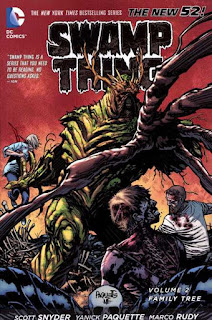 Scott Snyder's Swamp Thing Vol. 2: Family Tree contains just four Swamp Thing issues, plus the "Zero Month" issue and the first Swamp Thing annual. As such, the book comes off a little thin; while the reader is treated to the first appearance of the new Alec- Holland-as-Swamp-Thing, the story mainly serves to spotlight one of Swamp Thing's long-time enemies.


