1. "No, The Question Is What Are You Doing Out There"I.
 In the chapter on "The Screenplay" in J. Michael
Straczynski's "The Complete Book Of
Scritpwriting", Mr
Straczynski writes that:
"... a screenwriter must develop a highly tuned sense of discipline, a willingness to write and rewrite the same story as often as necessary, to polish it until it is as hard and bright as a diamond. You have to have an almost infinite capacity to look at your own words and the objectivity to restructure and rewrite as necessary, without holding onto something just because it's what you wrote that first day."And given Mr
Straczynski's often-stated love for the art of comic book writing, and for the character of Superman in particular, it would surely be disingenuous to believe that any less an exhausting standard of self-examination and re-drafting would be at work in his scripts for Superman # 700 and 701. Yet, without repeating in detail the many and
persistant criticisms of Mr
Straczynski's tale of Superman deciding to walk across America, there's no doubt that the character of Clark Kent is shown there-in behaving in ways which we wouldn't expect him to, as the following scan might indicate;

Now, there's no doubt that the dog-walking stranger who accuses Superman in this sequence is at the very least behaving presumptuously, and in fact I'd peg him down as having been plain rude. And yet, faced with a superhero in costume, who's presenting that iconic "S" for "Superman" on his chest, there are some grounds for believing that his outburst is at least partially understandable. After all, it is Clark who choose to wear that the costume and Clark who has permitted the nickname "Superman" to become the title he responds to while in uniform. And he has constantly sold himself to the American public as a standard-model superhero, and consistently lectured his fellow citizens on the common duties they hold to truth and justice and whatever particular "way" is politically correct at the moment of publication. In essence, having played the role of super-hero for so long, Superman at the very least ought to expect to be challenged when he appears to be avoiding his self-proclaimed responsibilities.
Yet, whatever the rights and wrongs of verbally accosting Superman as he wanders past you on a suburban street, the fact is that Superman's response to the imposition is quite out of character. In fact, I can't remember a single time when Superman has met a non-violent challenge with the degree of self-absorption and intellectual snobbery that he manifests here. For Clark Kent is an exceptionally well-educated man, and he's a similarly exceptionally well-brought up man as well; he'll know that Thoreau isn't a household name among most of America's citizens, and that the political-backwoodsman's words are by idiom and content unfamiliar and difficult to engage with for most everyone he meets. And yet Superman doesn't even enquire whether his debating partner has an knowledge of Thoreau. In truth, he behaves exactly like a snobbish, intellectual bully would, lecturing contemptuously a man who hasn't a chance of debating with him, and even sarcastically leaning his head forward and stroking his chin as he closes his strange argument. (Thoreau's quote, after all, was concerned with the business of not paying taxes which would fund politically sanctioned violence. I'm unsure what's relevant and clever about applying those concepts to the radical political sacrifice of, er, walking across America. The "prison" of being a super-man in the eye of the media and the reality of being a prisoner in a small town jail for not paying taxes is one which only a rather confused or supremely arrogant Superman would make. To put it mildly, he doesn't seem to be thinking clearly at all.) And it's hardly in line with the picture we've been given of Jonathan and Martha Kent's son that Clark would then, having delivered his pretentious and inappropriate quote and extrapolation, walk off while his interlocutor is absolutely lost about what Superman has been saying. For that's the behaviour of a deeply condescending and arrogant man, pleased with himself for brow-beating and baffling a perceived opponent; the only metaphorical meaning I could take from
such a scene if it were to be taken at face value would be that Superman is learning on his journey to ignore the views of anybody who doesn't know what he knows, and who can't debate in the particular terms that he chooses to.
But I suspect that this scene, and many of those which accompany it, aren't meant to be taken at face value at all.
 II.
II. It's not simply the fact that Clark is portrayed as being so out of character, and so deeply unpleasant and dismissive too, that should set our alarm bells ringing in this scene. For the behaviour of Superman in issues # 700 and 701 also seem to bend several of the rules of writing which Mr
Straczynski himself repeatedly returns to in the various sections of his primer "The Complete Art Of Scriptwriting", and though he nowhere in the 426 pages of the Titan 1997 version of the book attends directly to the writing of comic books, I hope we might take it as read that certain principles hold to one degree or another across most if not all visual mediums. So, for example, in the chapter on "The Craft Of
Telescripting", Mr
Straczynski repeatedly counsels would-be writers against verbose speeches, of which there may be held to be several over the course of his two Superman scripts. And yet, tellingly, in the section on "The Screenplay", he recommends that such "long-winded" monologues may however be used to a specific effect;
"If the speaker is long-winded himself, or pompous, you can use the monologue as a device to reinforce this detail."From which we can assume that if a character of Mr
Straczynski's is suddenly rambling on, it's for the purpose of a deliberate effect, and that if he's apparently breaking his own "rules" of writing, it's to a specific purpose. Consequently, if Clark Kent has become transformed from a decent and polite man to a rather cruel and pretentious windbag, we're surely supposed to be asking "why?" rather than simply discrediting the speech as out-of-character.
 III.
III. There is a great deal of other advice from "The Complete Book Of Scriptwriting", which could be applied to the craft of writing for comic books, and I suspect that clues might be productively dug out from the text of it to help begin to deduce what's actually going on "Grounded". For in his chapter on writing for Television, for example, Mr
Straczynski discusses how important it is to respect the
pre-existing nature and boundaries of a character in serial fiction. (
"The schematic has already been laid down. Your task is to plug your own ideas into that context, which for some writers is where the process becomes quite difficult. You're required to work with characters created by someone other than yourself .... and set aside your ego when when the producer says, "Our character wouldn't do that" ...) Now, since "Superman" # 701 is constantly providing us with an at-best rather baffled Clark Kent, and an at-worst vindictive and rather vicious Superman, one that nobody has ever seen before, we have to assume that there's a reason for that. (In essence, a writer of Mr
Straczynski's stature and experience wouldn't carelessly, or even deliberately, radically reboot Superman in this fashion, because that would involve what he himself has counselled against; violating the "schematic.") And so when in "The Writer, the Language, The Formats", Mr
Straczynski recommends that a writer should
"End each act on a dramatic high note, a complication that makes the viewer want to stick around after the commercial break", we ought to notice that both Superman # 700 & 701 concludes with what seems to be a pair of rather undramatic notes, with, in the latter tale, the Man Of Steel just walking onwards, hard-faced, ignoring the man he was claiming to be engaging in high-purposed political discourse. Perhaps the "dramatic high note" is that Clark Kent has become - on some occasions if not others - such an apparently self-consumed and pompous man, and, again, perhaps the point of what we're reading is that we're supposed to be asking ourselves, again, why?
 2. "What Are You Doing Out There?"I.
 I'd suggest, therefore, that no writer of Mr
Straczynski's stature and experience would simply ignore more than 70 years of "Superman", as these stories seem to do. There has to be a reason why, for example, Superman is simply ignoring the most fundamental relationships and responsibilities of his private life. It's simply inconceivable that he should walk out on his wife, to take but one beat of the tale, with so few words and so little explanation, particularly after having spent so long and so tragic a time away from her while on New Krypton. Similarly, the fact that he's effectively turning away from his widowed Mother at a time when even
Krypto the super-dog has realised that her broken heart needs company can't be accommodated into any take on Superman I've ever seen.
But that doesn't mean that this apparently Superman isn't in some way "our" Superman. It simply means that something has happened to him to change him.
 II.
II. If Superman is behaving in such an atypical fashion where his private life is concerned in these stories, then it's worth considering what the consequences of his dealings in the public sphere since beginning his walk have been too. And on reflection, it's easy to see why so many critics have been moved to note a considerable degree of irresponsibility in the walking Superman's behaviour at several key moments in his journey. The
least of his sins, and I use that word deliberately, given the strict old school Protestantism that many writers have associated with Superman's upbringing, have involved humiliating and scorning lippy pedestrians that he's past by, as we talked about above. Far more worrying behaviour can be observed in the scene where he aggressively hauls an irritating reporter high into the sky just to establish that Superman still has his flying
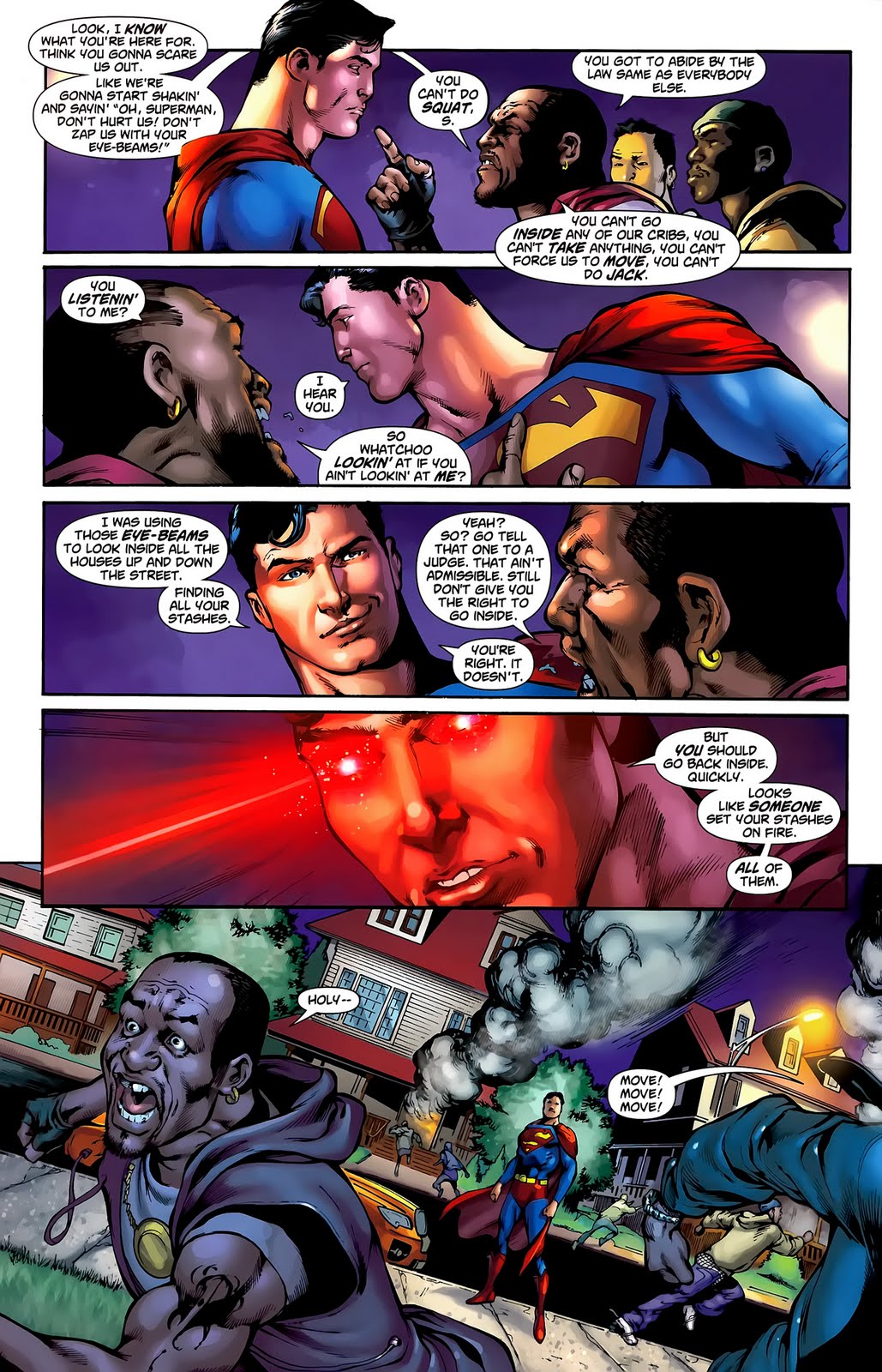
mojo intact. It's an astonishing moment, for since when did the son of Jonathan and Martha Kent physically terrify fellow law-abiding if unpleasant Americans in such a way? That's the mark of a bully responding with what the courts could well judge violence, and yet Superman has always been portrayed as a man of restraint and reason. Similarly, Superman's short-term and crowing run-in with a drug-gang showed no concept of a reporter's understanding of how the drug-trade works or how lives are affected by it in any fashion whatsoever, and stands as the most ugly example of super-heroics I've seen short of a Red Arrow/Arsenal comic book for a long time. Surely the Clark Kent of "The Daily Planet" knows that the best case scenario for the gang after he's scared them away is that they'll set up shop elsewhere, and that the worse case is that a very violent situation is going to break out when
whoever's next up in the chain of supply wants their money for their destroyed merchandise. ("Superman burnt it all up!" "Oh, sure....".) And, in what is perhaps the most despicable scene of all, where Superman recommends that a young boy threaten the gang with the prospect of his return while he wanders off never to be seen again, this portrayal of a Clark Kent to whom something deeply disturbing has occurred is capped and confirmed. After all, no Clark Kent I've ever read would advise a young boy to go threaten an already enraged gang of committed criminals; that would be at the very least a passport to a severe beating, would it not?
And Superman would never do that. He'd help out, assist in managing if not solving the problem, because Superman, like the good Samaritan, doesn't pass by trouble without stopping to properly help.
So what's happened to Superman?
 3. "Nothing But The Shell"
The answer to the question of "what's happened to Superman?" might well be found in the walk across America that he's undertaking itself, because his reasons for undertaking the epic journey don't stand up to even the most moderate of scrutiny. For example, Superman is portrayed as being inspired to set out by the memory of his foster father's man-of-the-farm monologue which is recalled as having stated that;
"Anything that stays in the the same soil too long withers and eventually dies. I think that people are the same way. If we stay too long in the same soil, we start to dry up inside .... If we do the same things, in the same way, over and over in time, we fall asleep in our lives."It's an odd speech to be inspired by, given that Jonathan seems to have spent decades after decades as a farmer in the same place doing the same things
"over and over in time". Surely his advice is not intended to be taken quite so literally, or he would have needed to have followed his own words to a far more considerable degree. And it's also an incredibly banal speech, given that, yes, things left too long in the soil wither and die, but that, strangely enough, so do things which don't. It's also telling that when Jonathan's words advise Clark to
".. rotate back to fertile ground...to the soil that nourished you ...", Superman doesn't interpret this as recommending that he spend a great deal of time with Lois, or with his beloved and lonely foster mother, but rather as a homily suggesting that he ups sticks and wanders without specific purpose across America making passing acquaintances with strangers.
The words don't seem to connect rationally to Clark's decision, and this cognitive dissonance is, I suspect, the best clue we have to this mystery of why our Clark is behaving so strangely and so out of character. For I can't help believing that Clark isn't walking across America to find either it or himself, but to
avoid finding himself.
Or to put it another way; he isn't walking to anything at all, but rather, he's walking away from something quite fearsome that he doesn't know how to face.
 4. "Trust Me /You're Safe"I.
 One of the key indicators of the devastating psychological condition known as Post-Traumatic Stress Syndrome (
PTSD) is often known as "avoidance and numbing". The individual who has been psychologically traumatised cannot engage with the pain they are feeling, and so they effectively turn away from their suffering and engage in excessive measures of distraction. These avoidance techniques can be as apparently minor as investing massive amounts of time and energy on apparently unimportant routines, from hobbies to work, and can often extend to crippling abuses of alcohol and drugs. Regardless of what path of avoidance is unconsciously chosen, the traumatised mind is desperate to numb itself, to cut off the possibility of communication with others, and to create a world where every minute of the day is spent holding any reminder of their suffering and its causes at arm's length.
What better explanation of Clark's walk across America could there be? For Clark can put one foot in front of another and simply keep going, never truly resting or in truth belonging anywhere, while whatever traumas he bears which might be revealed through intimate contact with wife or mother or friends can be repressed. Could it be, therefore, that Clark isn't seeking America, or humanity, or to save the one and not the many, or any interpretation of Jonathan Kent's parable of the ground where he can avoid withering and dying, but that he's rather running away from civil society? For why else would he turn away from Lois and Martha, and Jimmy and Bruce and Perry and all the rest of his many friends? What possible motivation could he have? For certainly nothing that we've been shown could possibly cause a man such as Clark Kent to simply abandon his life and begin walking the continent, particularly after returning from such a long exile and a war in space.
But then, there
is that business of a war in space, and a long exile, and the death of a world, and the genocide of people, and the loss of a dearly beloved father too.
 II.
II. The causes of PTSD are now well-understood, even if the diagnostic process is still limited to being able to describe the problem rather than being able to reliably predict who will and who won't develop it. But Superman has suffered so many of those key events which are known to trigger the condition he's recently been in severe military combat, and suffered gruesomely life-threatening physical injuries. (His horrendous near death at Brainiac's hands was followed up with an attack with a Kryptonite knife from one of his own people, and then things got worse!) He's been
effectively a prisoner of war, and he's been caught up in man - and superman- made disasters as what what is efefctively a combination of soldier and emergency worker. He's had the most
terrible and
elongated period of suffering.
And death has followed Clark Kent around as if it had a personal hatred of him. Jonathan Kent, dead, as a consequence of an assault by Brainiac. The great mass of his people, and the planet of New Krypton itself, wiped from existence, again by Brainiac, a figure so inhuman and relentless that it might as well carry a sickle so close is it to a symbol of the inevitable victory of death. And as to the degree of death that has followed Clark, it must be remembered that the end of the great mass of his people was undoubtedly an act of genocide, and that's above all what Superman is now a witness of, and a survivor of too, in so many ways.
Genocide.
The question is not whether Clark Kent has PTSD, I'd suggest. The question is how could any of us believe otherwise?
 5. "The Slap..."I.
 There is a substantial amount of further evidence in the two issues of Superman so far crafted by Mr Straczynski to support a working hypothesis of PTSD afflicting Superman.
"The Snap Heard 'Round The World", for example, begins with a portrayal of an already desperately sad and disconnected Superman facing reporters emphasising how alienated the media feels he's become from his adopted homeworld. (A man returning from a war needs something more than reporters questioning his allegiance, especially when his loyalties are surely obvious and always have been.) But our Clark can't even engage with the reporters, as we'd expect a man so erudite and intelligent to be able to do so.
"I .. I don't know." is his woeful response, accompanied by an equally woeful face. This is a Superman who was lost and shattered long before the apparent inciting incident of the slap and the widow's accusation.
In the light of this, Superman's response to the woman who blames him for the death of her husband "Richard" is hardly out-of-character so much as the product of a character under terrible stress and strain. For Superman has, in many ways, if he is suffering from PTSD, no character as such at all; he has a shell which his mind is desperately constructing to hold his pain at bay, and seeing the grief of one woman and the charge of his responsibility for it has surely torn through his defences and opened up all his unresolved feelings of loss and regret and guilt.

Well,
of course he's going to walk away, and America is a very safe distance across to walk away over while avoiding everything that so unconsciously frightens him. As an act of "dissociation", it's so brilliantly effective that the reader can only fear for his sanity. Because that's what so many sufferers of PTSD do, they may walk away into an obsessive private life, or into abuse, or from the world entirely, for their very brain structure and chemistry is often being changed by the excesses of appalling emotion which they're bearing under, and escape is the only option they can consider.
And yet such escape is the worst thing that a sufferer of PTSD can do. It is in the re-engagement with the day-t0-day structures of their everyday lives that improvement can be found. PTSD itself cannot be run from. Modern techniques of Cognitive Behavioural Therapy, to take but one example, can help the sufferer grasp that what they are feeling is not being caused by their environment, but by their trauma. But the survivor of PTSD has to be in an environment where they and others recognise that the problem exists so that help can be sought. And so, Superman isn't solving anything through his long walk, because he's carrying the trauma with him, and the world he was in was actually a better place for him to be in order to try to recapture the life he had than anything the mythical America before him can offer.
It could almost make me smile, if it weren't so terrible a thought, to realise that what Clark Kent is doing is chapter and verse the opposite of what the advice on PTSD recommends. "Don't go on holiday alone", sagely advises one patient's guide to the condition
 II.
II. We have evidence of other symptoms of PTSD too. Superman must surely be thinking of New Krypton and its loss when talking to the soon to be para-suicide on the top of a skyscraper, discussing as he does how he'd once believed that he was going to save the world and now can only truly accept the possibility of the saving of single lives. (We see him crucially having a flashback to the traumatic scene of his own escape from a dying planet, a scene he's seen through records and through time too over and over.) In addition, "hyper-vigilance" might be reflected in the fact that he keeps registering every slight, and not so slight, problem in the lives of the folks he's walking past, even as the scatter-minded problems of mental application lead him to, for example, diagnose an elderly gentlemen with what seems like serious heart disease without grasping that he ought to carry him to medical assistance. (He can't avoid noticing trouble, but he can't grasp how to engage with it either; he has to keep moving on.) He obsesses about the unhappiness he feels, the dislocation from the world he experiences, and yet he's escaped from anybody he has intimate bonds with who might compel him to face up to his feelings.
Similarly, Clark's irritation towards that dog-walking passer-by demanding he return to his super-heroic responsibilities, or his aggressive response to the demanding newspaper-man, all indicate a mind in denial and trying with some considerable force to avoid engaging with anyone that might behave in a challenging or disconcerting way. Irritation, anger and despair are the constant handmaidens of PTSD. And when Superman walks away from the drug-dealers and the community they live within, his PTSD is no doubt driving him to turn away from responsibility, pushing him towards the kind of laissez-faire attitude to law enforcement and community care which Jonathan and Martha, let alone Lois, would be appalled by.
 6. "They Said You Were Doing Something Important"I.
 A great deal of commentary on the interbloggofannet has focused on a
contemptuous reading of the woman who slapped Superman and blamed him for her husband's death. And while that's understandable at first reading, it's surely plain from the evidence that she was herself quite traumatised. As a culture, we're remarkably disengaged with even the most basic psychological truths of our own nature, and in a strange way, life seems easier to bear and less frightening if our perceptions stay that way. But, I'd suggest, there's a strong possibility that neither the grieving widow nor Superman are in any way
responsible for the irrational acts they undertake in Mr Straczynski's scripts. These are terribly damaged people desperately trying to make the pain stop.
But walking across America, or slapping a blameless
traumatised man, won't help them. And neither will the folks around them, who watch without understanding, or even thinking to help.
II. Am I claiming that the above reading of Mr Straczynski's work is the correct one? Of course not. But I am saying that it would be consistent with the facts that we've been shown, and that all the events which have so puzzled and enraged internet commentators might actually be rooted in a solid narrative structure which has a far more deliberate, rational and moving purpose than is currently evident.

And if Clark Kent does have PTSD, and my belief would be that I can't see how he couldn't, then my fear for him is how he'll cope when he's finally helped to his senses and realises how many people he hasn't helped because he was uselessly walking across the USA. It might be enough to compound his serious condition and result in Complex PTSD, if he isn't already bearing that level of suffering already.
But then, perhaps a scene where he goes back and ensures that certain drug dealers receive both a fair trial and appropriate counselling, and one where he apologises to a vile reporter because that's the right thing to do, and another where he tracks down an inarticulate dog-walker and chats with him in his own language over a coffee or two, might close what has begun as a difficult experience for the reader too.
 7. "... But It Must Be Important."
Or, everything's exactly as it seems on the surface of the story, in which I case I both respect the right of Mr Straczynski to tell his own story, and despair because of it too.
Ah, as is obvious, the promised Deadshot piece has had to be delayed due to my UTTERLY losing my copy of "Six Degrees Of Devastation", a desperately stupid act which left me with just a few hours to get a different piece up for today, when the ol'self-set schedule said I ought to. Deadshot will appear when the replacement volume of SDOS arrives from Amazon, to supplement the other Secret Six volumes again, and I hope to see you then, if not before. A splendid day to any and all who have made it down this far! Huzzah! .


 *Yes, I'm aware of modern slang usage of the word "rack" and what a "rackman" would be.