Number 1372: Dastardly drugmaker vs phighting pharmacist!

Người đăng: Unknown on Thứ Sáu, 24 tháng 5, 2013

I give Black Terror some credit for having an unusual secret identity for a costumed hero. He was Bob Benton, a pharmacist. We don’t think of those guys as crime fighters as such. But I knew a pharmacist who wasn't afraid of crooks. He was my former pharmacist, Mark, who was 5'3" and slight of build, and who took off across a parking lot after a man who had just stuck him up for Oxycontin. Mark didn't need a mask or cape; he had a golf club, a flapping white pharmacist's jacket, and righteous anger. He was able to subdue the robber, whose drug habit had apparently left him unable to get far by running. The story made the local news and when I asked Mark about it he said, “When he gave up he asked me, ‘do you think you could give me a half dozen Oxys before I go to jail?’” I’m not sure even Black Terror could have handled the situation better than Mark.

Black Terror, and his young buddy, Tim, get on the bad side of ex-con, drug inventor Sinistro, who has created a drug to bring out the animal in man. My feeling about people with such talents using them for crime has been mentioned in the past. Anyone who could come up with such a drug could make a fortune peddling it to a drug company. It’s better than stealing. It just doesn’t make for good comic books.

From America’s Best Comics #2 (1942):


More about →

Review: Joker: The Greatest Stories Ever Told trade paperback (DC Comics)

Người đăng: Unknown on Thứ Năm, 23 tháng 5, 2013

The Joker: The Greatest Stories Ever Told[Guest reviewer Zach King blogs about movies as The Cinema King]

Up to this point, the "Greatest Stories" series has profiled the best and brightest of the DC Universe. But when the series takes a turn toward the villainous, it's in many ways appropriate that DC's most iconic villain gets the "Greatest Stories" treatment in The Joker: The Greatest Stories Ever Told.

Perhaps even more so than with Batman, it's a bit difficult to assess what makes a Joker story "great" since I'm a staunch proponent of Grant Morrison's theory that The Joker is "super sane," reinventing his personality almost every day; as such, it's not hard to reconcile a Joker who builds sandcastles with a Joker who guns down Barbara Gordon.

But perhaps it's just that the relationship between The Joker and Batman is (literally) so black-and-white that it's difficult not to create an interesting match-up between the two. As for the contents of this volume, it's safe to say that each story in here is significant in one way or another; there are no real duds, and readers new and familiar will get a strong sense of who this character is -- just in time for Scott Snyder's big Joker story "Death of the Family" over in the New 52's Batman title.

The sum of the parts being more than the whole in this series, let's take a look at what's inside this volume.

"Batman Versus the Joker" (Batman #1, Spring 1940): It's no surprise that we begin with The Joker's first appearance, but what is surprising is just how fully formed the character is While The Joker's creation has been a point of contention for Batfans, writer Bill Finger and artist Bob Kane both craft a dynamite introduction to the character who has, aside from a goofy period in the Silver Age, remained mostly unchanged. The story's formula is familiar -- Joker vows to kill prominent Gothamites -- but its familiarity points to its influence on numerous adaptations (including The Dark Knight and an Steve Englehart remake reprinted later in this anthology). Kane's Joker is more morose and of somber countenance than readers might be prepared for, but he's never unrecognizable as Batman's greatest foe.

"The Joker's Comedy of Errors" (Batman #66, August/September 1951): Here might be the weakest story reprinted in this collection, because it doesn't seem to have been chosen for its importance to The Joker's character -- there's no "first" in this story, nor is his plot against Batman and Robin particularly compelling. No, it seems the editors chose this story because of its popularity on the Internet for its repeated use of the word "boner." Of course, the word meant something entirely different in 1951, but that doesn't stop the occasional snicker -- even from this reader, who usually considers himself above toilet humor. Finger's plot is overly involved, and Lew Schwartz's art stockier and cheekier (literally, The Joker's cheeks are huge here) than most, but the tale is ultimately not a terrible one. It's just that the editorial insight here seems sophomoric at best.

"Joker's Utility Belt" (Batman #73, October/November 1952): The story begins with a full-page teaser splash by Dick Sprang, in which Batman and Robin are menaced by perversely large Joker heads springing from an oversized utility belt. It's one of the most iconic Joker shots ever drawn by one of the definitive Joker artists, and the story by David V. Reed introduces a gimmick that, while abandoned in later stories, amps up the dark mirror in which The Joker reflects Batman. The story is cleverer than I was expecting, finding unique ways to utilize the bizarre gags that pack The Joker's utility belt. And while I've lamented the fact that this series doesn't reprint full covers, the inclusion of the hydra-like Joker's belt is "great" enough.

"Crime of the Month Club" (Batman #110, September 1957): Dave Wood and Dick Sprang take The Joker into new territory with this story, which casts the Clown Prince of Crime as a criminal consultant, auctioning off his master plans to the highest bidder. The premise is intriguing and given sufficient attention despite the brevity of the story, and it plays up one of my favorite Joker traits -- he always has a back-up plan. This is no "dog chasing cars," but rather the master strategist he always lies about being. Sprang's art again is classic and cements the angular grin which is The Joker's trademark.

"Joker's Last Laugh" (Detective Comics #332, October 1964): It's hard to believe that The Joker's signature laughing gas wasn't introduced until 1964, but here it sees first light -- this time as a powder which is (spoiler warning) easily defeated by a strong antihistamine prescription. While Sheldon Moldoff's pencils here are less compelling than Sprang's (indeed, Sprang is a tough act to follow), he's quite good with facial expressions, a key skill to have in a story where characters frequently erupt into spontaneous laughter. And the story also includes the rotating jail cell gag, which sums up The Joker's whole relationship with law enforcement but also raises serious questions about the security of Gotham's police station.

"The Laughing Fish" / "Sign of The Joker" (Detective Comics #475-476, February -- March 1978): If we're excluding The Killing Joke (if only for reasons of length) and Mad Love (on the grounds that it's more a Harley Quinn story), this might be my favorite Joker story of all time, so I'm elated to see it included here. It's easily the "Hey Jude" of Batman/Joker stories, because it's included on every top list and performed at every available opportunity. I gushed at length about this Steve Englehart and Marshall Rogers story in my review of Batman: Strange Apparitions, but it bears repeating that these are near-perfect stories, even thirty-some years later. Here is The Joker's dead-serious attempt to copyright fish, his trademark entrance in a stretched panel surrounded by laughter, and his spooky and dogged pursuit of the copyright officials. But it's also a great Batman story, giving us a snapshot of the Dark Knight's life at this time, as well as providing a look at the state of Gotham City as a whole. The story echoes The Joker's debut with a series of announced homicides, and its adaptation into an episode of Batman: The Animated Series only reverberates its iconic and greatest nature. It's a story that every Batfan needs to read.

"Have a Dreadful Birthday, Mr. Joker" (Batman #321, March 1980): After "The Laughing Fish," any story might feel like a comedown, and unfortunately for Len Wein and Walter Simonson such is this case with "Dreadful Birthday." It's not that it's a bad story; there's no shift in tone with the oversized (notice a trend?) birthday cake to which The Joker's hostages are tethered like candles, and the exploding boat finale is probably the most familiar version of the classic "We haven't seen the last of him" trope. It feels familiar, but it might just be a chicken-and-egg case of a spot-on distillation of this kind of story. What's more, Simonson's Joker is a wonderful interpretation, even more elongated than Rogers's, if it can be believed. While I may be sad that we didn't get anything from The Joker's solo series, the inclusion of Simonson in this story might atone for that.

"Laughter After Midnight" (Batman Adventures Annual #1, 1994): Throughout this series of reviews I've been clamoring for more representation from the DC Animated Universe, so it's wonderful to see that interpretation of The Joker represented here. I've long contended that the Dini/Timm approach to The Joker is the best and most accurate in any media adaptation -- even including Heath Ledger's wildly original Joker -- and it's telling that I still hear Mark Hamill's voice in my head when reading this and every other story in the collection. This story finds The Joker making his way home after yet another ignominious defeat at the hands of the Caped Crusader. John Byrne apes the style of the DCAU so cleanly that I had to double-check the artist wasn't Bruce Timm. It's a great story, one that I missed in my days reading the original series, but it's also a perfect peek into the odd blend of dark humor and deadly evil that made this interpretation of The Joker so beloved -- and so great.

"New Year's Eve" (Batman: The Long Halloween #4, March 1997): One of the earliest Joker stories in the post-Crisis canon (being that The Long Halloween is essentially "Year Two," only The Man Who Laughs is earlier for my money), this story combines many of my favorite characteristics of a Batman story: a dead serious Dark Knight, an eccentric Joker with a lethally insane plan, Jeph Loeb's writing, Tim Sale's art, and snow. While the whole issue isn't reprinted, the parts relevant to the collection unite seamlessly, such that you'll be hard-pressed to find the edits without a copy of the original on hand. Sale takes The Joker's facial elongation to its absurd nadir, such that The Joker's chin dangles near his navel by the end of Dark Victory, but it fits within the cartoonized world of the story; Batman is similarly exaggerated, muscular beyond plausibility but unmistakeably our hero. Considered by many a definitive Batman story, The Long Halloween does justice to The Joker and ought to encourage readers who had never read it before.

"Case Study" (Batman: Black and White, Volume 2, 2002): Ah, Alex Ross -- it's been a while since we saw you around these parts. Here Ross teams up with Paul Dini for a classic Joker origin story -- classic in that it's entirely plausible but probably not true. Riffing on Batman '89, Dini and Ross cast pre-chemicals Joker as a cunning and ambitious mobster whose last days as The Red Hood only made him more audacious. It's a nice nod to The Killing Joke, too long to be reprinted here but undeniably worthy of the "Greatest" appellation, but Dini puts a new "multiple choice" spin on Joker's possible origin, which is too clever to spoil. Ross's artwork is, as ever, stellar, even in black-and-white; his Joker reminds me of Jack Nicholson, which couldn't be less of a bad thing.

"The Joke" (Batman #614, June 2003): It's been said that Batman: Hush, of which this is the seventh chapter, is a retelling of all the iconic Batman moments in one epic story. If that's the case, "The Joke" represents the moral issue at the heart of the Batman/Joker conflict: Should Batman kill The Joker? Writer Jeph Loeb uses his internal narration style to its maximum potential here, stepping inside Batman's head as he beats The Joker near death; using Batman's memory to cycle back to some of The Joker's most notorious moments. It's a tidy package that interrogates what separates Batman from The Joker, but as an entry in this collection it also encompasses stories (i.e., The Killing Joke and A Death in the Family) that were too long to be included but still immensely significant. And the superstar artwork by Jim Lee doesn't hurt, either; Lee plays with shading and line thickness to emphasize the emotional shifts between memory and reality. As a part of one of my all-time favorite Batman stories, "The Joke" is also a wonderful summation of this complicated relationship.

"Slayride" (Detective Comics #826, February 2007): After fully exploring the Batman/Joker dynamic in "The Joke," Paul Dini returns to the writer's chair with "Slayride," another Christmas story in which The Joker abducts Robin Tim Drake and holds him captive during a series of brutal holiday crimes. Don Kramer's artwork in particular stands out for how well he makes The Joker look insane and evil without compromising his more clownish features. Dini is the master of the one-and-done Batman story, having honed his craft on The Animated Series, and this story is both thrilling and unforgettable; it's not difficult to picture this as an episode of the cartoon, although it's more violent than fans of the show will expect. It is, however, a great note on which the book can close, showing us what The Joker is like in the modern era -- still spooky and still uncomfortably funny.

Up to this point, Shazam! The Greatest Stories Ever Told was probably my favorite "Greatest Stories" collection, with Superman/Batman: The Greatest Stories Ever Told as a successful close second, with neither book wasting a story and instead presenting a highly canonical approach to the character's (or team's) history. But now I'm almost certain that The Joker: The Greatest Stories Ever Told is my new favorite, in part because the character is so strong but also because the editors have really done a bang-up job acknowledging every major interpretation of the character while providing each of his most significant moments without reprinting some of his longer appearances.

Indeed, I can't think of a story that's missing, no glaring omissions that got short shrift here; the only major story absent is the O'Neill/Adams tale "The Joker's Five-Way Revenge," but that's reprinted over in Batman: The Greatest Stories Ever Told, Volume One. I can't kvetch about the DCAU not being represented, since the editors rightfully recognize that The Joker, more than anyone, became a star at the hands of Dini and Timm; on that note, though, I might have liked a bit more Harley Quinn in this trade, since she only appears only peripherally in three small appearances here. And the Grant Morrison fan in me can't help but wonder why "The Clown at Midnight" didn't make the cut, although it's either too weird or too recent to merit inclusion.

All told, The Joker: The Greatest Stories Ever Told is as near to perfection as this series ever came, hitting all the important beats without wasting pages on unrewarding stories. It's a first-rate primer on the character -- exactly what I wanted from this series -- and it's excellent for all readers who want to know what The Joker is really all about. Just don't gaze too hard into the abyss, lest ... well, you know.

We've reached the last of the official "Greatest Stories" collections, but there's one more entry in this review series. No, it's not a post full of my complaints about missing stories. For the final entry in this series, I'll be reviewing The World's Greatest Superheroes, a collection of the oversized Paul Dini/Alex Ross OGNs which seems to fit nicely as a coda to the "Greatest Stories" line. Stay tuned!

More Greatest Stories reviews: Superman Vol. 1 and Vol. 2, Batman Vol. 1 and Vol. 2, Wonder Woman, Green Lantern, Flash, Justice League, Shazam, Batgirl, and Superman/Batman.
More about →

Review: The Judas Coin graphic novel (DC Comics)

Người đăng: Unknown on Thứ Tư, 22 tháng 5, 2013

The Judas Coin by Walter Simonson (DC Comics)[Review by Doug Glassman, who Tumblrs at Hell Yeah '80s Marvel!]

A few years ago, DC published a book called Solo, allowing artists a chance to create stories in their style as they saw fit. Despite decent sales, great critical reception, and three Eisners for three individual issues [plus a forthcoming collection -- ed.], the title folded in 2006. Various artists had already begun working on ideas for issues; one of them was Walt Simonson. Last year, Simonson reworked some of his Solo ideas into a graphic novel, The Judas Coin, which was one of Collected Editions’ recommendations for holiday shopping. Even though The Judas Coin is broken up into six individual stories and a brief prologue, it doesn’t feel like a watered-down miniseries in the way JLA/JSA: Virtue and Vice does.
As the prologue reveals, the titular coin is one of the pieces of silver paid to Judas in exchange for betraying Jesus to the Romans. However, the book doesn’t dwell on theology; Jesus is simply called a betrayed friend, and the curse seems to derive more from the betrayal than any Christian doctrine. The coin’s cursed nature is immediately apparent: after Judas flings his blood money in the faces of his benefactors, a beggar finds the coins, only to be immediately trampled by a Roman soldier. Throughout The Judas Coin, simply being in the coin’s proximity is enough for bad luck to happen, although it gets progressively worse if you invoke the coin as a lucky totem.

Each section is prefaced with a brief text piece about the actual history of the time period to set up the situation with a minimum of exposition. The one exception is Part 5, starring Batman and Two-Face, where the text blurb is just reads “Gotham is an awful, awful place.” Instead, hints of backstory are given through newspaper articles printed behind the panels. The entire story is printed so that you have to tilt the comic on its side, turning it into a newspaper broadsheet complete with a “Gotham Gazette” header on the first page. Normally I complain about this technique; a particularly annoying example was in Iron Man/War Machine: Hands of the Mandarin, in which one single random Force Works splash page was printed vertically. But in The Judas Coin, the entire story is done this way, and it actually enhances the story. Two-Face is actually the only person to really figure out the curse, a refreshing take on the character.

Batman and Two-Face are the most famous characters to feature in the graphic novel; the rest are obscure stars of features in books like The Brave and The Bold, the home of Golden Gladiator and Viking Prince. The Golden Gladiator story finds the character near the end of his life in the service of Vespasian, who rose to power during the bloody “Year of the Four Emperors.” In fact, Vespasian co-stars in the story, a detail I thought was odd until I found out that he was a soldier as well. By setting the story in Germania, Simonson allows the coin to migrate from Judea to Europe in a realistic manner. This sets the stage for the Viking Prince chapter, which, as you might expect, has a few The Mighty Thor nods, including a picture of Hela with a half-rotted face and elaborate Kirby-esque Viking helmets.

The next three chapters were two of the furthest along in the creation of Simonson’s Solo issue, and are thus the most solid. The Captain Fear tale takes advantage of the traditional greed of pirates and uses it to accentuate the treachery of Fear’s crew in a mutiny. His resulting plan ends up destroying his ship, and the mutineer leader experiences the book’s most karmic death. Next, the tone shifts to comedy with a poker game between Bat Lash and some hooligans where everyone is on an even keel due to cheating. Like Captain Fear, Bat Lash has an intricate way to get out of his bad situation, even if it involves beating the crap out of himself. It’s a necessary tonal shift after three fairly dark stories in a row. The aforementioned Batman and Two-Face story was, according to Simonson, a Solo concept which would have taken up the entire issue, so it’s satisfying that it found a home here.

Simonson’s last story takes us into space with Manhunter 2070, a character I didn’t even know existed until I read The Judas Coin. I thought Starker was just an extrapolation of Archie Goodwin and Simonson’s famous Manhunter stories, but no, he was created back in the 1970s. The coin appears to be destroyed in this final chapter, although the final captions indicate that the curse can even withstand the force of a star. There could easily be a sequel if Simonson ever wants to do it; personally, I’d love to see Booster Gold in a story about greed and cursed coins.

Along with letterer John Workman and his brilliant sound effects, Simonson’s other collaborator is Lovern Kindzierski, a prolific colorist and the creator of Lobo parody Lunatik. Occasionally, the coloring seems a little rough, but that might be the interaction between Kindzierski’s colors and Simonson’s often heavy inks. One excellent technique is that each chapter is colored in a different manner. While the Golden Gladiator chapter is “normal,” the Viking Prince chapter has a more pastel palette in the manner of The Mighty Thor. The Captain Fear chapter has heavier white panel borders and distinctly thicker lines. The Bat Lash chapter has almost a sepia tone to it. Most dramatically, the Batman story is in black and white, while the Manhunter 2070 chapter has bright colors and swifter lines to evoke a manga style.

If you went into The Judas Coin not knowing that it was all by one writer and penciller, you might think it was an anthology from various creators. Not only does the art go through various styles, but the stories vary in tone as well. It’s a well-balanced graphic novel worthwhile for both the story and the artwork.

[Includes Walt Simonson sketchbook]
More about →

Number 1371: Babes gone bad

Người đăng: Unknown

In crime comics bad girls were usually blonde, and they wore red dresses. Those things translate to scarlet women. Not only are such females criminals, but they probably have spent many nights standing under lamp posts luring innocent guys to moral doom. Trust crime comics to warn us of the evils of blonde hair and red dresses.

“The Female Of the Species” is from Fawcett’s Down With Crime #5 (1952). Art by Maurice Gutwirth (?); “Marie Swain, ‘Rod-Baby!’” is from Avon’s Gangsters and Gunmolls #3 (1952). Artist unknown. (Also unknown is why in one panel Marie is called Sally.)


**********

Click on the masthead to read the story of Pappy's Golden Age Comics Crime Wave:


More bad blondes from Pappy’s past. Just click on the pictures:


More about →

Two new Collected Editions ebooks

Người đăng: Unknown on Thứ Ba, 21 tháng 5, 2013

Today Collected Editions announces the release of two new ebooks!


In 2011, DC Comics relaunched their entire line of titles, replacing over twenty-years of post-Crisis on Infinite Earths continuity (and some pre-Crisis continuity!) with the New 52. The Collected Editions website chronicled the newly unfolding DC Universe with reviews of each of the inaugural New 52 collections, and now those reviews are collected in a new ebook as an in-depth study of the New 52. The book includes two new, never-before-published Collected Editions reviews, as well as a new introduction by the author.


The second volume in the Unofficial DC Comics Trade Paperback Timeline series is updated and expanded to include over 900 titles, including all the New 52 Volume 1 titles, making this the perfect guide for both new and established readers. The Timeline shows how to read DC's library of collected editions in order, offering a quick glance at the most significant DC events as well as collections that readers might have missed. Copious notes help explain how the collections fit together. Whether a fan of DC's old continuity or new, the Trade Paperback Timeline is your map to navigating the DC universe. This volume also contains a new introduction by the author.

How to order

The ebooks are just $0.99 each, available direct from Smashwords and compatible with all ebook apps and devices (Kindle see below). You can also order the books from Barnes and Noble for the Nook, the Apple iBookstore, Kobo, and the Sony ReaderStore (link to come).

Kindle users: Collected Editions ebooks are sold DRM-free from all vendors. For Kindle compatibility, download the free Calibre ebook management system and easily convert the Smashwords EPUB file to MOBI format.

For press/blogger inquiries and review copies, contact collectededitions at the Yahoo account or DM @collecteditions on Twitter.

Reviews appreciated. Enjoy your new ebooks!
More about →

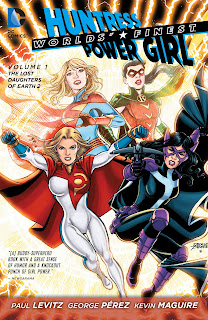
Review: Worlds' Finest Vol. 1: The Lost Daughters of Earth 2 trade paperback (DC Comics)

Người đăng: Unknown on Thứ Hai, 20 tháng 5, 2013

Worlds' Finest Vol. 1: Lost Daughters of Earth 2An interesting premise and some wisely re-imagined characters carries Paul Levitz's Worlds' Finest: The Lost Daughters of Earth 2 a very far distance. Unfortunately, the number of issues collected here outpaces the utility of the plot, to the point where the book begins to feel decompressed; the juxtaposition of the past and present with artists Kevin Macguire and George Perez respectively is entertaining and certainly pretty to look at, but this too gets gimicky after a while as it fails to come to any cohesive point.

[Review contains spoilers]

The best part of Paul Levitz's Worlds' Finest is his new Earth 2-born Power Girl and Huntress. Though the two initially seem much like their pre-Flashpoint counterparts (as did Huntress in Levitz's Crossbow at the Crossroads miniseries), later in the book Levitz begins to differentiate and re-imagine their voices. Huntress is, in comparison to the former Helena Bertinelli, somewhat bookish and reserved, preferring to remain in the shadows; Power Girl is bold but also surprisingly flirty, more tawdry than one would expect considering that she was once Earth 2's Supergirl.

The two are friends but not close, only having recently reunited; Power Girl Karen Starr nee Kara Zor-El has spent the past five years in the spotlight, building a tech company in an attempt to find a way back to Earth 2, while Huntress has fought crime but largely remained hidden.

Power Girl is brash enough that at times it's hard to fully sympathize with her character; also, that Levitz chooses to have Karen buy her way into corporate dominance rather than on her own smarts, as in the previous continuity, seems a step backward. Huntress, however, is a more interesting study -- a new Robin, the daughter of Bruce Wayne and Selina Kyle, raised from birth for the role and having experienced all the pressure and adventures that go along with that. Levitz only scratches the surface of the stories he could tell, well aside from the present Worlds' Finest action.

But most of what this book establishes, it establishes in the first issue. In the past, Power Girl and Huntress are mistakenly shunted to "our" Earth, as also seen in James Robinson's Earth 2: The Gathering, they filch a little of Bruce Wayne's money, and they set up lives for themselves; in the present, they fight a radioactive hulk named Hakkou that's bent on destroying the device that will send them home. Little about that, if at all, changes over the next successive three issues; Levitz shows them continuing to set up their lives, but there are no surprises there that change our understanding of the characters in the present, nor does their continuing fight with the one-note Hakkou reveal anything about how they became stranded across dimensions.

Levitz would seem to take the Lost approach (or do we call it "the Arrow approach" now?), paralleling the present with the characters formative moments in the past. Worlds' Finest has a classic art team, and Maguire especially sells Power Girl and Huntress's clowning around and the differences in their personalities. But again, well-drawn flashbacks aren't enough -- Levitz doesn't actually tie the past action to the present nor offer any new information, so four issues in, the book feels repetitious.

The fifth issue sets Huntress and Power Girl in separate adventures, but again what follows is mostly predictable -- Power Girl fights a rampaging machine in the sunlight, Huntress takes out a sniper in the night. The final issue is the book's Zero Month issue, and this is a good look at the characters' more interesting Supergirl and Robin personas, though I wonder whether Levitz has revealed here too early the circumstances of Selina Kyle's death.

At the same time, Levitz offers up plenty of other mysteries -- maybe too many. Power Girl's powers don't work right on "our" Earth for some reason (though Levitz is never specific how they're different), Huntress has apparently gained a modicum of invulnerability somehow, there's a mysterious belt that made the trip across dimensions with them, Hakkou has some sort of dimension-hopping in his background, and apparently even the circumstances of Power Girl's original arrival on Earth 2 are suspect (it would be an interesting turn if it ended up that Power Girl was sent from "our" Earth to Earth 2 originally and not vice versa as in pre-Flashpoint continuity). Levitz sums up these questions at the end of the fourth chapter, perhaps too helpfully; mystery is fine, but the list of questions only serves as a reminder of all that hasn't been explored already six issues into this series.

I really enjoyed James Robinson's first Earth 2 collection, but unfortunately this second book in the franchise doesn't live up to the first. From writer -- Paul Levitz created Huntress, once upon a time -- to artists to characters and concept, Worlds' Finest: The Lost Daughters of Earth 2 should be a book that can't miss, but unfortunately some good character work only takes it so far. Possibly Levitz had to bide his time here to line up with other events in the DC Universe; hopefully that's the case and this series's second outing will be better than its first.

[Includes original covers, costume designs and sketches by various artists]

New reviews on the way!
More about →

Number 1370: Doiby’s ruint derby

Người đăng: Unknown

Paul Reinman was an American comic book journeyman who was born in Germany and emigrated to the U.S. at a young age. He worked in comics from at least the early forties to the mid-seventies. His work is instantly recognizable, and he drew thousands of pages over a long career.

Green Lantern was one of the features he worked on during his time at DC in the 1940s. This entertaining story, which takes place in the time of King Arthur, is a pretty good example of the DC superheroes of the era whose time ended in 1949, only to be revived in different form about ten years later. By then Reinman was long gone from DC, working at Marvel, ACG and Archie. Reinman died in 1988, at age 78.

Doiby Dickles was Green Lantern’s sidekick, supposed comic relief. I find the character annoying, like I did the Three Stooges knockoffs who showed up with The Flash in his comics. I suppose they were there so the main character had someone to talk to, like Woozy Winks in the Plastic Man stories. The difference was Woozy Winks was actually funny.

From All-American Comics #72 (1946):


More about →